
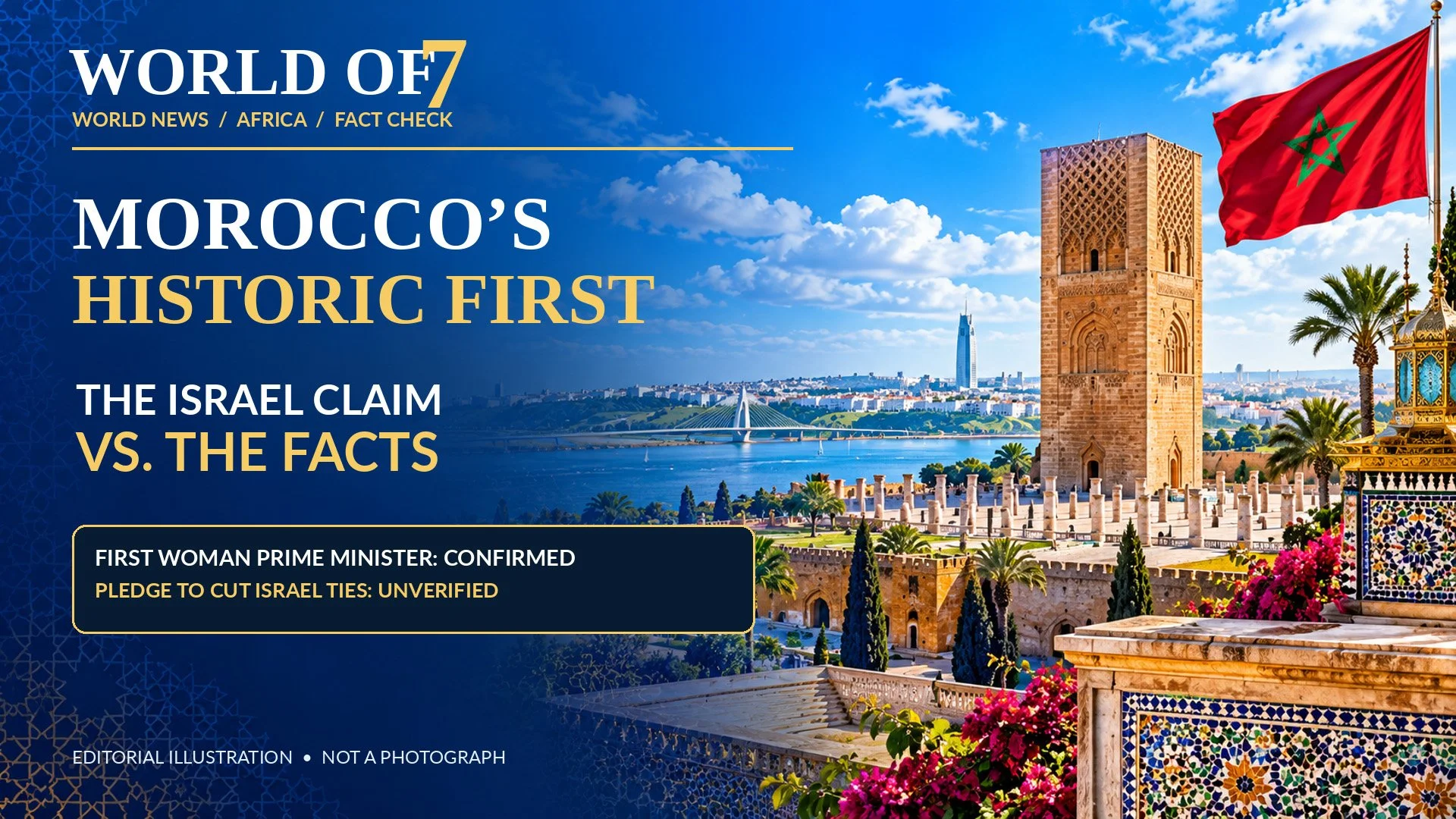
Morocco has appointed its first woman prime minister. But did she promise to sever ties with Israel?
By Publisher Ray Carmen
A historic change in Rabat
Morocco has made history. On 29 September 2026, King Mohammed VI appointed Fatima Ezzahra El Mansouri as head of government, the first woman to hold the office in the kingdom’s history. Her Authenticity and Modernity Party (PAM) finished first in the parliamentary election of 23 September with 97 seats in the 395-member House of Representatives.
Her new four-party government was appointed on 16 October, and the transfer of responsibilities from outgoing prime minister Aziz Akhannouch took place the following day. A lawyer and former mayor of Marrakech, El Mansouri also served as minister responsible for urban planning and housing before leading the government.
The Instagram claim — what is actually verified?
A social-media headline circulating under her name claims that the new prime minister has pledged to end all diplomatic relations with Israel. The appointment is genuine. The alleged pledge is not supported by the reliable government statements and news reports examined for this feature as of 25 October 2026.
That distinction matters. A dramatic quotation can race across social platforms while attaching itself to a real political event. Without an identifiable speech, formal government announcement or reliable independent report, WORLD OF 7 cannot report such a pledge as fact.
What she said about Palestine
On 19 October, presenting her government programme to parliament, El Mansouri reaffirmed Morocco’s longstanding support for the Palestinian cause and Jerusalem. She backed a peaceful settlement based on a two-state solution intended to deliver a just and lasting peace.
That is an important position, but it is not the same as promising to sever relations with Israel. Support for Palestinian statehood and diplomatic engagement with Israel can coexist within the policy of a government, however contested the combination may be domestically.
The diplomatic reality
Morocco restored relations with Israel in December 2020 within the US-brokered normalisation process. On 16 September 2026, the foreign ministers of Morocco and Israel met with the United States ambassador to the United Nations in New York. The announced measures included upgrading diplomatic missions to embassies, appointing ambassadors, expanding direct flights and pursuing investment-related agreements.
Those steps were announcements and commitments, not proof that every proposed measure has already been implemented. They nonetheless run against the suggestion that the new government had announced a comprehensive diplomatic break. Foreign Minister Nasser Bourita remained in his post when El Mansouri formed her cabinet.
A powerful monarchy, and a divided debate
Morocco’s constitutional arrangements also help explain why a prime ministerial foreign-policy declaration would be significant: King Mohammed VI retains broad authority over foreign affairs and defence. Any major reversal of relations would warrant particularly careful official confirmation.
The broader national debate is real. Many Moroccans have expressed solidarity with Palestinians and opposition to normalisation amid the suffering in Gaza. Others emphasise security, diplomacy, trade and Morocco’s strategic interests. These tensions deserve serious coverage — not an invented quotation.
The priorities of a new government
Beyond foreign policy, El Mansouri’s programme focuses on jobs, purchasing power, education, healthcare, corruption and stronger public services. Her administration has set an ambition for average annual economic growth of 5 per cent across 2027–2031, while preparing for Morocco to co-host the 2030 FIFA World Cup.
The appointment also carries symbolic force for women in Moroccan politics. But symbolism is only a beginning: the performance of the new government, and the everyday opportunities it creates, will determine the legacy.
The WORLD OF 7 verdict
CONFIRMED: Fatima Ezzahra El Mansouri became Morocco’s first woman head of government on 29 September 2026 and formally took office in October.
NOT VERIFIED: the social-media assertion that she pledged to end all diplomatic relations with Israel. Her publicly reported 19 October position instead called for a peaceful two-state solution.
A historic story needs no embellishment. For now, the facts are compelling enough: a political first for Morocco, an unsettled debate about Israel and Palestine, and a new government whose decisions will be closely watched.