
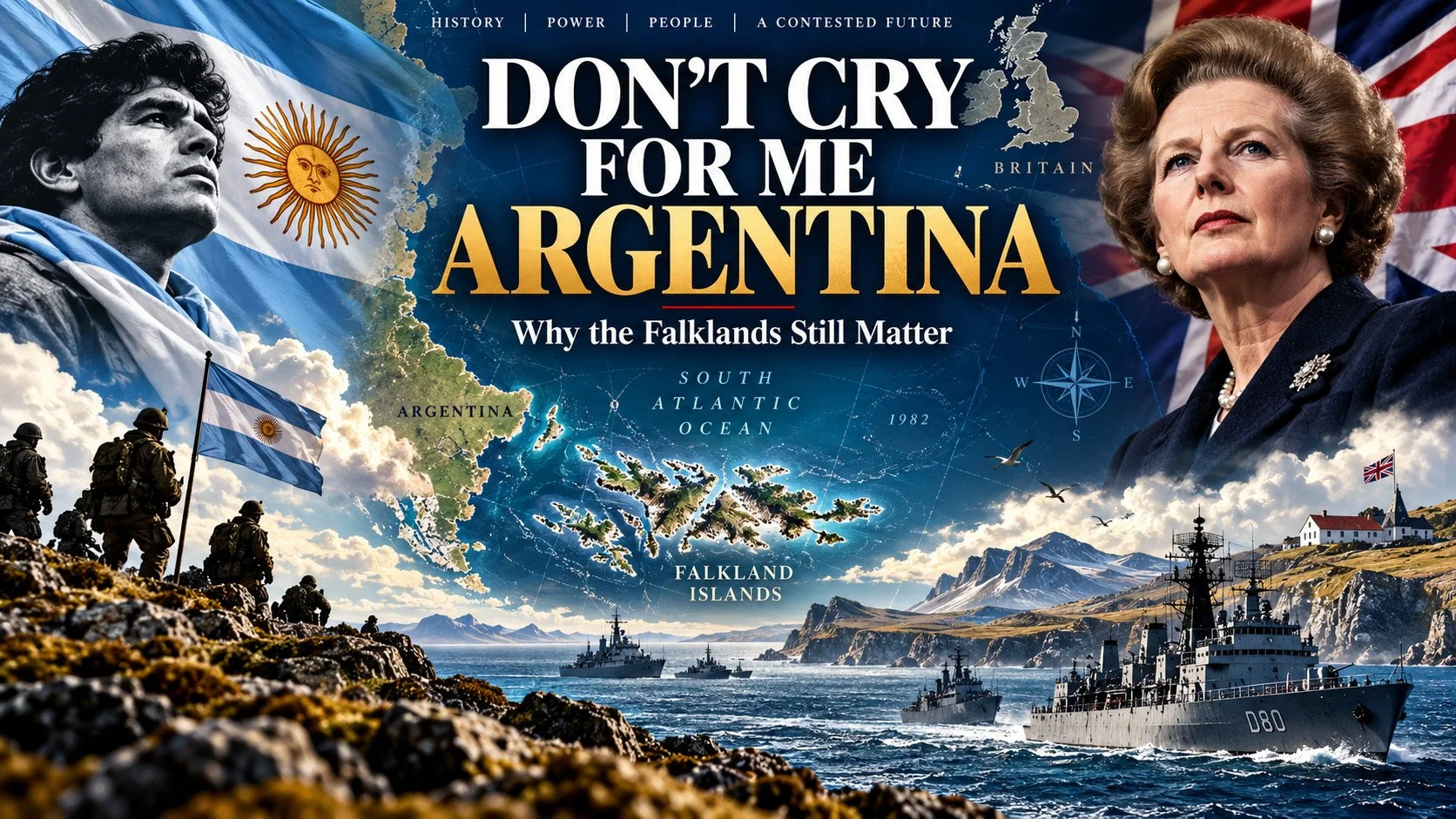
Margaret Thatcher, the Falklands War, and the sovereignty question that will not go away.
By Publisher Ray Carmen
An irresistible headline. A serious history.
The title echoes a famous stage song associated with Argentina, but the question at its heart is no theatrical matter. In the windswept South Atlantic, some 300 miles from Argentina, lie the Falkland Islands — Islas Malvinas to Argentinians. For Britain, they are a self-governing Overseas Territory whose people choose their own future. For Argentina, the islands remain an unresolved national claim rooted in history, geography and identity.
Why does Argentina care so deeply about these remote islands? And why, more than four decades after the 1982 war, has the controversy returned to Britain's international headlines?
Why Argentina wants the Falklands
Argentina regards the islands as territory inherited from Spain after independence. It points to earlier administration and to Britain's re-establishment of control in 1833 as a historical injustice. The UK disputes that interpretation and traces its own longstanding claim and administration to earlier periods. Both sides possess elaborate legal and historical arguments; neither national attachment can be explained simply as a hunt for oil.
For Argentina, the Malvinas have become a powerful emblem of sovereignty and national pride, taught in schools and remembered across generations. Proximity to the South American coast matters, as do fishing grounds, potential offshore energy deposits and the strategic position of the South Atlantic. But national identity is the dispute's deepest emotional force.
Margaret Thatcher and the 74-day war
On 2 April 1982, Argentina's military dictatorship invaded the islands. British Prime Minister Margaret Thatcher ordered a naval task force south to retake them. What followed was a short but fierce conflict fought across enormous distances by sea, air and land.
The Argentine garrison surrendered on 14 June 1982, ending the 74-day war. The human cost was devastating: 255 British service personnel, 649 Argentine personnel and three Falkland Islanders lost their lives. Thatcher emerged politically strengthened, while Argentina's military regime was weakened. Those outcomes, however, should never eclipse the grief of families on both sides.
Thatcher's decision is remembered by many in Britain as a decisive defence of the islanders against military conquest. In Argentina, the defeat remains painful, even among those who opposed the dictatorship that launched the invasion.
The islanders have a voice
Today the Falklands have their own elected government and significant domestic self-government, with Britain retaining responsibility for defence and foreign affairs. In a referendum on 10–11 March 2013, 99.8 per cent of voters supported remaining a British Overseas Territory — 1,513 votes in favour and just three against.
Britain maintains that there should be no sovereignty negotiations without the consent of the islanders. Argentina argues that the question is fundamentally a bilateral territorial dispute and that the current population cannot settle it through a referendum. The United Nations recognises a dispute over sovereignty and its General Assembly has repeatedly called for peaceful negotiations; that does not amount to an international ruling awarding the islands to Argentina.
Has Israel sided with Argentina? A disputed report
On 24 October 2026, The Telegraph reported that Israeli Prime Minister Benjamin Netanyahu had directed diplomats to acknowledge Argentina's historical connection to the Falklands and support direct talks between London and Buenos Aires. Some early accounts overstated this as Israel formally endorsing Argentine sovereignty; even the reported change was described more narrowly as support for negotiations rather than full recognition of Argentina's claim.
The Israeli Embassy in London disputed the central allegation. Its spokesman, Alex Gandler, said: 'I categorically deny this allegation. No such directive exists.' It would therefore be wrong to present an Israeli policy reversal as an established fact. The claim and the denial both deserve to be reported.
The context is nevertheless significant. President Javier Milei has cultivated unusually warm ties with Israel. At the same time, British–Israeli relations have become strained over UK measures concerning Israeli settlements in the occupied West Bank, and Israel's October move to end the British Consulate's previous status in Jerusalem. The two governments continue diplomatic dialogue; their relationship has not simply ended.
A dispute that diplomacy must face
There is no evidence that the latest diplomatic controversy signals another imminent military confrontation. The immediate battleground is political: international support, statements at the United Nations, negotiations and arguments about self-determination.
It is right to remember Margaret Thatcher's determination in 1982. It is equally right to remember all those whose lives were lost, and to ask how future generations can be spared another war. History is not undone by an irresistible headline. In the Falklands, the essential question remains how to address competing sovereign claims without silencing the people who call the islands home.