
A UN COMMISSION CONCLUDED: GENOCIDE IN GAZA
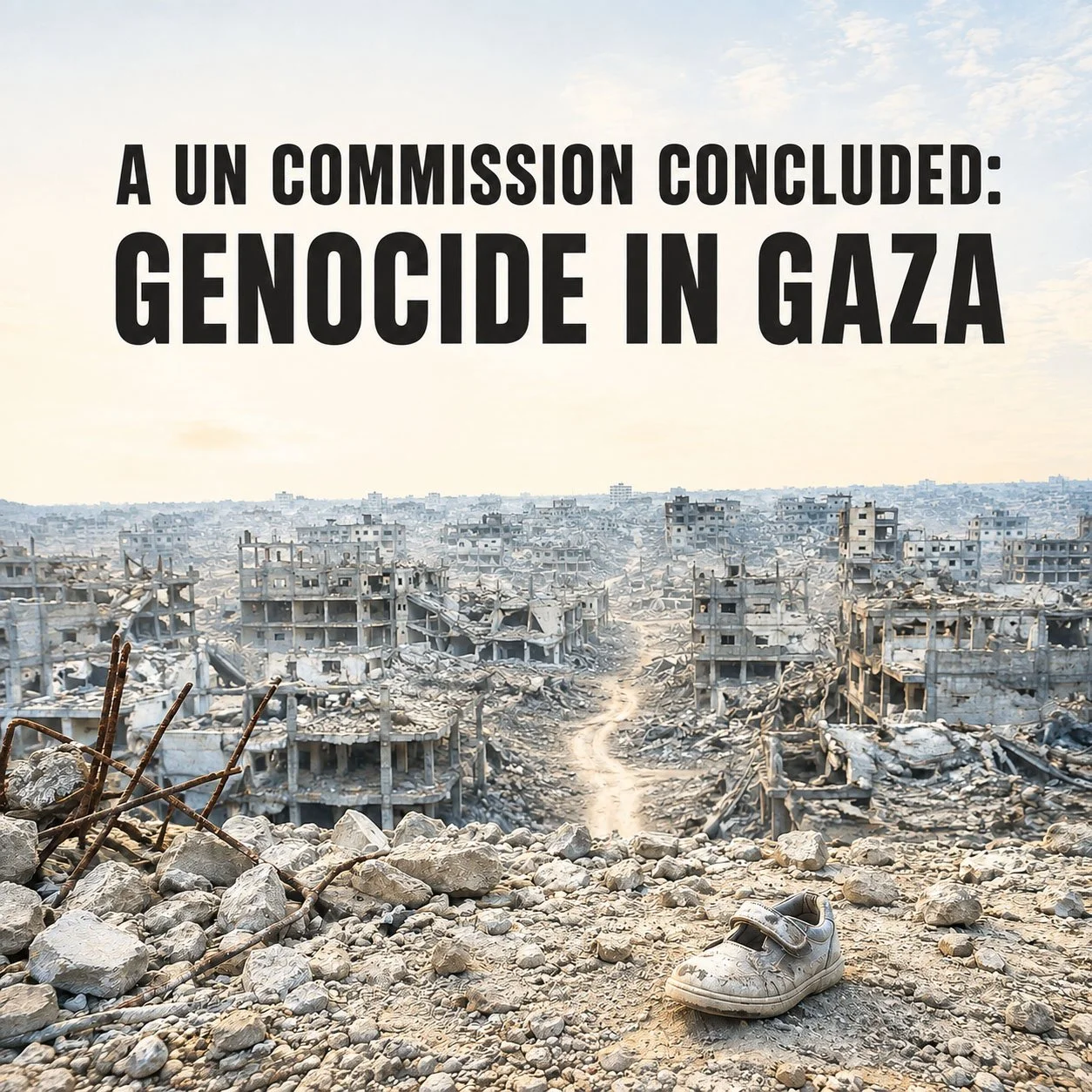
The world cannot say it did not know
By Publisher Ray Carmen
On 16 September 2025, the United Nations Independent International Commission of Inquiry reached a conclusion of historic gravity: it found on reasonable grounds that Israeli authorities and security forces had committed—and were continuing to commit—genocide against Palestinians in Gaza.
The Commission concluded that four of the five acts listed in the 1948 Genocide Convention had been committed:
Killing members of the group
Causing serious bodily or mental harm
Deliberately inflicting conditions of life calculated to bring about the group’s physical destruction, in whole or in part
Imposing measures intended to prevent births
This was not a slogan, a social-media verdict or the language of a protest placard.
It was the formal legal conclusion of an independent Commission mandated by the UN Human Rights Council, following an investigation covering events from 7 October 2023 to 31 July 2025.
The Commission examined military operations, the siege and obstruction of humanitarian aid, starvation, the destruction of healthcare and education, sexual and gender-based violence, attacks on religious and cultural sites, and the direct targeting of children.
It concluded that the pattern of conduct and statements by Israeli authorities demonstrated the specific intent required under the Genocide Convention.
Almost two years had passed since 7 October 2023.
Almost two years of death, injury, displacement, hunger and destruction.
Almost two years in which Palestinian children were killed, wounded, orphaned, traumatised and deprived of education and healthcare.
Then, in June 2026, the Commission issued a further report focused specifically on children.
It said Israeli authorities and security forces had deliberately targeted Palestinian children, resulting in genocide, crimes against humanity and war crimes in Gaza.
The report described death, serious injury, starvation, repeated displacement, mass trauma and the destruction of the systems needed for childhood itself.
It also addressed newborn life.
The Commission found that attacks on neonatal and maternity healthcare had harmed infant survival and the reproductive future of Palestinians in Gaza.
The destruction of maternity wards, neonatal facilities and reproductive healthcare was linked to miscarriages, premature births, low birth weight, neonatal deaths and lifelong vulnerabilities among newborns.
This is why language matters.
The Commission did not officially designate Gaza a “genocide zone.” Nor was its report a final judgment by the International Court of Justice. The case brought by South Africa before the ICJ is a separate judicial process.
Israel rejected the Commission’s findings, accused it of bias and maintained that its war was against Hamas rather than Palestinian civilians.
But those distinctions do not diminish what the Commission itself concluded.
A UN-mandated independent body examined the evidence and found genocide.
It later found that children had been deliberately targeted and that the destruction of neonatal and maternity care had gravely harmed newborns and future generations.
By then, more than two-and-a-half years had passed since 7 October 2023.
That delay should trouble the conscience of the world.
International law is not supposed to become meaningful only after neighbourhoods have been erased, hospitals destroyed and children buried.
The Genocide Convention is not merely a promise to describe catastrophe accurately once it is well advanced.
It is a commitment to prevent genocide and punish it.
The real test is therefore not whether governments can find the correct words after years of evidence.
The test is what they do once those words have been spoken.
The world cannot claim it did not know.
It can only be judged by what it does now.