
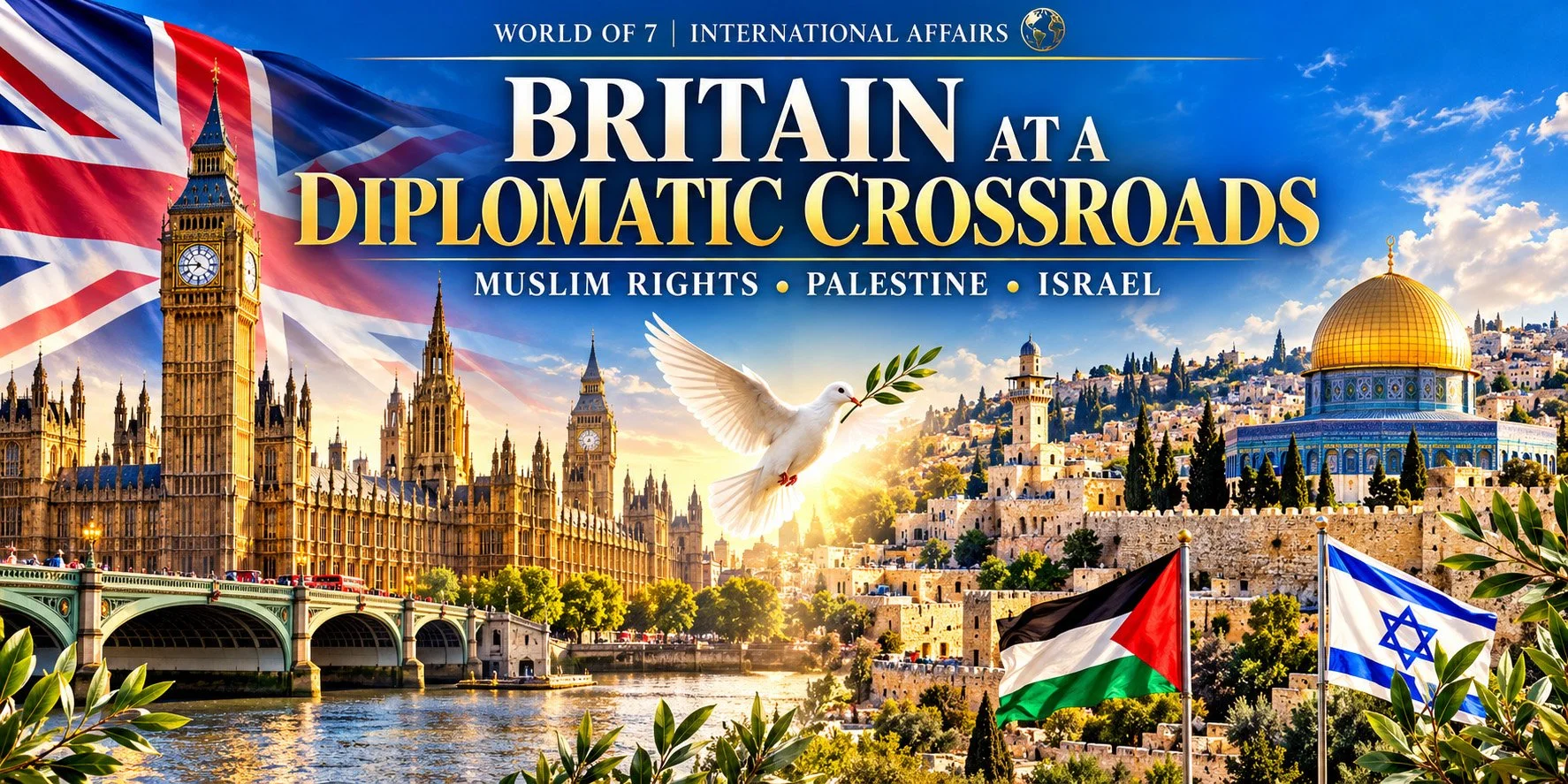
Muslim Communities, Palestinian Statehood and the Growing Divide with Israel
By Publisher Ray Carmen
As Britain strengthens protection for Muslim communities, recognises Palestinian statehood and challenges Israeli government policy, a question is attracting increasing attention: is British foreign policy entering a new era?
A CHANGING POLITICAL LANDSCAPE
Something significant is happening in Britain’s relationship with the Middle East.
Decisions made in London are attracting international attention. Britain’s recognition of Palestine, its opposition to Israeli settlement expansion and its new measures against anti-Muslim hostility have become subjects of considerable debate, particularly across social media.
For some observers, these developments signal a British government increasingly willing to defend Palestinian rights. For others, they raise concerns about the deterioration of relations with Israel, a longstanding British security and diplomatic partner.
But three separate issues must be distinguished: protecting Muslims in Britain, recognising Palestinian national rights and deciding how Britain should conduct its relationship with the Israeli government.
Understanding those differences is essential to understanding the story.
BRITAIN MOVES TO PROTECT MUSLIM COMMUNITIES
On 9 March 2026, the British Government published a new, non-statutory definition of anti-Muslim hostility, intended to help organisations identify and respond to prejudice, intimidation and discrimination.
The definition, applying to England, does not create new criminal offences. It is also explicitly designed to preserve freedom of expression, including the right to criticise Islam and religious practices.
The Government has committed up to £4 million towards tackling anti-Muslim hostility and helping implement its approach.
Meanwhile, protective security funding announced for 2026–27 includes up to £40 million for mosques, Muslim schools and community centres.
These are tangible government measures. But they are measures to protect people, rather than an endorsement of one religion above others.
And there is a serious reason for concern.
Home Office statistics released on 8 October 2026 show that police-recorded religious hate crimes targeting Muslims in England and Wales rose by 15% in the year ending March 2026, reaching 5,132 offences.
PALESTINE: BRITAIN’S HISTORIC DECISION
On 21 September 2025, the United Kingdom formally recognised the State of Palestine.
The announcement represented a major diplomatic step in Britain’s longstanding involvement in the Israeli–Palestinian conflict.
Britain explained the decision as an attempt to preserve the possibility of two states, Israel and Palestine, living alongside one another in peace and security.
It also made clear that Hamas should have no governing role in a future Palestinian state.
Recognition does not, by itself, resolve the difficult questions of borders, security, Jerusalem, refugees and Palestinian governance.
Nor does it automatically create an independent Palestinian state on the ground.
Nevertheless, the decision carried considerable diplomatic significance, particularly because Britain has a distinctive historical connection to the region through the British Mandate for Palestine.
WHY RELATIONS WITH ISRAEL HAVE DETERIORATED
During 2026, the dispute became more pronounced.
On 8 September, Britain’s Foreign Secretary, Ed Miliband, announced measures targeting Israeli settlement expansion in the occupied Palestinian territories.
The proposals included restrictions on goods originating from illegal settlements, action against businesses facilitating settlement construction and further sanctions against individuals involved in settler violence.
Britain’s position is that these settlements undermine the prospect of a viable Palestinian state.
On 19 October, Miliband issued another warning concerning construction tenders for the E1 settlement project, cautioning companies that participation could expose them to sanctions.
The Israeli government, however, strongly rejects Britain’s approach, regarding the measures as hostile and one-sided.
Israel also points to its security concerns, the threat posed by Hamas and other armed groups, and its objections to unilateral recognition of Palestine.
The disagreements are therefore not merely differences in diplomatic language.
They concern territory, sovereignty, international law and security.
THE JERUSALEM DIPLOMATIC CONFRONTATION
The clearest demonstration of the growing tension came on 8 October 2026.
Israel reduced Britain’s longstanding consular presence in Jerusalem, prompting a negotiated arrangement under which the building would continue operating as the UK Mission, Jerusalem, with fewer diplomats.
Israel’s Foreign Minister, Gideon Sa’ar, accused Britain’s government of adopting hostile measures against his country.
Britain rejected Israel’s claimed legal authority to close the consulate and reaffirmed its view that East Jerusalem is occupied territory.
The agreement avoided a complete closure of Britain’s premises but exposed the scale of disagreement between two countries with longstanding diplomatic connections.
Even so, relations have not been severed.
Dialogue continues, and important security interests remain.
WHAT ABOUT BRITAIN’S JEWISH COMMUNITIES?
It would be inaccurate to suggest that stronger protection for Muslims means Britain is withdrawing protection from Jewish citizens.
In February 2026, the Government allocated up to £28.4 million through the Jewish Community Protective Security Grant for the 2026–27 period.
In July, it announced further investment of more than £250 million over three years to strengthen policing and security affecting Jewish communities.
Home Office figures also showed a 10% rise in police-recorded religious hate crimes targeting Jewish people in the year ending March 2026.
The Government has publicly condemned antisemitism while continuing to support Israel’s right to security.
British Jews, British Muslims, Israelis and Palestinians are not interchangeable political groups.
Within each community there are different opinions, experiences and aspirations.
The actions of any government should not be attributed collectively to people who share a religion or national background.
IS BRITAIN CHOOSING SIDES?
The answer is more complicated than many social-media headlines suggest.
Britain has become more assertive in challenging particular policies of Israel’s government while strengthening its support for Palestinian self-determination.
At the same time, it continues to maintain that Israel must be secure and that Palestinians deserve a viable state.
Domestically, Britain has announced measures against both anti-Muslim hatred and antisemitism.
The distinction is crucial:
Defending Muslims is not the same as opposing Jews.
Supporting Palestinian statehood is not the same as supporting Hamas.
Criticising the Israeli government is not, by itself, hostility towards Israel’s people.
These distinctions matter because international disputes can too easily become domestic divisions.
A TEST OF BRITAIN’S INTERNATIONAL ROLE
Britain now faces difficult questions about how its diplomatic positions will translate into lasting results.
Can it persuade Israel and Palestinian leaders to support a sustainable political settlement?
Can restrictions on settlement activity make a measurable difference?
Can Britain protect its own Muslim and Jewish communities from hostility while maintaining robust public debate?
And can a diplomatic relationship under considerable strain recover without abandoning fundamental disagreements?
None of those questions has a simple answer.
What is clear is that Britain’s relationship with Israel and Palestine is undergoing significant change.
The outcome will depend not only on speeches and announcements, but on decisions made in London, Jerusalem and across the wider Middle East.
For WORLD OF 7, the larger story is about the responsibilities of a modern democracy:
Defending its citizens, upholding international law, supporting peace and allowing principled disagreement without allowing hatred to take root.