
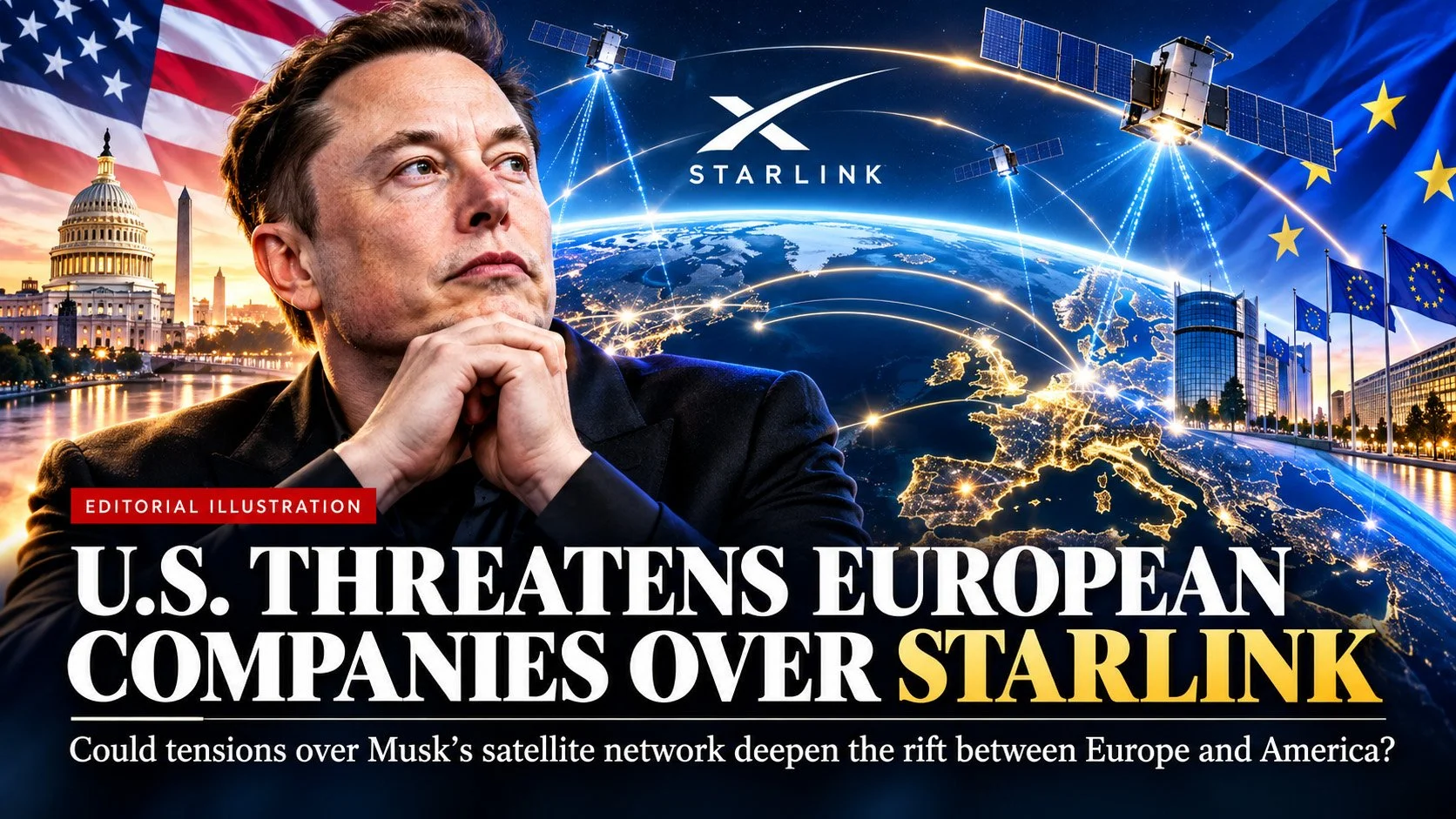
Washington warns of devastating retaliation as Brussels challenges Elon Musk’s satellite ambitions.
By Publisher Ray Carmen
A remarkable new confrontation is unfolding between the United States and Europe — not over territory, oil or traditional military power, but over the invisible frequencies linking mobile phones to satellites orbiting hundreds of kilometres above Earth.
At the centre of the dispute stands Elon Musk, whose SpaceX-owned Starlink network has become one of the most strategically important communications systems in the world.
The United States has warned that European companies could face devastating economic retaliation if the European Union proceeds with proposals limiting access for American satellite operators to valuable radio spectrum.
It is a remarkable warning between longstanding allies — and a powerful illustration of how technology, commerce and national sovereignty are becoming increasingly inseparable.
Washington’s warning
The controversy intensified after US Ambassador to the European Union Andrew Puzder warned, in an interview published by the Financial Times on 18 October, that European businesses could suffer severe consequences in the American market.
Washington’s argument is that European regulators should not deliberately disadvantage successful American businesses to favour domestic competitors. Brussels sees the situation differently: European policymakers want to ensure that essential communications infrastructure is not excessively dependent on companies headquartered outside the European Union.
No specific retaliatory measure, target company or timetable has been publicly announced in connection with Puzder’s warning. The immediate dispute is regulatory and economic, not military.
Why Starlink matters
Starlink is more than an internet service for people living in remote locations. Its satellite network has become significant for maritime communications, emergency connectivity, isolated communities and military operations.
The war in Ukraine has demonstrated how satellite communications can become critically important when terrestrial networks are damaged or disrupted. SpaceX argues that the European proposals could weaken connectivity options, including those important to Ukraine.
For European policymakers, however, Ukraine’s experience also underlines the risks of depending too heavily on any single privately controlled communications network. The central question is increasingly clear: who should control the infrastructure on which modern societies depend?
Europe strikes back — through technology
On 19 October, four of Europe’s major telecommunications groups — Deutsche Telekom, Orange, Telefónica and Vodafone — announced that they were exploring a joint bid for satellite spectrum. Their ambition is to help develop European-governed satellite-to-phone services, providing greater choice and resilience.
The companies have not announced a completed European satellite constellation. They intend to explore partnerships with satellite operators while developing important supporting infrastructure.
Under the European Commission’s May 2026 proposal, one-third of the relevant 2 GHz spectrum would be reserved for European governmental communications, another third for European commercial operators, and the final third open to European and qualifying non-European operators.
Starlink is not being banned from Europe under this proposal. The dispute concerns future access to a particular frequency band, not the removal of the entire service.
Could Europe and America become enemies?
Perhaps the most disturbing aspect of this disagreement is what it reveals about the changing relationship between Washington and Brussels. The United States and Europe have been partners in defence, trade, technology and diplomacy for generations.
Yet economic rivalry, disputes over regulation and concerns about technological dependence are testing that relationship. Could such tensions eventually lead to a wider confrontation?
Trade restrictions, retaliatory penalties, legal challenges and diplomatic disputes are plausible consequences. However, the present Starlink confrontation provides no credible basis for predicting a third world war between Europe and the United States.
The two remain deeply connected through NATO, commerce and shared security interests. The more realistic danger is a prolonged struggle over who controls the technologies of tomorrow.
The publisher’s perspective
The world may be entering a new era in which satellites are as strategically important as oilfields, shipping routes and military bases once were.
Elon Musk has helped demonstrate the extraordinary influence that private technology companies can exercise on international affairs. But Europe also has a legitimate interest in ensuring that its critical communications infrastructure remains secure, resilient and competitive.
Neither Washington nor Brussels benefits from turning commercial rivalry into lasting hostility. The wisest outcome would be negotiation, fair competition and stronger cooperation between allies.
The battle over Starlink is not World War III. But it could become an important chapter in the struggle for control of the world’s digital future.