
PARIS : THE GLAMOROUS CAPITAL THAT TAUGHT THE WORLD TO DRESS
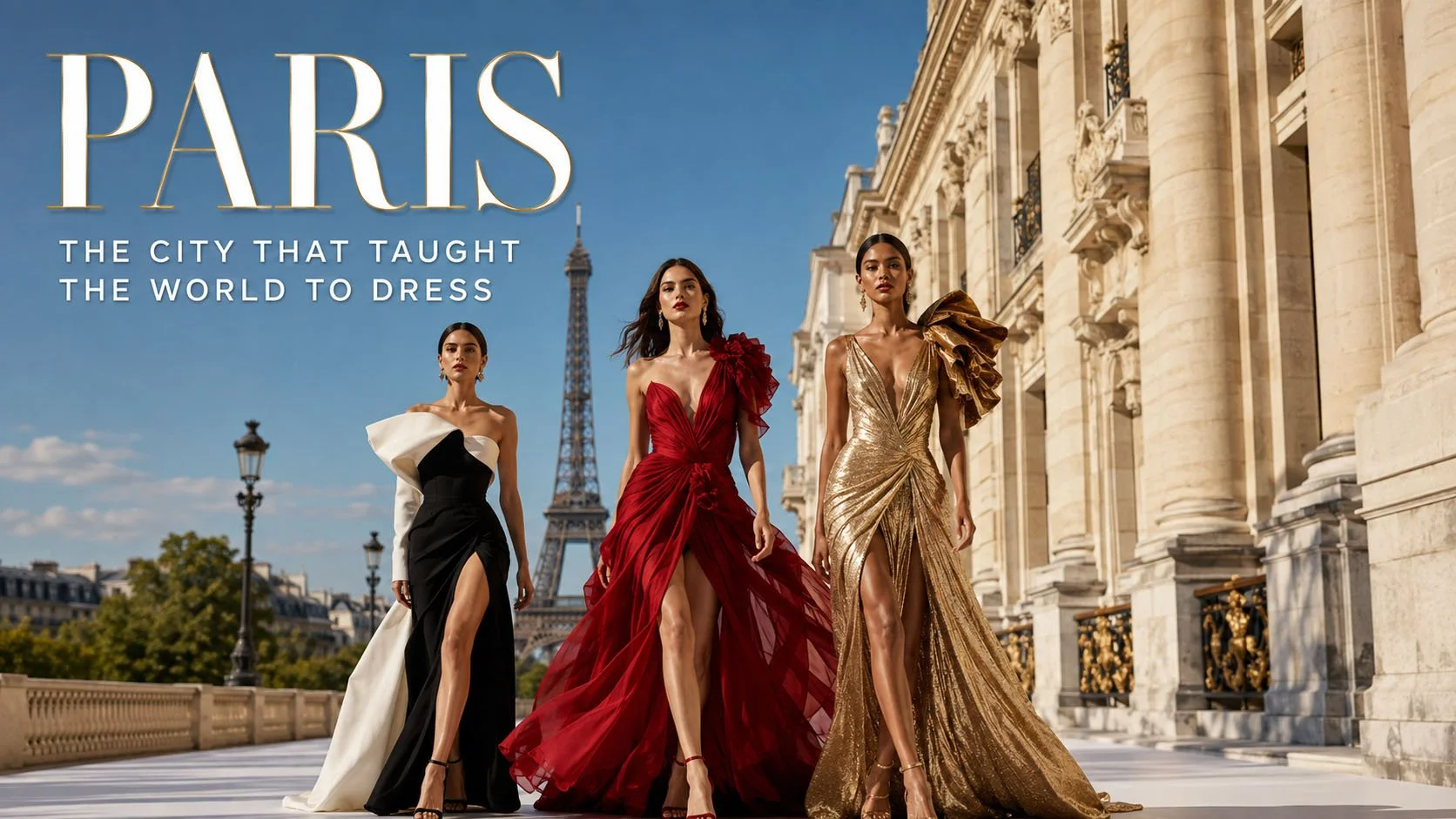
By Publisher Ray Carmen
Paris does not merely create fashion. Paris creates desire.
For centuries, this extraordinary city has persuaded the world that clothing can be more than protection and beauty can be more than decoration. In Paris, a dress can become a declaration, a perfume can become a memory and a pair of shoes can carry the confidence of an entirely new life.
Fashion here is not confined to the runway. It is found in the sweep of a coat along a grand boulevard, the flash of red lipstick at a pavement café, the immaculate window of a luxury boutique and the quiet concentration of an artisan sewing thousands of tiny beads onto a single gown.
Other cities make magnificent clothes. Paris made fashion a language of power, fantasy, sensuality and reinvention.
WHEN STYLE BECAME POWER
The roots of Parisian fashion reach deep into France’s royal history. Under Louis XIV, the court at Versailles became a dazzling theatre in which clothing displayed wealth, rank and influence. Elaborate textiles, decorative shoes, towering wigs and carefully controlled rules of dress helped turn French luxury into an international obsession.
The king understood image with remarkable clarity. France developed industries capable of producing the silks, lace, ribbons, jewellery and accessories demanded by the court. Fashion stimulated commerce while projecting French prestige across Europe.
By the eighteenth century, figures such as Marie Antoinette and her celebrated dressmaker Rose Bertin helped transform fashion into a continuing cycle of spectacle and novelty. The queen’s extravagant wardrobe made her one of history’s most influential—and controversial—style personalities.
The Revolution swept away the old court, but it did not end Paris’s fascination with appearance. Styles changed, silhouettes shifted and political messages were expressed through clothing. The city’s ability to reinvent itself had begun.
THE BIRTH OF HAUTE COUTURE
In the nineteenth century, Paris established the foundations of the modern fashion house. Charles Frederick Worth, an English-born designer who built his career in the French capital, is widely regarded as a father of haute couture.
Worth did something revolutionary: instead of simply waiting for clients to dictate what they wanted, he presented his own designs and encouraged fashionable women to choose from his creative vision. His house used live models to display garments and attached the designer’s identity to the clothes.
The couturier was becoming an artist, tastemaker and brand.
Haute couture elevated dressmaking to extraordinary heights. Garments were created individually, requiring numerous fittings and immense manual skill. Embroidery, pleating, feather work, fabric flowers and invisible internal structures could demand hundreds of hours of specialised labour.
That tradition survives through Paris’s ateliers—the workshops where highly trained hands turn drawings into reality. Their work may be hidden inside a finished garment, but without them the magic would not exist.
THE WOMAN WHO FREED THE BODY
The twentieth century brought one of fashion’s most consequential figures: Gabrielle “Coco” Chanel.
Chanel rejected much of the stiffness and ornamentation that had confined women’s clothing. She embraced simplicity, comfortable fabrics, clean lines and ideas influenced by menswear. Jersey—previously associated more with practical garments—became part of a new vocabulary of elegant freedom.
Her approach helped popularise the little black dress, relaxed tailoring and an image of modern femininity that was self-possessed rather than fragile. Pearls could be mixed with costume jewellery. A woman could look luxurious without appearing imprisoned by her clothes.
Chanel’s complicated personal history remains part of her legacy, but her impact upon fashion is undeniable.
She understood that the sexiest quality a garment could give a woman was not exposure. It was confidence.
DIOR AND THE RETURN OF THE DREAM
After the austerity of the Second World War, Christian Dior unveiled his first collection in Paris in 1947. Its dramatically rounded shoulders, narrow waists and voluminous skirts created a striking silhouette that became known as the “New Look.”
The designs were not universally welcomed. Some considered their extravagant use of fabric inappropriate after years of rationing and hardship. Yet they captured a longing for glamour, romance and renewal.
Paris once again offered the world a dream.
Dior demonstrated the power of a fashion house to build an entire universe. Clothing, accessories, fragrance and image could work together to create a recognisable idea of elegance.
The modern luxury empire was taking shape.
SAINT LAURENT CHANGES THE RULES
Yves Saint Laurent brought another revolution. He recognised that women’s changing lives required a new kind of wardrobe—one that could be powerful, seductive and modern.
His famous evening trouser suit, widely known as Le Smoking, challenged assumptions about gender and formal dress. Borrowing the authority of the tuxedo, it allowed women to occupy space with a different kind of confidence.
What had once appeared provocative became an enduring symbol of sophisticated sexuality.
Saint Laurent drew inspiration from art, travel, street culture and menswear. He helped break down the barrier between couture fantasy and the clothes modern women wanted to wear.
Parisian fashion was no longer only about presenting a perfect lady. It could present an independent woman who wrote her own rules.
THE GREAT PARIS FASHION HOUSES
Paris became home to a remarkable constellation of fashion houses, each building its own visual mythology.
Some are associated with architectural precision, others with romantic femininity, sculptural experimentation or theatrical fantasy. Together, they helped define the grammar of modern luxury: the carefully staged runway, the signature handbag, the instantly recognisable silhouette and the fragrance capable of introducing millions of people to a designer’s world.
The greatest houses do more than repeat their archives. They continually reinterpret them. A familiar shape may return in a new fabric; an old emblem may be given an unexpected meaning; a young creative director may challenge everything an audience thought it knew about a historic name.
That tension between inheritance and rebellion keeps Paris alive.
BEHIND THE GLAMOUR
The public sees the model, the lights and the final gown. Behind that moment stands an army of creative and technical talent.
Designers begin with research, sketches and fabric. Pattern cutters translate a two-dimensional idea into a shape capable of moving around a body. Seamstresses assemble delicate materials with astonishing precision.
Specialist artisans create embroidery, feathers, pleats, buttons, flowers, gloves and hats. Stylists, casting directors, hair artists, makeup artists, photographers, set designers and producers then construct the image presented to the world.
A few minutes on a runway may represent months of work.
This hidden labour is one reason genuine couture possesses such emotional power. The garment carries evidence of human touch. It may be extravagantly expensive, but it also preserves abilities that could disappear if they are not valued and passed to another generation.
THE PARISIAN WOMAN—MYTH AND REALITY
The world has long been fascinated by the idea of the Parisian woman: effortlessly elegant, intellectually confident and never appearing to have tried too hard.
She is imagined in a perfectly cut jacket, dark sunglasses and understated makeup, perhaps with one element deliberately undone. Her attraction lies in restraint. She knows when to stop.
Of course, Parisian women are no more uniform than women anywhere else. Paris is a multicultural city filled with contrasting ages, backgrounds and styles.
Its streets can produce classic tailoring, African colour, Asian minimalism, vintage romance and fearless youth culture within a few minutes’ walk.
The true Parisian secret is not a particular garment. It is ownership. Style becomes seductive when the wearer appears completely at home inside it.
PARIS FASHION WEEK—THE WORLD COMES TO WATCH
During fashion week, Paris becomes the centre of an international performance. Editors, buyers, celebrities, photographers, clients and digital creators arrive from around the globe.
Historic buildings, museums, courtyards and unexpected spaces are transformed into temporary theatres.
The runway remains important, but the show now extends into the streets. Arrivals are photographed, pavement style travels instantly online and audiences far beyond the invited front row react in real time.
Yet beneath the spectacle lies serious business. Collections influence buying decisions, editorial coverage, advertising and the wider direction of global style. A colour, shape or styling idea introduced in Paris can echo through department stores and high streets months later.
Paris does not control fashion alone—but when Paris speaks, the industry still listens.
PERFUME, BEAUTY AND THE ART OF SEDUCTION
Parisian fashion has always understood that glamour extends beyond clothing.
Fragrance creates an invisible wardrobe. Lipstick can transform a face and a mood. Skincare, powder, eyeliner and carefully styled hair complete the character imagined by a fashion house.
French beauty culture frequently balances polish with suggestion. The goal is not always perfection. A slightly smudged eye, natural skin or an apparently casual hairstyle can feel more alluring because it leaves room for mystery.
Paris knows that seduction depends not upon revealing everything, but upon making the world want to look again.
THE CHALLENGE OF A NEW ERA
Fashion’s glamour cannot excuse its environmental and social costs. The industry faces difficult questions about waste, overproduction, labour, animal welfare, cultural appropriation and the pressure to generate endless novelty.
Paris is part of that challenge—and must be part of the solution.
Designers are exploring recycled and lower-impact materials, circular systems, resale, rental, repair and methods that reduce unnecessary production. Couture’s emphasis on craft and longevity offers one valuable lesson: a beautiful object should be treasured, not treated as disposable.
The future of Parisian fashion will depend upon its ability to preserve fantasy while accepting responsibility.
WHY PARIS STILL MATTERS
Paris remains fashion’s most powerful dream because it has never been only one thing.
It is royal splendour and revolutionary change. It is the privacy of the atelier and the frenzy of the runway. It is black tailoring, red lipstick, a cloud of perfume and a gown so extraordinary that an entire room falls silent.
Most importantly, Paris understands transformation. It allows clothing to become theatre and the wearer to become whoever they wish to be.
Styles will change. New capitals will rise. Technology will reshape how fashion is designed, presented and purchased.
But somewhere in Paris, an artisan will still guide a needle through silk, a designer will still stare at an unfinished sketch and a woman will still step before a mirror and discover a new version of herself.
That is why the city’s spell survives.
PARIS DID NOT SIMPLY TEACH THE WORLD HOW TO DRESS—IT TAUGHT THE WORLD HOW TO DREAM.