
THE WORLD’S CATWALK
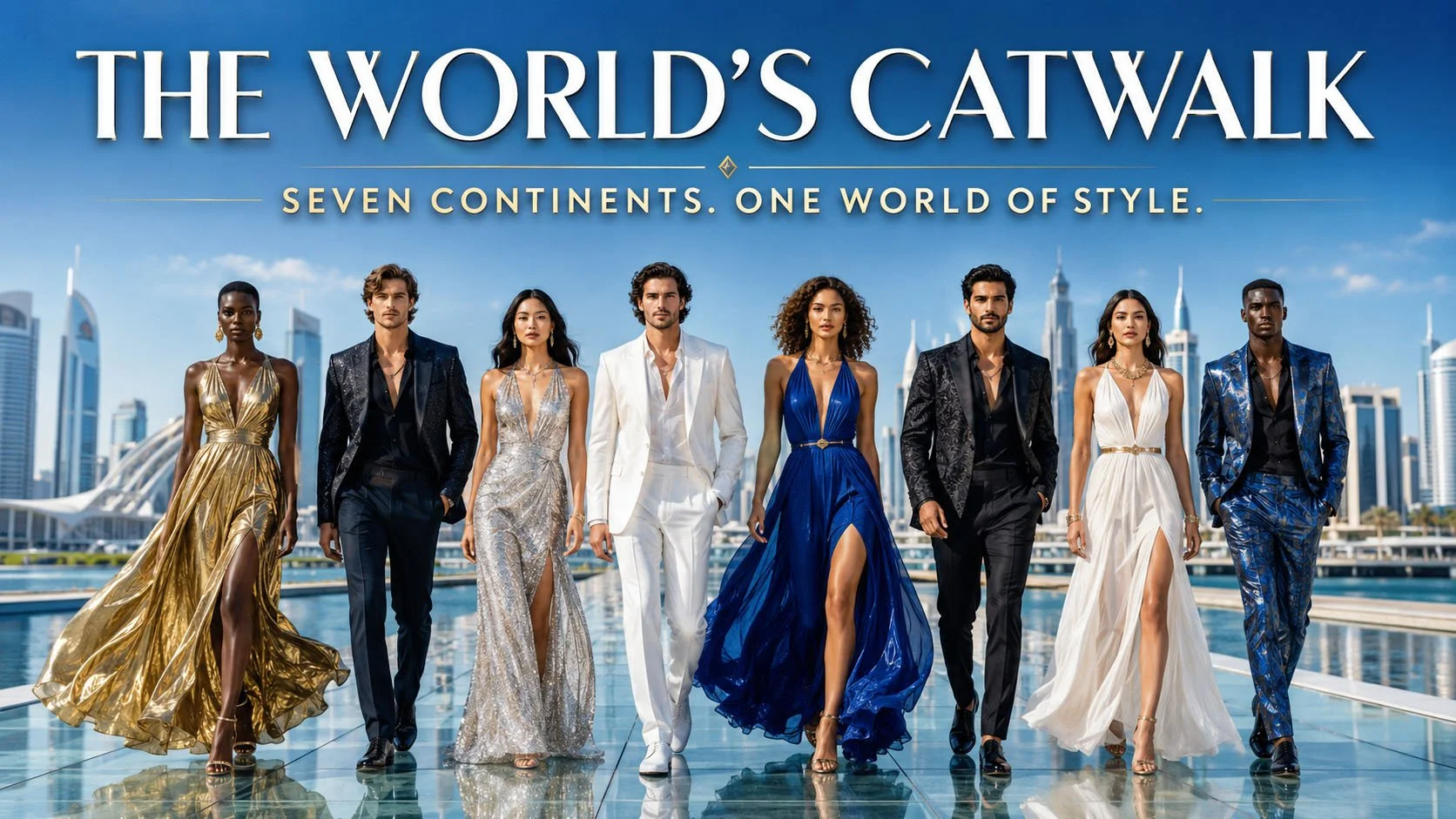
HOW SEVEN CONTINENTS CREATED ONE GLOBAL LANGUAGE OF STYLE
By Publisher Ray Carmen
Fashion has never respected borders.
It travels in suitcases, crosses oceans, appears on cinema screens and races through the streets of the world’s great cities. A colour born in one culture can ignite a catwalk thousands of miles away. A traditional fabric can be transformed by a young designer into tomorrow’s most desirable look. A jacket cut in London, silk woven in India, a print inspired by Africa and a silhouette perfected in Paris may meet in one unforgettable outfit.
The modern catwalk belongs to the entire world.
For generations, a small group of European capitals appeared to dictate what was fashionable. Paris presented couture as an art form. Milan turned craftsmanship into seductive luxury. London brought rebellion and fearless experimentation. New York fused design with ambition, celebrity and business.
Those cities remain enormously influential—but the fashion map has expanded. Today, Lagos, Johannesburg, Mumbai, Seoul, Tokyo, Dubai, São Paulo, Mexico City and Sydney are helping to shape global style.
The result is fashion at its most exciting: international, multicultural, sensual and gloriously unpredictable.
EUROPE — THE GREAT HOUSE OF COUTURE
Europe gave the world many of fashion’s most celebrated institutions. Paris elevated dressmaking into haute couture, where garments are constructed with extraordinary skill for individual clients. Milan built an image of polished glamour around fine tailoring, leather, knitwear and immaculate finishing. London became famous for the precision of Savile Row and the creative disruption of designers who repeatedly tore up fashion’s rulebook.
Across the continent, every country adds a different accent. Scandinavian style favours clarity and practicality. Spanish fashion can move effortlessly between romantic drama and modern minimalism. Italy’s artisans preserve knowledge handed through generations, while France continues to treat fashion as both culture and commerce.
Europe’s power lies not only in famous names. It survives through pattern cutters, embroiderers, textile specialists, leatherworkers and craftspeople whose hands turn imagination into something that can be worn.
ASIA — TRADITION MEETS THE FUTURE
Asia possesses some of the world’s richest textile traditions—and some of its most futuristic fashion cities.
India’s saris, embroidery, jewellery, handloom fabrics and spectacular bridal couture represent centuries of artistry. Japan has profoundly influenced modern design through precise construction, conceptual silhouettes and a willingness to find beauty in simplicity. South Korea has become a global force in music, beauty and street style, turning Seoul into a stage watched by young audiences everywhere.
From the silk traditions of China to Indonesia’s batik, the Philippines’ formal heritage garments and the intricate weaving cultures found across the region, Asian fashion demonstrates that modernity does not require the rejection of history.
Asia’s fashion influence is amplified by enormous creative industries, digital culture and consumers willing to experiment. Here, the ancient and the ultramodern can walk side by side.
AFRICA — COLOUR, POWER AND CREATIVE CONFIDENCE
Africa is not one fashion story. It is a continent of many nations, textiles, identities and design languages.
From West African wax prints and kente traditions to North African kaftans, Ethiopian weaving, South African tailoring and the work of contemporary designers across Lagos, Dakar, Nairobi and Johannesburg, African fashion commands attention through colour, structure, storytelling and pride.
For too long, international fashion borrowed African inspiration without giving adequate recognition to its sources. A new generation is changing that equation. African designers are presenting collections on their own terms, building businesses, dressing international stars and proving that the continent is not merely a source of inspiration—it is a centre of innovation.
The wider world is finally beginning to understand what Africa has always known: clothing can carry ancestry, community and celebration while remaining irresistibly modern.
NORTH AMERICA — WHERE FASHION MEETS POP CULTURE
North American fashion has mastered the art of turning clothing into a global conversation.
New York remains one of the world’s great fashion capitals, but the continent’s influence reaches far beyond its runways. Denim, sportswear, trainers, workwear, red-carpet dressing and street fashion have all been transformed by American culture. Film, television, music and celebrity give a new look the power to travel around the planet overnight.
The Caribbean, Mexico and Canada bring additional creative voices. Caribbean designers channel colour, movement and resort glamour. Mexico’s extraordinary craft traditions and contemporary fashion scene connect design with place and identity. Canadian style moves between cosmopolitan polish, technical clothing and cultural diversity.
North America’s greatest fashion invention may be the freedom to mix everything: luxury with streetwear, tailoring with trainers and vintage discoveries with brand-new pieces.
SOUTH AMERICA — SENSUALITY IN MOTION
South American style possesses energy. It understands the relationship between clothing, movement, celebration and the body.
Brazil has given global fashion its own language of beach confidence, athletic sensuality and joyful colour. Colombia’s designers have built international recognition through feminine silhouettes, resort wear and exceptional craftsmanship. Argentina brings sophisticated urban elegance, while Peru’s prized natural fibres connect luxury with ancient textile knowledge.
Across the continent, designers draw inspiration from rainforests, mountains, cities, Indigenous heritage and the extraordinary variety of South American life.
South America does not simply wear fashion. It dances in it.
OCEANIA — STYLE SHAPED BY LIGHT, LAND AND OCEAN
Australia and the Pacific have created a fashion identity that feels relaxed without being careless.
Australian style moves naturally between sophisticated city dressing, beach culture, resort wear and high-performance clothing. Sydney and Melbourne support distinctive design communities, while the continent’s climate encourages lightness, colour and an easy relationship with the outdoors.
Across New Zealand and the Pacific Islands, designers are increasingly bringing Māori and Pasifika perspectives into contemporary fashion with authority and respect. Traditional knowledge, local materials and cultural symbolism can inform modern garments without becoming costume.
Oceania reminds the world that luxury need not always be rigid. Sometimes it is the perfect fabric moving in an ocean breeze, a beautifully cut swimsuit or an outfit that looks as wonderful barefoot as it does beneath city lights.
ANTARCTICA — FASHION AT THE EDGE OF SURVIVAL
Antarctica has no permanent native population and no conventional fashion industry, yet it has influenced one of clothing’s most important frontiers: protection from extreme conditions.
Scientists, expedition teams and visitors depend upon advanced layering systems, insulation, weatherproof outerwear, specialist boots and technical fabrics. Here, appearance must answer to survival. Every zip, seam and material has a purpose.
Ideas developed for demanding environments eventually influence the wider world. Technical jackets move from expeditions to city streets; performance fabrics become fashionable; warmth and protection are redesigned with elegance in mind.
Even at the coldest edge of the planet, clothing continues to evolve.
BEAUTY NO LONGER HAS ONE FACE
The transformation of fashion is not only geographical. It is human.
The most compelling modern catwalks recognise that beauty exists across different skin tones, ages, body shapes, identities and abilities. Progress remains uneven, but the old idea that glamour belonged to one narrow physical ideal has been permanently challenged.
This matters because fashion affects how people see themselves and who is allowed to feel visible. When a young reader encounters someone on a runway who shares their complexion, heritage or body shape, fashion can become an invitation rather than a rejection.
True diversity requires opportunity behind the scenes as well—in design studios, photography, styling, editing, manufacturing and executive leadership.
THE DIGITAL FRONT ROW
The front row is no longer reserved for a tiny circle of editors, buyers and celebrities. A collection shown in one city can now be watched instantly across the globe.
Social platforms have given independent designers direct access to international audiences, while customers can influence trends with extraordinary speed. Street style may now be as influential as the runway. A teenager’s unexpected combination of colours can travel farther than a carefully planned advertising campaign.
Fashion’s conversation has become faster, louder and more democratic.
That brings risks—imitation, relentless consumption and disposable trends among them. But it also allows talent to emerge from places that the old fashion establishment might never have noticed.
THE NEXT GREAT LUXURY
The future of style will not be judged by beauty alone. Consumers increasingly want to know who made their clothes, how workers were treated, where materials originated and what happens when a garment is discarded.
Fashion’s next great luxury may be permanence: clothing made with integrity, designed to be loved and constructed to last. Repair, resale, recycling and responsible materials are becoming part of the new vocabulary of desire.
This does not mean fashion must lose its sensuality or excitement. Responsibility becomes most powerful when it is irresistible.
The winning garment of tomorrow will make us look wonderful, feel confident and understand that glamour need not come at the planet’s expense.
ONE PLANET. ENDLESS STYLE.
Fashion will always celebrate fantasy. It allows us to reveal ourselves, reinvent ourselves and occasionally become the person we have imagined being.
Yet the world’s catwalk carries a deeper message. Every continent has beauty. Every culture has creativity. Every generation has the power to take what came before and transform it.
The finest global fashion does not erase difference. It places those differences beneath the same bright lights and allows each one to shine.
WHEN THE WHOLE WORLD WALKS THE CATWALK, BEAUTY HAS NO BORDERS.