
Florida Has Become One of the World’s Strongest Magnets for the “Billionaire Jet Set”
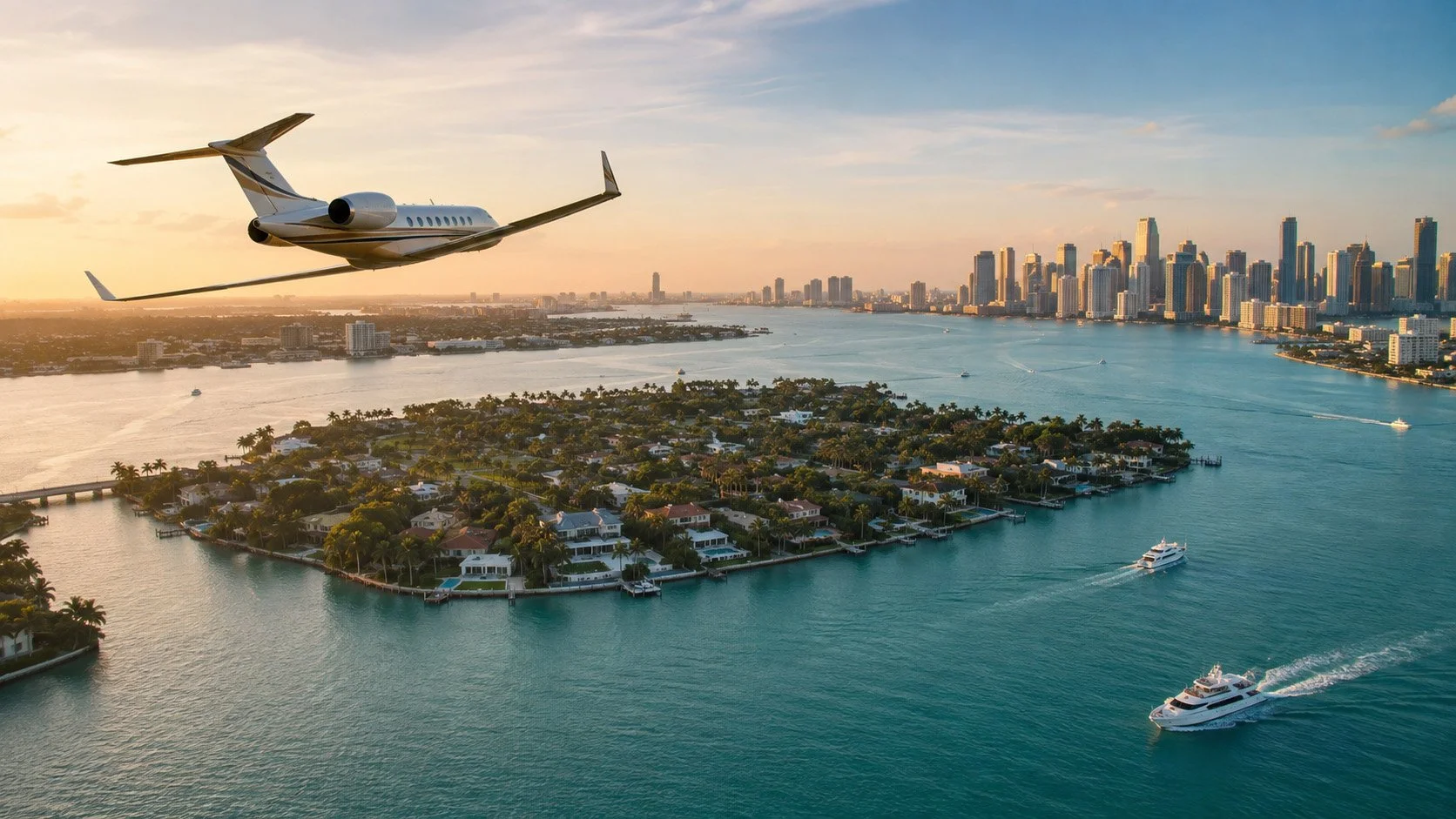
From Miami and Indian Creek to Palm Beach, a new geography of extreme wealth is taking shape—powered by tax advantages, private aviation and waterfront living.
By Publisher Ray Carmen
Florida’s latest status symbol may not be a mansion, yacht or private jet. It is access.
On Indian Creek, the guarded island in Biscayne Bay known as the “Billionaire Bunker,” some of the richest people on Earth own extraordinary waterfront estates. Yet membership of the island’s exclusive country club can remain elusive.
The Wall Street Journal recently reported that Jeff Bezos, despite acquiring three Indian Creek properties for approximately $234 million, had not secured membership of the nearly century-old club.
The episode captures the paradox of South Florida’s new wealth culture: money can open extraordinary doors, but the most coveted rooms still trade on discretion, tradition and belonging.
A Capital Migration With a Tropical Address
The billionaire migration is more than a luxury-property story.
South Florida has become a meeting point for finance, technology, private equity, international family wealth and high-end development.
Miami provides connections with Latin America, the Caribbean and Europe. Palm Beach offers privacy, established social institutions and exceptionally scarce oceanfront property. Fort Lauderdale contributes world-class yachting facilities and an extensive private-aviation network.
Together, they form an influential coastal corridor where international capital can live, work and circulate.
Florida’s lack of an individual state income tax is undoubtedly part of the attraction. For founders, financiers and investors with substantial earnings and investment gains, the difference compared with living in a high-tax state can be considerable.
But taxation alone does not explain the movement.
Florida offers warm weather, waterfront living, international schools, private airports, luxury marinas and direct connections to major global business centres. A Florida residence can function simultaneously as a family home, tax domicile, social headquarters and base for conducting business elsewhere.
Private aviation makes that lifestyle practical. New York is only a few hours away, the Caribbean is close and Europe is an overnight flight.
Miami’s Spectacle, Palm Beach’s Discretion
South Florida’s principal wealth centres offer different versions of prestige.
Miami is the extrovert: new residential towers, glamorous restaurants, Art Basel dinners, waterfront compounds and an energetic international business community. Its luxury is visible and highly produced.
Palm Beach is quieter but no less competitive. Its appeal lies in limited supply, established institutions and a culture that traditionally rewards understatement.
Indian Creek stands between those worlds. Its waterfront estates provide extraordinary privacy and immediate access to Miami Beach, while its country club preserves a social hierarchy older than the latest generation of billionaire residents.
The wealthy newcomers are not simply taking over South Florida. They are entering—and occasionally colliding with—institutions that already possess their own definitions of influence and social standing.
In this world, purchasing the house may be easier than gaining acceptance into the club next door.
The Infrastructure of Extreme Wealth
Billionaires rarely arrive alone. An entire service economy follows them.
Private banks, family-office advisers, lawyers, luxury-property agents, security specialists, yacht brokers and aviation companies expand around concentrations of extreme wealth.
Developers respond with larger residences, private lifts, secure entrances, marina access and hotel-style services. Restaurants, schools, galleries and cultural organisations also adapt to an increasingly international audience.
This creates a self-reinforcing cycle: wealth attracts specialist services, those services make the region more convenient, and that convenience attracts additional wealth.
Florida is therefore becoming much more than a collection of expensive homes. It is developing the infrastructure required to support a permanent global wealth community.
A Powerful Magnet—With Limits
Florida’s wider migration story has started to cool.
US Census Bureau estimates show that the state’s net domestic migration fell to 22,517 during the year ending June 2025, compared with 183,646 in 2023 and 310,892 in 2022.
However, Florida still recorded the largest net international migration total of any American state in 2025, with 178,674 more people arriving from abroad than leaving.
The state can therefore remain a powerful international and ultra-high-net-worth destination even as the broader pandemic-era migration boom slows.
Its success also carries costs. Waterfront property is scarce, insurance is expensive, traffic is increasing and hurricanes, flooding and rising sea levels present genuine long-term risks.
The essential question is no longer whether Florida can attract wealth. It is whether the state can transform those private fortunes into lasting businesses, stronger institutions and opportunities extending beyond its gated enclaves.
A New Global Address for Wealth
Florida’s transformation reflects a wider change in the architecture of elite life.
The climate and coastline provide the emotional attraction. Tax policy and private aviation make relocation practical. Finance and property create the economic ecosystem. Exclusive clubs, schools and neighbourhoods supply identity and status.
Florida is no longer simply a winter playground. It has become a genuine centre of gravity for the world’s mobile wealthy—with its own gatekeepers, rituals and social order.
The private jets may arrive from everywhere.
Increasingly, the address on their flight plans is Florida.