
AI Is Reshaping Banking Jobs—and Senior Positions Are No Longer Safe
By Publisher Ray Carmen
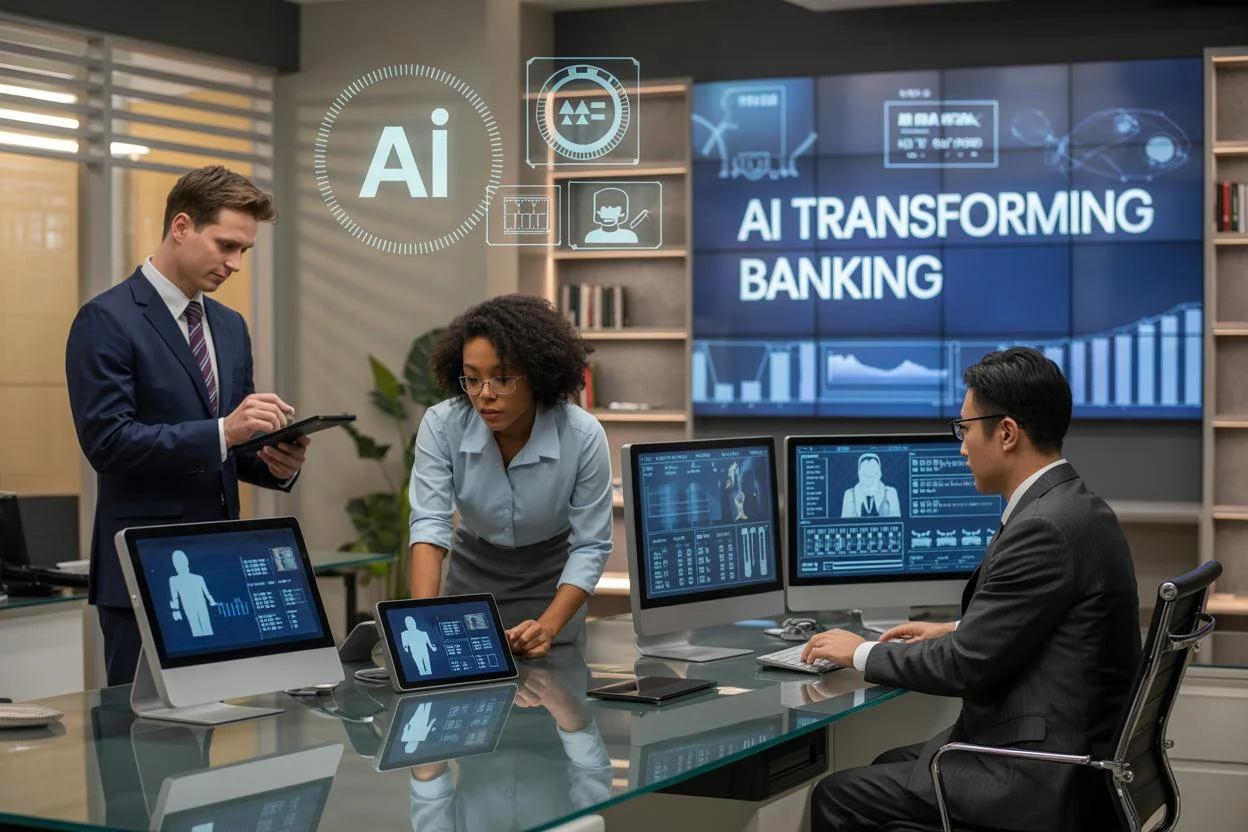
Artificial intelligence is rapidly changing the banking industry, and its impact may reach far beyond entry-level employees.
Banks are preparing for a future in which fewer workers are needed as AI systems take over tasks once performed by analysts, administrators and other financial professionals. Although much of the early discussion focused on junior positions, concerns are now growing that middle-office and senior roles could also be affected.
Banking leaders acknowledge that jobs will disappear
Executives at several of the world’s largest banks have openly recognised that AI will eliminate certain positions.
Financial institutions are introducing the technology across customer service, recruitment, wealth management, transaction monitoring and regulatory processes. Generative AI is also being used to summarise customer calls, prepare presentations, analyse information and assist employees before meetings.
These tools could help banks operate more efficiently, but they may also reduce the number of people required to perform the work.
The middle office—which includes risk management, compliance, treasury and operational support—is considered particularly vulnerable. AI can process large amounts of information quickly, identify patterns and complete routine analytical work that previously required teams of experienced employees.
As these systems become more capable, the threat may move further up the professional ladder.
Junior opportunities are already shrinking
Young people hoping to begin careers in finance could face an especially difficult employment market.
Some banks are reportedly reducing the size of their junior analyst classes by as much as two-thirds. At the same time, they are recruiting workers with artificial-intelligence and technology skills, often from the same graduate groups affected by the reductions.
AI is also becoming part of the recruitment process. Applicants may encounter automated screening systems before speaking to a human recruiter, adding another challenge for students and graduates seeking their first opportunity in banking.
However, sharply reducing entry-level recruitment creates a serious long-term problem for the industry.
Banking has traditionally operated as an apprenticeship profession. Junior analysts develop their judgement by preparing financial models, producing presentations, studying transactions and working alongside experienced colleagues. Over time, these employees become senior bankers and managing directors.
If AI performs much of that foundational work, banks will need to find new ways to develop their future leaders.
Retraining may not protect every employee
Some banking executives have promoted retraining and reskilling as a way to protect workers. Employees could be taught to use AI tools or moved into positions requiring stronger judgement, creativity and personal interaction.
However, it remains unclear how many people can realistically be retrained or whether suitable alternative roles will be available.
There are also legal and social concerns surrounding large-scale reductions. If job cuts disproportionately affect younger workers, administrative employees or particular demographic groups, banks could face accusations of unfair or discriminatory practices.
Questions are also being raised about whether companies may sometimes use AI as a convenient explanation for workforce reductions that were already being considered for financial reasons.
Banks are focusing on specific uses of AI
Despite fears of widespread automation, most banks are not yet attempting to create fully autonomous institutions.
Instead, they are concentrating on targeted uses of AI. These include monitoring transactions, assisting customer-service representatives, summarising calls, supporting wealth-management clients and helping employees complete routine tasks more efficiently.
Some banks are continuing to recruit interns and graduates while trying to keep their overall workforce numbers steady. This suggests that AI’s immediate effect may be slower hiring and reductions through natural staff turnover rather than sudden mass dismissals.
Nevertheless, the direction of travel is becoming clear. Artificial intelligence is changing the type of work performed by banking employees and the number of people required to perform it.
The central challenge for banks will be balancing short-term efficiency with the need to maintain human expertise, professional judgement and a reliable pipeline of future leaders.
For banking employees, the message is equally clear: AI skills are quickly becoming essential, and no level of seniority can be considered completely protected from the changes ahead.