
CHINA-BACKED PORT CITY COLOMBO — SRI LANKA’S US$20 BILLION VISION TO RIVAL DUBAI
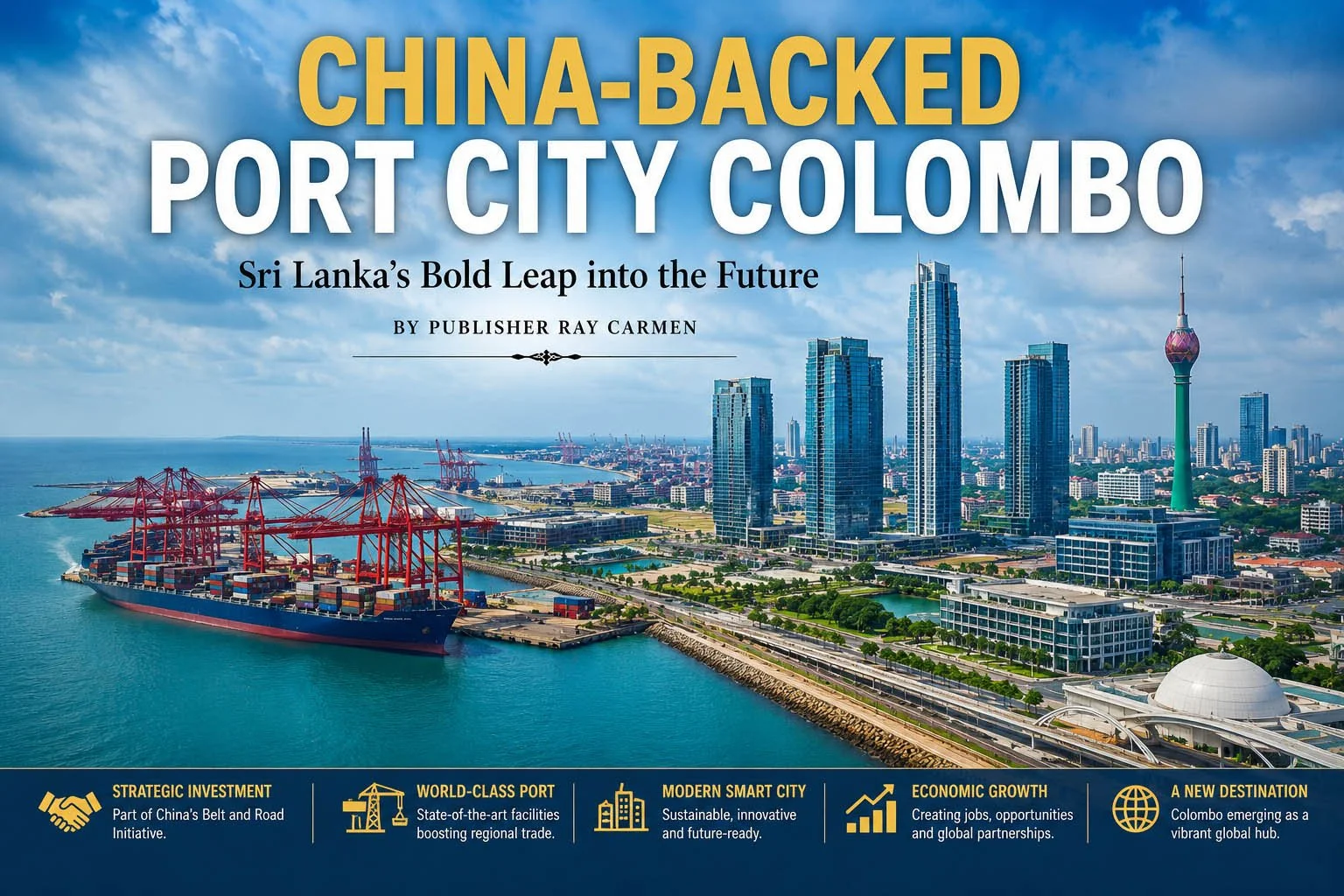
By Publisher Ray Carmen
Sri Lanka is attempting one of the boldest urban transformations in South Asia — creating an entirely new international business district on land reclaimed from the Indian Ocean.
Known as Port City Colombo, the vast development rises beside the existing commercial centre of the Sri Lankan capital and has frequently been described as the island nation’s answer to Dubai or Singapore.
But this is not simply another collection of luxury towers.
It is a China-backed, master-planned city designed to become a major centre for financial services, international trade, technology, tourism, maritime business, hospitality and high-end urban living.
Port City Colombo covers approximately 269 hectares of reclaimed land extending Colombo’s coastline into the sea. The reclamation and core infrastructure were developed by CHEC Port City Colombo, a subsidiary of China Harbour Engineering Company.
The project began with an estimated investment of around US$1.4 billion, while Sri Lanka’s Colombo Port City Economic Commission now expects overall investment to reach approximately US$20 billion when the development is completed.
That is a crucial distinction.
China has not already completed and handed Sri Lanka an entire US$20 billion city. Instead, Chinese investment created the reclaimed land and much of the essential infrastructure upon which hotels, residences, offices, shopping districts and financial institutions are expected to be developed over many years.
The vision is immense.
Port City Colombo is being promoted as a special economic zone with business-friendly regulations, modern infrastructure and incentives intended to attract global companies, entrepreneurs and investors seeking access to South Asia.
Its location is one of its greatest advantages.
Sri Lanka sits close to some of the world’s busiest maritime routes, between major markets in Asia, the Middle East and Africa. Supporters believe Port City could use that strategic position to transform Colombo into a regional financial, commercial and logistics gateway.
Promotional plans imagine a futuristic waterfront containing skyscrapers, luxury residences, hotels, marinas, entertainment districts, green spaces, retail centres and modern offices.
The ambition has inevitably produced comparisons with Dubai.
Like Dubai, Port City Colombo seeks to use international investment, striking architecture, tourism, financial services and waterfront development to build a powerful global identity.
But unlike Dubai, the Colombo project is still developing.
Many of the dramatic skyline images circulating online are architectural visions of what the finished city may eventually look like rather than photographs of a fully completed metropolis.
The development has also attracted political and public debate.
Some Sri Lankans see it as a once-in-a-generation opportunity to bring foreign investment, employment and international business to the country.
Others have raised concerns about Chinese influence, environmental consequences, transparency, land rights and whether the promised economic benefits will reach ordinary citizens.
The land itself remains under Sri Lankan authority through the Colombo Port City Economic Commission, although the Chinese project developer holds commercial rights connected to recovering and monetising its investment.
That balance between foreign investment and national sovereignty will continue to be closely examined.
The project’s future will ultimately depend not only upon impressive architecture but upon whether it can attract credible businesses, maintain strong regulation, create sustainable employment and become genuinely integrated with Sri Lanka’s wider economy.
Port City Colombo therefore represents both extraordinary ambition and enormous responsibility.
For China, it is a highly visible infrastructure and investment project along one of the world’s most strategically important maritime corridors.
For Sri Lanka, it is an opportunity to reshape Colombo’s international role and present the country as a modern commercial gateway to South Asia.
Whether it eventually rivals Dubai remains to be seen.
But there is no doubt that Sri Lanka is building something unprecedented upon its shoreline — a new city rising from the sea, carrying billions of dollars in expectations and the hopes of a nation seeking a powerful new economic future.
WORLD OF 7 — One Planet. Seven Continents. One Global View.