
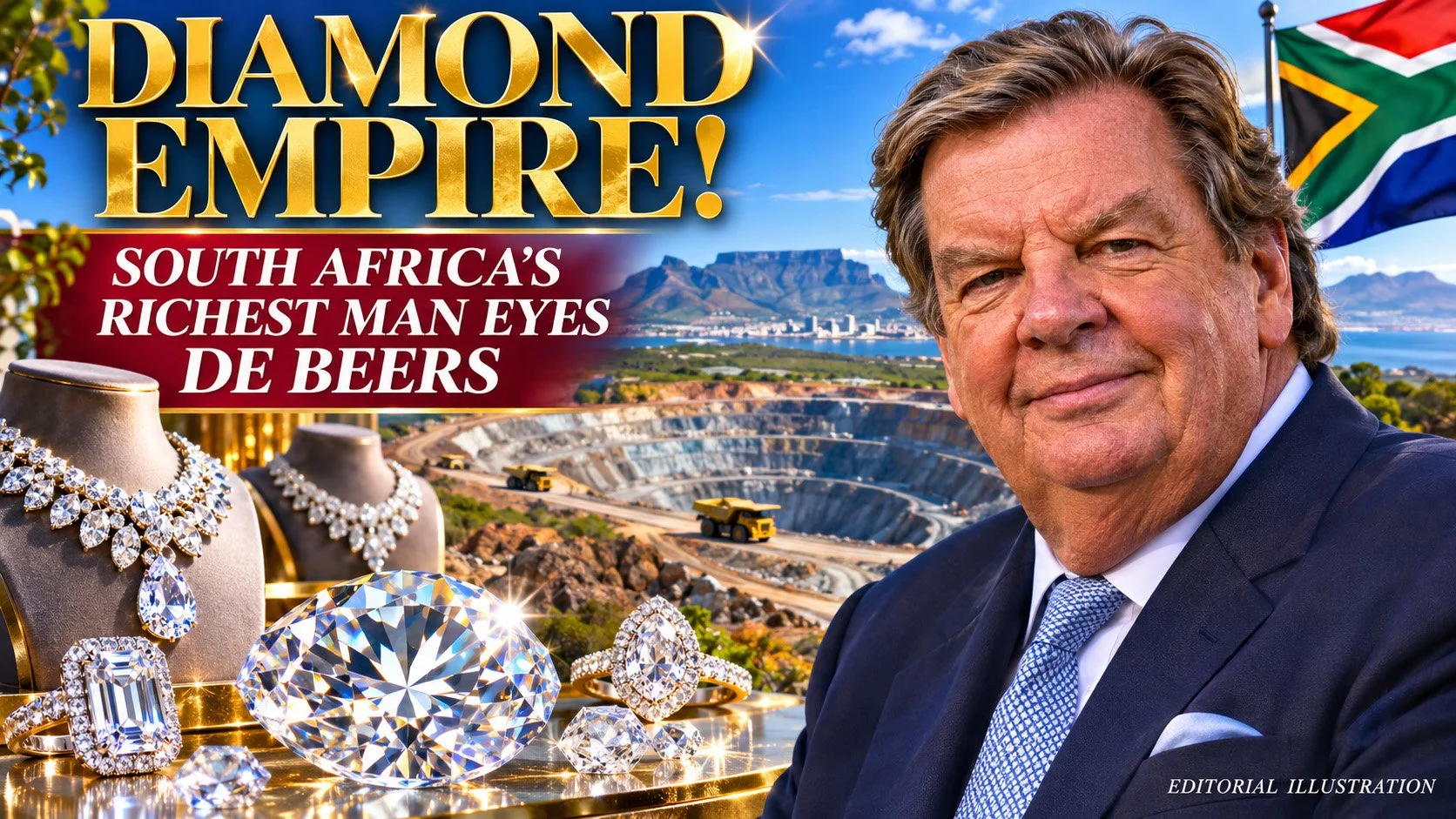
SOUTH AFRICA’S RICHEST MAN EYES DE BEERS — THE BILLION-DOLLAR BATTLE FOR THE WORLD’S DIAMONDS!
By Publisher Ray Carmen
Johann Rupert’s luxury group Richemont is discussing a possible stake in the consortium seeking to acquire De Beers. But a dramatic move by Botswana could make the diamond-producing nation the company’s largest shareholder — and reshape who controls the stones behind some of the world’s finest jewellery.
THE MAN BEHIND CARTIER
From the glittering boutiques of Cartier to the diamond mines of southern Africa, a potential new alliance is taking shape. South African billionaire Johann Rupert, chairman of Switzerland-based luxury group Richemont, is at the centre of it. Richemont — whose jewellery houses include Cartier, Van Cleef & Arpels and Buccellati — has been in talks to join the Global Diamond Consortium, a group pursuing Anglo American’s controlling interest in De Beers. American jewellery retailer Signet has also been in discussions. Reports have not established that either company has committed to invest.
BOTSWANA MAKES ITS MOVE
The story gained fresh momentum on 9 November 2026, when Botswana’s President Duma Boko endorsed the Global Diamond Consortium as his government’s preferred bidder. He said Botswana intends to double its De Beers shareholding from 15% to 30% under the proposed sale, which would make it the miner’s largest single shareholder. Angola and Namibia are also expected to participate in the proposed ownership structure. These plans remain subject to the completion of negotiations and binding agreements. For Botswana, one of the world’s great diamond-producing countries, the potential increase is about influence over pricing, investment, technology and the future value created from its natural resources.
WHY WOULD A JEWELLERY EMPIRE WANT A DIAMOND MINER?
Richemont already sells extraordinary diamond jewellery, but securing a position closer to the supply of natural stones could strengthen its long-term relationships and access to production. A De Beers investment might also allow Richemont to support natural-diamond marketing and traceability at a difficult moment for the industry. That strategic rationale is an interpretation of the proposed investment, not a confirmed statement of Rupert’s personal intentions. Industry reports suggest that any Richemont holding would likely be a minority stake, not a takeover by Rupert himself.
A LEGEND UNDER PRESSURE
Founded in 1888, De Beers helped define the modern diamond trade. Today, however, the industry faces weaker demand in China, pressure on rough-diamond prices and intensifying competition from less expensive laboratory-grown stones. Anglo American announced plans in 2024 to divest its majority holding in the business as part of a broader restructuring. The combination of miners, producing governments, diamond traders and perhaps luxury retailers is a proposed answer to a difficult question: who is best placed to revive the appeal and economics of natural diamonds?
WHO REALLY GETS THE CROWN JEWELS?
The consortium is led by Gareth Penny, a former De Beers chief executive. It seeks to acquire Anglo American’s 85% holding, while Botswana’s share would be restructured as part of the transaction. Botswana’s endorsement is an important step, but no completed acquisition has been announced. The final price, ownership percentages, financing and participation of Richemont and Signet remain subject to negotiations. The biggest development may be political and economic as much as luxurious: diamond-producing African nations could gain greater ownership of a company whose gems have long travelled from African mines to the world’s most prestigious shop windows.
THE WORLD OF 7 VERDICT
If the proposed transaction succeeds, the next chapter in De Beers’ history may be written jointly by African producer nations, global diamond specialists and some of the world’s best-known jewellery businesses. Johann Rupert’s involvement is still a possibility rather than a done deal. But one thing is certain: when the future of De Beers is decided, the conversation will be about much more than sparkle.