
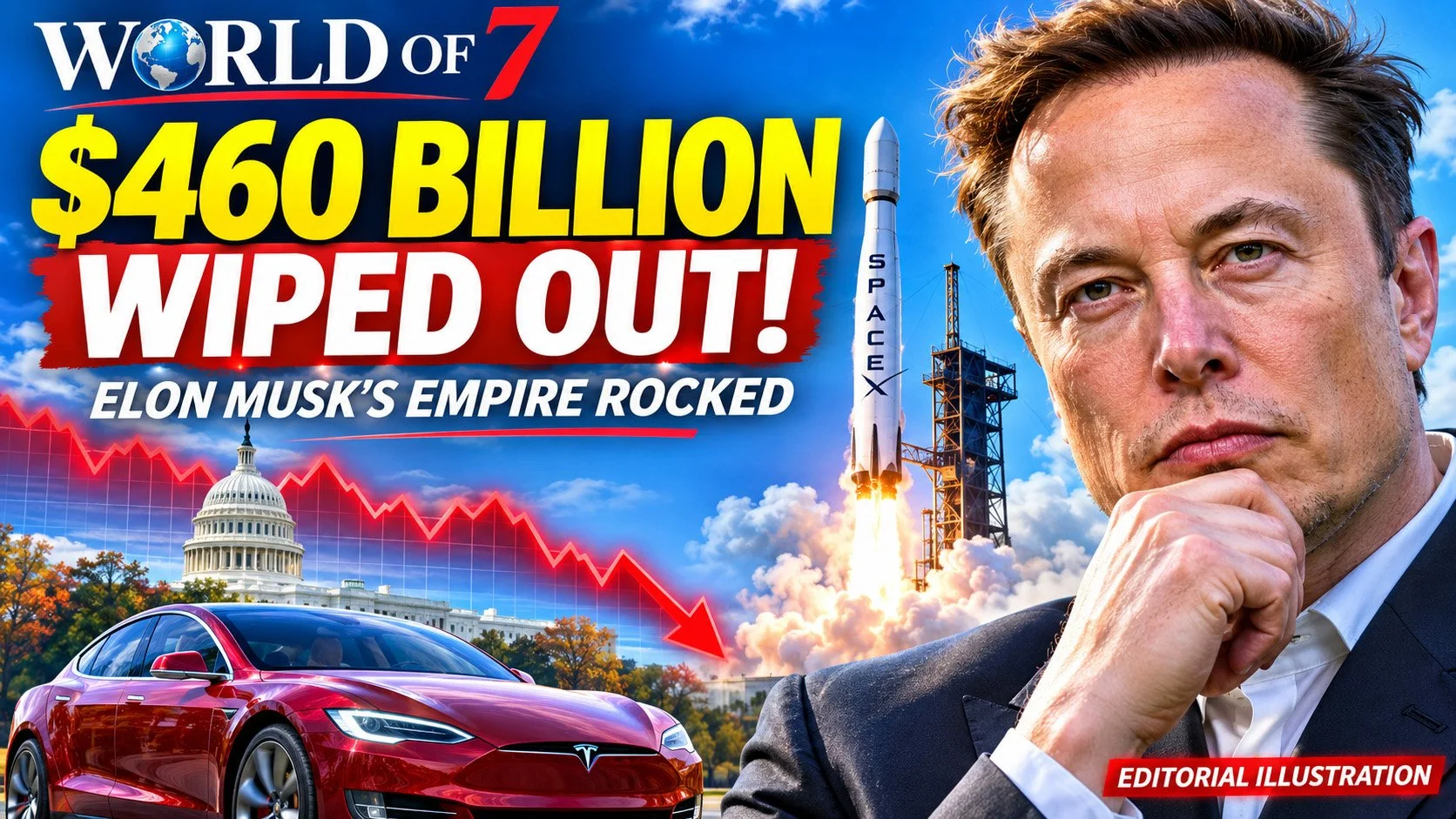
ELON MUSK’S EMPIRE ROCKED — THE POLITICAL AND FINANCIAL SHOCKWAVE
By Publisher Ray Carmen
Tesla and SpaceX suffer a staggering market-value collapse as America’s political landscape changes — but is this a temporary setback or a warning of greater trouble ahead?
The world’s richest man has experienced a spectacular financial setback.
In just two trading days following America’s midterm elections, approximately $456 billion was wiped from the combined market value of Tesla and SpaceX, two of the most prominent businesses associated with billionaire entrepreneur Elon Musk.
The extraordinary sell-off followed Democratic electoral victories that raised concerns among investors about tighter government scrutiny, new restrictions on artificial intelligence infrastructure and the future of Musk’s business interests.
For a man whose companies have transformed electric vehicles, satellite communications and commercial space exploration, the sudden decline represents a striking reminder that even the largest corporate empires remain vulnerable to political and financial uncertainty.
But the headline figure requires an important distinction.
Musk did not personally lose $460 billion. That was the approximate combined reduction in the market capitalisation of Tesla and SpaceX.
His estimated personal fortune declined by approximately $113 billion over the same period, according to figures reported from the Bloomberg Billionaires Index.
THE TWO DAYS THAT SHOOK MUSK’S EMPIRE
The financial turmoil unfolded on 4 and 5 November 2026.
Following the midterm election results, investors began reassessing the political and regulatory environment facing Musk’s businesses.
Tesla shares fell approximately 3.3% on 4 November, followed by a much steeper decline the following day.
SpaceX also experienced significant selling pressure.
By the close of trading on 5 November, the combined market value of the two companies had fallen from approximately $3.5 trillion to $3.04 trillion.
The decline was extraordinary in scale.
Tesla accounted for roughly $216 billion of the reduction, while SpaceX accounted for approximately $240 billion.
The losses reflected a combination of company-specific concerns and a wider technology-sector sell-off.
Importantly, markets subsequently rebounded, demonstrating how rapidly financial valuations can change.
THE POLITICAL EARTHQUAKE
The immediate backdrop was America’s midterm elections.
Democratic victories changed the balance of political power and increased the possibility of congressional investigations into Musk’s activities.
Particular attention has focused on his involvement with the Department of Government Efficiency, commonly known as DOGE.
Democratic lawmakers have raised questions about access to government information, potential conflicts of interest and the relationship between Musk’s companies and federal contracts.
These concerns do not establish wrongdoing.
However, the possibility of investigations and increased regulatory oversight can influence investor expectations.
For businesses operating in heavily regulated industries, political uncertainty can translate quickly into financial volatility.
TEXAS — FROM SAFE HAVEN TO POLITICAL BATTLEGROUND
Texas has become central to Musk’s industrial ambitions.
Tesla relocated its headquarters from California to Texas in 2021.
SpaceX subsequently expanded its presence in the state, which has become an important centre for rocket manufacturing, launches and technology development.
Musk has frequently praised Texas for its business environment.
However, the election of Democrat Gina Hinojosa as governor-elect has introduced new uncertainty.
Hinojosa has advocated stronger safeguards around the construction of large artificial intelligence data centres.
Such facilities can consume substantial electricity and water resources.
Her proposals have raised concerns about the pace at which major technology companies will be permitted to expand their infrastructure.
For Musk, whose ambitions increasingly extend into artificial intelligence and computing infrastructure, the issue could become commercially significant.
Nevertheless, proposed restrictions should not be confused with legislation already enacted.
TESLA — THE ELECTRIC CAR GIANT UNDER PRESSURE
Tesla remains one of the world’s most recognisable electric vehicle manufacturers.
Its influence extends beyond cars into battery technology, energy storage, robotics and autonomous-driving systems.
Yet the company operates in an increasingly competitive global market.
Chinese manufacturers have expanded rapidly, traditional carmakers are investing in electric vehicles, and consumers are becoming more demanding about price and technology.
Tesla’s valuation also reflects expectations about future developments, including autonomous transport and robotics.
When investors become less confident about those expectations, share prices can decline sharply.
The November sell-off demonstrated how sensitive the company’s valuation remains to changing market sentiment.
SPACEX — THE SPACE EMPIRE FACES NEW QUESTIONS
SpaceX has transformed commercial spaceflight.
Its reusable rockets have reduced launch costs and helped establish the company as a major supplier of space transportation services.
Its Starlink satellite network has also become an important communications system for consumers, businesses and governments.
But SpaceX’s expanding activities create additional regulatory and political considerations.
Federal contracts, national security relationships, satellite communications and proposed space-based computing infrastructure all involve government oversight.
A less favourable political environment could introduce delays, additional compliance requirements or closer examination of commercial arrangements.
None of these outcomes is inevitable.
Nevertheless, investors have begun reassessing the risks.
ARTIFICIAL INTELLIGENCE — THE NEXT BATTLE
One of the most important questions concerns artificial intelligence.
Musk has made substantial commitments to AI development and the infrastructure required to support increasingly powerful computing systems.
Across the United States, however, communities are raising concerns about the electricity, water and land requirements of large data centres.
Some political leaders are calling for tighter regulation.
Supporters of stronger safeguards argue that local communities should not bear disproportionate environmental or financial costs.
Technology companies counter that excessive restrictions could discourage investment, slow innovation and weaken America’s competitiveness.
The debate is likely to become increasingly important.
For Musk, the challenge is to expand his technological ambitions while navigating changing political expectations.
DID MUSK REALLY LOSE $113 BILLION?
According to financial reporting based on the Bloomberg Billionaires Index, Musk’s estimated personal wealth fell approximately $33.5 billion on 4 November.
A further decline of approximately $79.7 billion followed on 5 November.
Together, those movements amounted to roughly $113 billion.
However, this was primarily a reduction in the estimated value of his holdings.
It does not mean that $113 billion disappeared from his bank accounts.
Billionaire wealth calculations are heavily influenced by share prices and estimated company valuations.
When those valuations fall, the estimated wealth of major shareholders falls with them.
When markets recover, those estimates can rise again.
Despite the extraordinary decline, Musk remained among the wealthiest individuals in the world.
IS THE MUSK EMPIRE IN DANGER?
There is an important difference between a dramatic market sell-off and the collapse of a business.
Tesla continues to manufacture vehicles and develop technology.
SpaceX continues to operate rockets and satellite services.
A decline in market capitalisation does not automatically mean a company has lost the same amount of cash, revenue or productive capacity.
Nevertheless, valuations matter.
They influence investor confidence, financing opportunities and perceptions of corporate strength.
For Musk, the greatest challenge may be the increasingly complex relationship between his political activities and commercial interests.
His businesses operate across industries where government decisions can have enormous consequences.
The more closely those interests become associated with political controversy, the greater the possibility of financial and reputational volatility.
THE WORLD IS WATCHING
The implications extend beyond the United States.
Tesla operates in international automotive markets.
SpaceX supports satellite communications and space activities that reach customers across continents.
Changes affecting these companies can influence suppliers, investors, competitors and governments around the world.
The November turmoil also illustrates a broader lesson about the modern global economy.
Technology companies can achieve extraordinary valuations based partly on expectations of future growth.
But those expectations can change rapidly when political conditions, financing costs or regulatory assumptions shift.
THE FINAL WORD — A BILLIONAIRE’S WARNING
Elon Musk has built a business empire spanning electric vehicles, rockets, satellites, robotics and artificial intelligence.
Few entrepreneurs have exercised comparable influence across so many technologically important industries.
Yet November’s financial shock demonstrates that even extraordinary commercial success offers no immunity from market forces.
Approximately $456 billion in combined corporate market value disappeared over two trading sessions.
The subsequent rebound showed that such losses need not be permanent.
For Musk, the question is no longer simply how quickly his companies can expand.
It is whether they can navigate a more demanding political and regulatory environment while maintaining investor confidence.
The empire has been shaken. Whether the shock becomes a lasting turning point remains to be seen.