
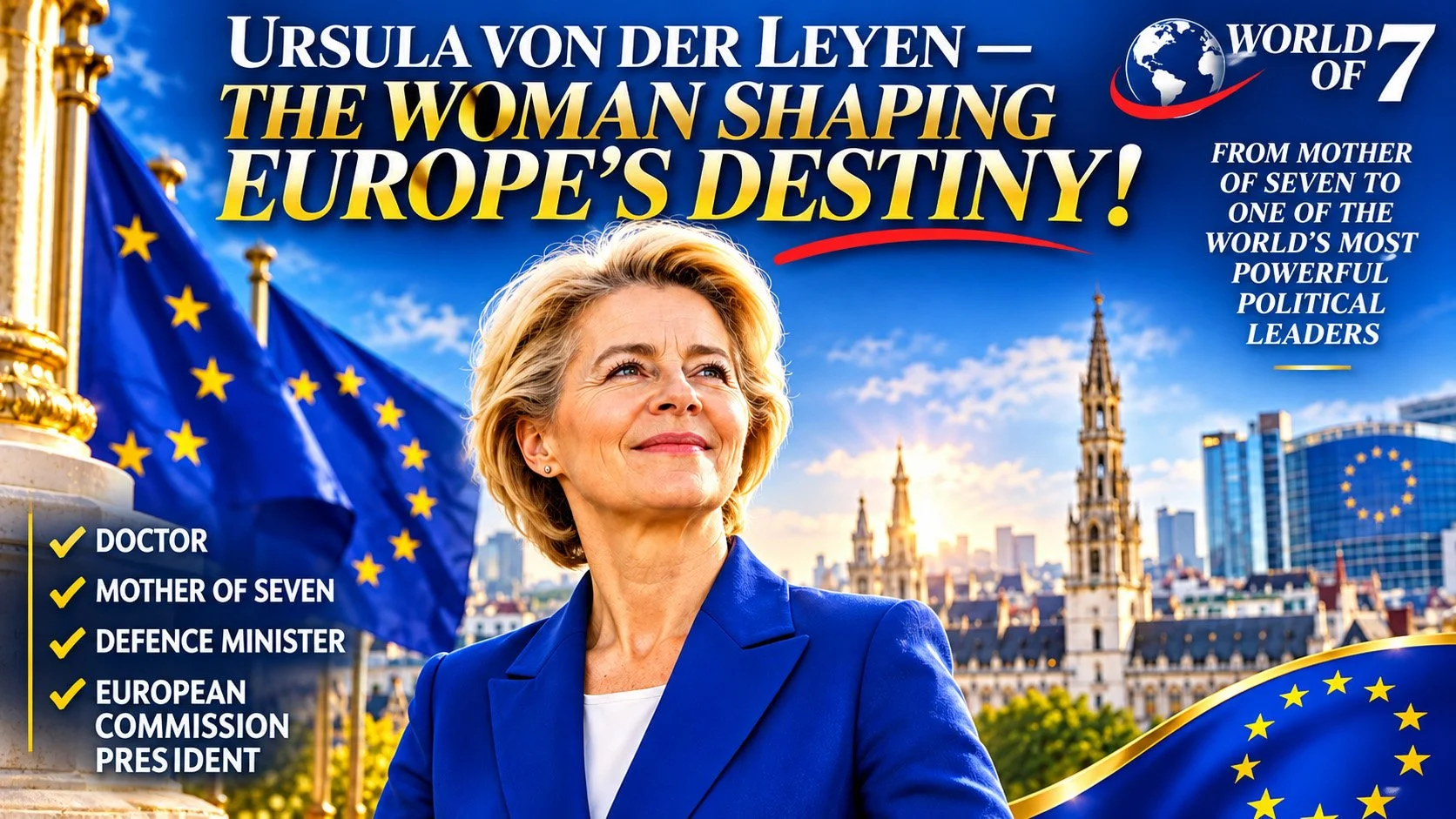
FROM MOTHER OF SEVEN TO ONE OF THE WORLD’S MOST POWERFUL POLITICAL LEADERS
By Publisher Ray Carmen
She began her professional life as a doctor, raised seven children and rose through German politics to become the first woman to lead the European Commission. Today, Ursula von der Leyen stands at the centre of Europe’s most consequential political decisions. But who is the woman behind the power, and what future does she envision for a continent facing extraordinary challenges?
A WOMAN WITH EUROPE IN HER BLOOD
Born in Brussels on 8 October 1958, Ursula von der Leyen grew up surrounded by the political institutions that would eventually shape her extraordinary career.
Her father, Ernst Albrecht, was a senior European civil servant who later became Minister-President of the German state of Lower Saxony.
Her upbringing reflected the increasingly international character of post-war Europe.
She studied economics before pursuing medicine, eventually qualifying as a physician.
Long before entering the highest levels of European politics, she worked in the medical profession and academic research.
Yet her life was never confined to hospitals, universities or government offices.
She and her husband, Heiko von der Leyen, raised seven children.
Balancing family responsibilities with a demanding professional career became an important part of her public identity.
Her eventual political rise would challenge assumptions about the opportunities available to women in European leadership.
FROM MEDICINE TO THE CORRIDORS OF POWER
Von der Leyen entered politics through Germany’s Christian Democratic Union, the centre-right party associated with former Chancellor Angela Merkel.
Her ascent was remarkable.
In 2005, she became Germany’s Federal Minister for Family Affairs, Senior Citizens, Women and Youth.
Four years later, she took responsibility for labour and social affairs.
In 2013, she made history as Germany’s first female Minister of Defence.
The defence portfolio placed her at the centre of debates about military preparedness, international security and Germany’s responsibilities within NATO.
Her years in Berlin provided experience across social policy, economic affairs and national security.
They also exposed her to criticism over defence procurement, military readiness and administrative decisions.
By 2019, however, she had become one of Germany’s most internationally recognised political figures.
Then came the appointment that transformed her career.
THE FIRST WOMAN TO LEAD THE EUROPEAN COMMISSION
In July 2019, the European Parliament elected Ursula von der Leyen President of the European Commission.
It was a historic milestone.
For the first time, a woman would lead the institution responsible for proposing European Union legislation, coordinating major policies and helping ensure that EU law is implemented.
Her appointment carried enormous symbolic significance.
The European Union had been shaped for decades by predominantly male political leadership.
Von der Leyen’s arrival represented a visible change.
But her position also came with formidable responsibilities.
The European Commission operates within a complex political system involving 27 member states, the European Parliament and the European Council.
Its president does not govern Europe alone.
Instead, she must negotiate, persuade and build support among national governments and elected representatives.
That makes European leadership an exercise in diplomacy as much as political authority.
A SECOND TERM — AND A NEW EUROPEAN CHAPTER
In July 2024, the European Parliament supported von der Leyen’s re-election with 401 votes.
Her second Commission began its mandate on 1 December 2024, with a term extending to 2029.
Her renewed presidency came at a time when Europe faced mounting pressure to strengthen its economy, security and international influence.
The Commission’s priorities include industrial competitiveness, defence, social fairness, environmental resilience, democratic institutions and international partnerships.
Von der Leyen has argued that Europe must become more capable of protecting its interests while remaining committed to cooperation and democratic values.
Yet ambitious policy announcements are only the beginning.
Actual results depend on agreements between European institutions and national governments.
The central question is whether Europe’s leaders can translate their promises into improvements felt by citizens and businesses.
EUROPE THROUGH CRISIS AFTER CRISIS
Few European Commission presidents have faced such a succession of major international emergencies.
During von der Leyen’s first term, Europe confronted the COVID-19 pandemic, severe economic disruption, Russia’s full-scale invasion of Ukraine and an energy crisis.
The Commission played an important role in coordinating vaccine procurement, economic recovery measures, sanctions and support for Ukraine.
Supporters argue that these crises demonstrated the value of European cooperation.
They point to collective action as evidence that the European Union can respond more effectively when its member states work together.
Critics, however, question whether Brussels sometimes exercises too much influence over decisions that should remain closer to national governments.
They also raise concerns about the financial and regulatory consequences of European policies for businesses, farmers and households.
These competing perspectives remain central to debates about the future direction of the Union.
THE WOMAN BEHIND THE POLITICAL OFFICE
Beyond the official speeches, international summits and political negotiations stands a woman whose personal journey has been unusually varied.
Von der Leyen has been a physician, mother, government minister, defence chief and European Commission president.
Her career has unfolded across different countries, institutions and professional disciplines.
The experience of raising seven children while pursuing demanding public responsibilities has become one of the most frequently discussed aspects of her biography.
But her achievements should not be understood solely through motherhood.
Her political career reflects decades of work, party relationships, administrative experience and the ability to navigate complex institutions.
Her rise also illustrates the changing role of women in European public life.
A generation ago, the prospect of a woman leading the European Commission would have appeared far less likely.
Today, female leadership is increasingly visible across European institutions.
Nevertheless, significant inequalities remain in political representation, business leadership and economic opportunity.
POWER, TRANSPARENCY AND ACCOUNTABILITY
No examination of von der Leyen’s leadership would be complete without considering the controversies surrounding her presidency.
One of the most prominent concerns involved access to communications relating to COVID-19 vaccine negotiations.
In May 2025, the European Union’s General Court annulled the Commission’s refusal to disclose text messages exchanged between von der Leyen and Pfizer’s chief executive.
The judgment concerned transparency and public access to institutional documents.
It did not establish personal criminal wrongdoing.
The controversy nevertheless intensified debate about accountability within European institutions.
In July 2025, a motion of censure against her Commission was defeated in the European Parliament.
For supporters, her leadership has demonstrated resilience during unprecedented crises.
For critics, the controversies underline the need for greater openness and institutional scrutiny.
Both perspectives form part of the wider democratic debate about how Europe should be governed.
CAN EUROPE BECOME STRONGER?
The challenges facing von der Leyen during her second mandate extend far beyond Brussels.
Europe must navigate difficult relationships with major international powers, respond to technological competition and address concerns about economic growth.
Energy security, defence spending, migration and climate policy remain major political issues.
The rapid development of artificial intelligence is also transforming the global economic landscape.
European governments must consider how to encourage innovation while protecting citizens, businesses and democratic institutions.
Von der Leyen’s challenge is to help create a Union capable of competing internationally without sacrificing the principles on which European cooperation was founded.
Whether she succeeds will depend not simply on speeches or political ambition, but on measurable outcomes.
A WOMAN WHO CHANGED THE FACE OF EUROPEAN LEADERSHIP
Whatever judgments historians eventually make about her policies, Ursula von der Leyen has already secured a distinctive place in European political history.
She became Germany’s first female defence minister.
She became the first woman to lead the European Commission.
And she secured a second mandate at a time of profound international uncertainty.
Her story illustrates how political careers can develop through unexpected pathways.
Medicine led to public service.
Public service led to national government.
National government opened the door to European leadership.
Her journey also offers a broader lesson about the changing opportunities available to women in positions of authority.
THE WORLD OF 7 VERDICT
Ursula von der Leyen is neither Europe’s monarch nor its sole political decision-maker.
She is the president of an institution whose influence extends across a continent and into the wider world.
Her achievements are substantial, her responsibilities immense and her decisions frequently contested.
The coming years will test whether her vision of a stronger, more competitive and secure European Union can become reality.
For a woman who began her career caring for patients and went on to raise seven children while navigating the demands of public life, the journey has been extraordinary.
But history will ultimately judge her not simply by the offices she has held.
It will judge her by the Europe she helps leave behind.
FROM THE FAMILY HOME TO THE HEART OF EUROPEAN POWER — URSULA VON DER LEYEN’S MOST IMPORTANT CHAPTER MAY STILL BE AHEAD.