
SCIENTISTS UNCOVER EVIDENCE OF A VAST WATER RESERVOIR DEEP INSIDE EARTH — POSSIBLY HOLDING THREE TIMES THE WATER IN ALL OUR OCEANS!
By Publisher Ray Carmen
Imagine an extraordinary world hidden hundreds of kilometres beneath our feet. A world where immense quantities of water are locked inside rock, far beyond the reach of sunlight, submarines or human exploration. Scientists have uncovered compelling evidence that Earth’s interior may contain more water than all the oceans on its surface combined.
For centuries, humanity has gazed towards the heavens in search of undiscovered worlds.
We have sent spacecraft towards distant planets, explored the deepest ocean trenches and developed instruments capable of detecting galaxies billions of light-years away.
Yet one of the greatest mysteries of our own planet lies directly beneath us.
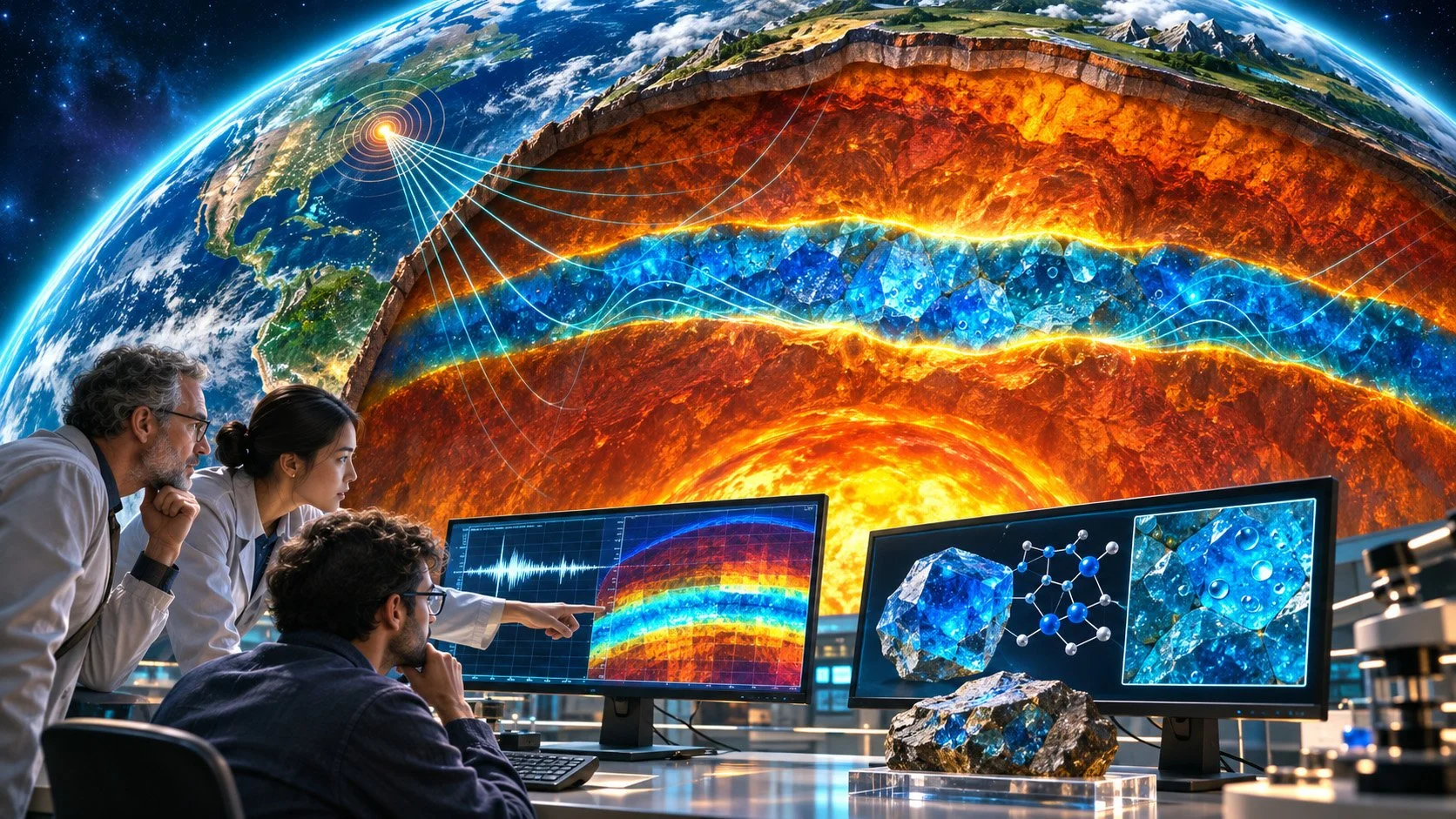
Deep within Earth’s mantle, scientists have discovered evidence of water trapped inside minerals under extraordinary pressures and temperatures.
And the quantity could be astonishing.
Some scientific estimates suggest that a water-rich region deep inside Earth could hold the equivalent of several times the volume of all the world’s surface oceans.
But this is no ordinary underground sea.
It is something far more extraordinary.
THE DISCOVERY THAT CHANGED OUR UNDERSTANDING OF EARTH
The story centres on a remarkable mineral called ringwoodite.
Ringwoodite forms under the immense pressures found deep within Earth’s mantle.
Unlike ordinary rocks, its crystal structure can incorporate hydrogen in a form that scientists describe as water stored within the mineral.
This means the water is not flowing through underground rivers or collecting in enormous caves.
Instead, it is chemically bound within the structure of solid rock.
The discovery has fundamentally changed scientific thinking about how water is distributed throughout our planet.
In 2014, researchers reported evidence that Earth’s mantle transition zone, approximately 410 to 660 kilometres beneath the surface, could contain substantial quantities of water.
The findings attracted worldwide attention because they suggested that Earth’s water cycle might extend far deeper than previously understood.
THREE TIMES THE WORLD’S OCEANS?
The most sensational claim associated with this research is that Earth’s mantle could contain three times as much water as all the oceans combined.
But what does that actually mean?
Scientists have calculated that if certain minerals throughout the mantle transition zone contained sufficient water, the total could potentially equal several ocean volumes.
However, this is an estimate of possible storage capacity, not proof that a single underground reservoir containing three oceans has been discovered.
The actual quantity remains uncertain.
What researchers have established is that minerals deep within Earth can store significant amounts of water under extreme conditions.
That alone represents a remarkable scientific discovery.
Consider the scale.
The Pacific Ocean is the largest ocean on Earth.
The Atlantic stretches between the Americas, Europe and Africa.
The Indian Ocean connects Africa, Asia and Australia.
Together with the Southern and Arctic Oceans, they cover more than 70 per cent of Earth’s surface.
Now imagine the possibility that comparable quantities of water are hidden within the rocks beneath our feet.
It is an extraordinary thought.
HOW DID SCIENTISTS FIND WATER SO DEEP UNDERGROUND?
No human being has travelled anywhere close to the mantle transition zone.
Even the deepest scientific boreholes penetrate only a tiny fraction of the distance.
Instead, researchers rely on evidence from earthquakes, laboratory experiments and minerals carried towards Earth’s surface by geological processes.
Earthquakes generate seismic waves that travel through the planet.
As those waves pass through different materials, their speed and behaviour change.
By studying these variations, scientists can identify regions where the physical properties of rocks differ.
Researchers have also reproduced the enormous pressures and temperatures of the mantle in laboratories.
These experiments demonstrate that ringwoodite can store water within its crystal structure.
One particularly important discovery involved a tiny sample of ringwoodite trapped inside a diamond originating from deep within Earth.
Analysis provided direct evidence that water-bearing minerals exist in the mantle transition zone.
Together, these findings have strengthened the scientific case for substantial quantities of water within Earth’s interior.
THE CARIBBEAN CONNECTION — A REGION SHAPED BY EARTH’S HIDDEN FORCES
For the Caribbean, the discovery provides a fascinating new perspective on the geological forces that created one of the world’s most beautiful regions.
The Caribbean archipelago owes much of its existence to the movement and interaction of tectonic plates.
Volcanic activity helped create islands including Dominica, Saint Lucia, Saint Vincent, Montserrat and several others.
The region also contains active submarine volcanic systems and complex geological boundaries.
These processes are connected to the movement of heat, minerals and water through Earth’s interior.
When oceanic tectonic plates descend beneath other plates, they carry water-bearing minerals into the planet.
As pressure and temperature increase, some of that water is released.
This can contribute to melting processes that generate magma and feed volcanic systems.
Water therefore plays a significant role in the geological activity that has shaped the Caribbean.
However, the deep mantle water identified in ringwoodite should not be confused with an accessible underground ocean beneath the Caribbean.
The connection is geological: the movement of water through Earth’s interior influences the processes responsible for volcanoes, earthquakes and the formation of islands.
COULD THIS WATER EVER REACH THE SURFACE?
Water continuously moves between Earth’s surface and interior over geological timescales.
Some water enters the mantle when tectonic plates descend into the Earth.
Some eventually returns through volcanic activity and other geological processes.
This is sometimes called the deep water cycle.
Unlike the familiar water cycle involving evaporation, clouds, rainfall and rivers, the deep water cycle operates over immense periods.
It may take millions of years for water-bearing material to move through parts of Earth’s interior.
Scientists are still investigating how much water travels through this system and how the balance has changed throughout Earth’s history.
The research may also help explain why Earth possesses such abundant surface water compared with many other rocky worlds.
DOES THIS MEAN THE WORLD WILL NEVER RUN OUT OF WATER?
Unfortunately, no.
The discovery does not provide humanity with a new supply of drinking water.
Water trapped hundreds of kilometres beneath Earth’s surface cannot be extracted using existing technology.
Even if it could, the temperatures, pressures and geological consequences would present extraordinary obstacles.
The world’s freshwater challenges remain very real.
Drought, pollution, groundwater depletion, population growth and climate change continue to threaten water security.
The existence of water-bearing minerals deep within the mantle does nothing to eliminate those problems.
The discovery is scientifically important because it helps explain Earth’s geological evolution, not because it offers an unlimited new water supply.
COULD OTHER PLANETS HAVE HIDDEN WATER?
Perhaps the most exciting implications extend beyond Earth.
If minerals can store substantial quantities of water deep inside our planet, scientists must consider whether similar processes operate elsewhere.
Rocky planets may possess hidden reservoirs of water within their interiors.
The ability of minerals to store and transport water could influence volcanic activity, planetary evolution and potentially the conditions necessary for life.
Mars, for example, shows abundant evidence of water in its ancient history.
Researchers continue investigating where that water went and how much may remain trapped beneath its surface or within minerals.
Understanding Earth’s deep water cycle could therefore help scientists interpret the geological histories of other planets.
The discovery reminds us that searching for water in space does not always mean looking for visible oceans.
Sometimes the most important clues are hidden inside rock.
THE MYSTERY IS FAR FROM SOLVED
Despite the excitement, major questions remain.
Scientists still do not know precisely how much water is stored throughout Earth’s mantle.
They continue debating how evenly it is distributed, how it moves between geological layers and how its presence affects the planet’s behaviour.
The famous three-oceans figure remains a theoretical possibility rather than a measured global total.
Nevertheless, the evidence for water-bearing minerals deep within Earth is substantial.
And that evidence has transformed our understanding of the planet.
THE FINAL WORD — A PLANET STILL FULL OF SECRETS
Humanity has spent centuries exploring the oceans.
We have sailed across the Atlantic, crossed the Pacific, discovered remote islands and mapped enormous stretches of the seabed.
Yet beneath every continent, every mountain and every Caribbean island lies an interior world we are only beginning to understand.
A world of crushing pressure, extraordinary heat and minerals capable of storing astonishing quantities of water.
The discovery of water deep within Earth’s mantle is a reminder that our planet remains one of the greatest unexplored frontiers in the universe.
Perhaps the most extraordinary revelation is not that Earth may contain more water than we ever imagined.
It is that, after thousands of years of human exploration, we are still discovering what lies beneath our own feet.
WE SEARCH THE UNIVERSE FOR HIDDEN WORLDS — WHILE ONE OF THE GREATEST MYSTERIES OF ALL LIES DEEP INSIDE OUR OWN PLANET.