
THE BHAGAVAD GITA — ETERNAL WISDOM FOR THE MODERN WORLD
By Publisher Ray Carmen
More than two thousand years after its words first entered human consciousness, The Bhagavad Gita remains one of the world’s most profound works of spiritual wisdom.
It is a book born not in the silence of a monastery, but on a battlefield.
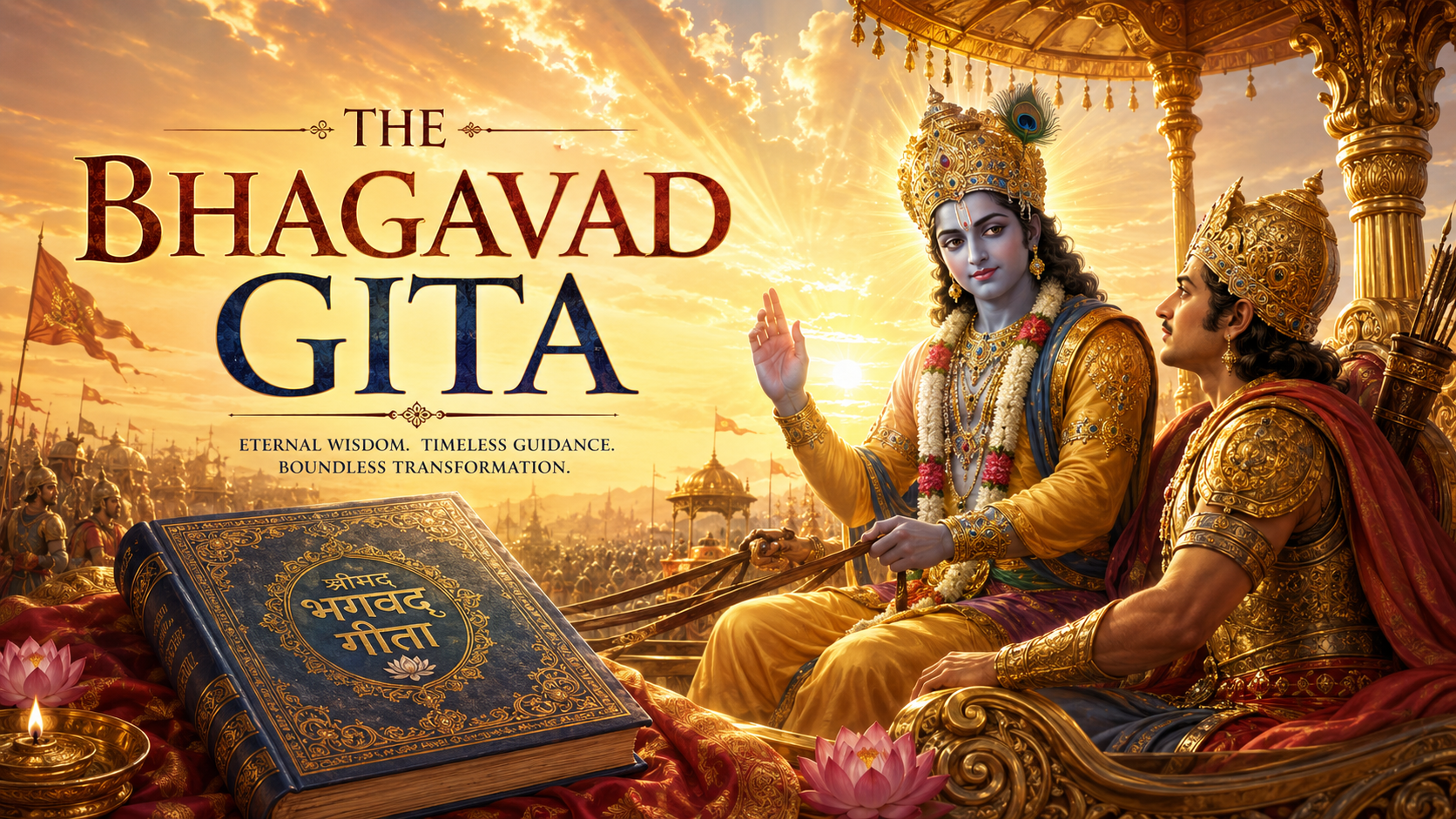
At Kurukshetra, with two great armies preparing for war, the warrior prince Arjuna looks across the field and sees teachers, friends and relatives among those he may have to fight. Suddenly overwhelmed by grief and doubt, he lowers his bow.
He no longer knows what is right.
Beside him stands his charioteer — Lord Krishna.
What follows is one of civilisation’s great conversations: a dialogue about life and death, courage and fear, duty and conscience, action and consequence, the human soul and the search for the Divine.
THE GREAT CONVERSATION
The Bhagavad Gita — meaning “Song of the Lord” — forms part of the great Sanskrit epic, the Mahabharata.
Across its 18 chapters and approximately 700 verses, Krishna guides Arjuna through questions that remain extraordinarily familiar today.
What should we do when every choice seems difficult?
How do we remain calm when the world around us is in turmoil?
What is our duty?
What is success?
Who are we beyond our possessions, status and physical bodies?
And perhaps most importantly: how should a human being live?
These are not merely ancient questions.
They are eternal ones.
DO YOUR DUTY — BUT DO NOT BECOME A PRISONER OF THE RESULT
One of the Gita’s most celebrated teachings concerns action without attachment.
Human beings must act. We must work, make decisions, accept responsibilities and confront difficulties.
But Krishna teaches that we should not allow ourselves to become consumed by the rewards of our actions.
Do your work properly.
Give it everything you have.
Act with integrity.
Then accept that the final outcome may not always be yours to control.
It is a lesson with extraordinary relevance to modern life, where people are constantly measured by wealth, position, popularity, followers, targets and possessions.
The Gita offers another measure:
Was the action right? Was it honourable? Was it performed with sincerity?
THE POWER OF DHARMA
Central to the Bhagavad Gita is the idea of dharma — righteous duty, moral responsibility and the path one is called upon to follow.
For Arjuna, the problem is agonising because his responsibilities appear to conflict with his emotions.
Krishna does not promise him an easy life.
Instead, he teaches him to see beyond fear and temporary emotion and to understand the deeper responsibility before him.
The message is powerful: sometimes doing what is right may be harder than doing what is comfortable.
Character is often revealed precisely at those moments.
THE SOUL BEYOND THE BODY
The Gita also teaches that the deepest self — the Atman — is not destroyed when the physical body dies.
The body changes.
Youth becomes age.
Possessions come and go.
Fortunes rise and fall.
But the spiritual self is described as enduring beyond these temporary conditions.
For generations, this teaching has given millions of people a different way of thinking about mortality.
Death is not presented simply as an ending, but as part of a much greater spiritual journey.
MANY PATHS TOWARD THE DIVINE
One of the great strengths of the Bhagavad Gita is that it does not offer only one route toward spiritual understanding.
It explores several.
There is Karma Yoga — the path of selfless action.
There is Bhakti Yoga — the path of devotion and love for God.
There is Jnana Yoga — the path of knowledge and understanding.
And there is disciplined meditation and mastery of the mind.
Different people possess different temperaments, talents and callings.
Yet the destination is ultimately the same: liberation from ignorance, selfishness and attachment, and a deeper understanding of the Divine.
MASTERING THE MIND
Anyone living in the frantic modern world may recognise another of the Gita’s great challenges: the restless mind.
Our surroundings have changed dramatically since the ancient world.
We have smartphones, aircraft, artificial intelligence, instant communication and extraordinary technology.
Yet human anxiety, jealousy, anger, ambition, fear and uncertainty remain remarkably familiar.
The Bhagavad Gita teaches that the uncontrolled mind can become our enemy — while a disciplined mind can become one of our greatest allies.
The goal is not indifference.
It is balance.
To experience success without arrogance.
Failure without destruction.
Pleasure without addiction.
Difficulty without surrender.
And change without losing ourselves.
COURAGE IN THE FACE OF LIFE
The image of Arjuna lowering his bow has endured because nearly everyone experiences an “Arjuna moment.”
A moment when confidence disappears.
A moment when responsibility feels too heavy.
A moment when we ask:
Can I really do this?
Krishna's answer is not simply an instruction to fight.
It is an invitation to understand.
Understand who you are.
Understand why you act.
Understand what is temporary and what is lasting.
Then act courageously and with wisdom.
FROM INDIA TO THE WORLD
Although profoundly rooted in Hindu philosophy and Indian civilisation, the Bhagavad Gita has travelled far beyond India.
It has been translated into languages across the world and studied by philosophers, spiritual teachers, political leaders, writers, scholars and ordinary readers seeking answers to life's biggest questions.
Its international appeal is easy to understand.
The scenery is ancient India.
The questions belong to humanity.
A BOOK FOR TROUBLED TIMES
Perhaps this explains why the Bhagavad Gita remains so compelling today.
Our century is filled with extraordinary opportunities — but also conflict, uncertainty, competition and constant distraction.
The Gita does not pretend that life will always be peaceful.
Its great conversation takes place with armies waiting.
Instead, it asks something far more practical:
Can we find peace within ourselves even when the world around us is unsettled?
Can we act without hatred?
Can we fulfil our responsibilities without becoming slaves to ambition?
Can knowledge overcome fear?
Can devotion overcome despair?
Can human beings discover something eternal within a constantly changing world?
More than two millennia later, those questions have lost none of their power.
THE ETERNAL SONG
At the beginning of the Bhagavad Gita, Arjuna is paralysed by doubt.
By its conclusion, he is transformed by understanding.
That transformation is the heart of the work.
The Bhagavad Gita does not tell humanity that there will never be battles.
Sometimes the battlefield is outside us.
Sometimes it is within us.
Its enduring message is that wisdom, courage, discipline, devotion and righteous action can guide us through both.
That is why this ancient Song of the Lord continues to speak to generation after generation.
The battlefield may change.
The world may change.
Humanity may change.
But the search for purpose, truth and inner peace remains eternal.
And perhaps that is the greatest wisdom of the Bhagavad Gita.