
SEPTEMBER 11, 2001 — 25 YEARS ONTHE DAY THE WORLD CHANGED
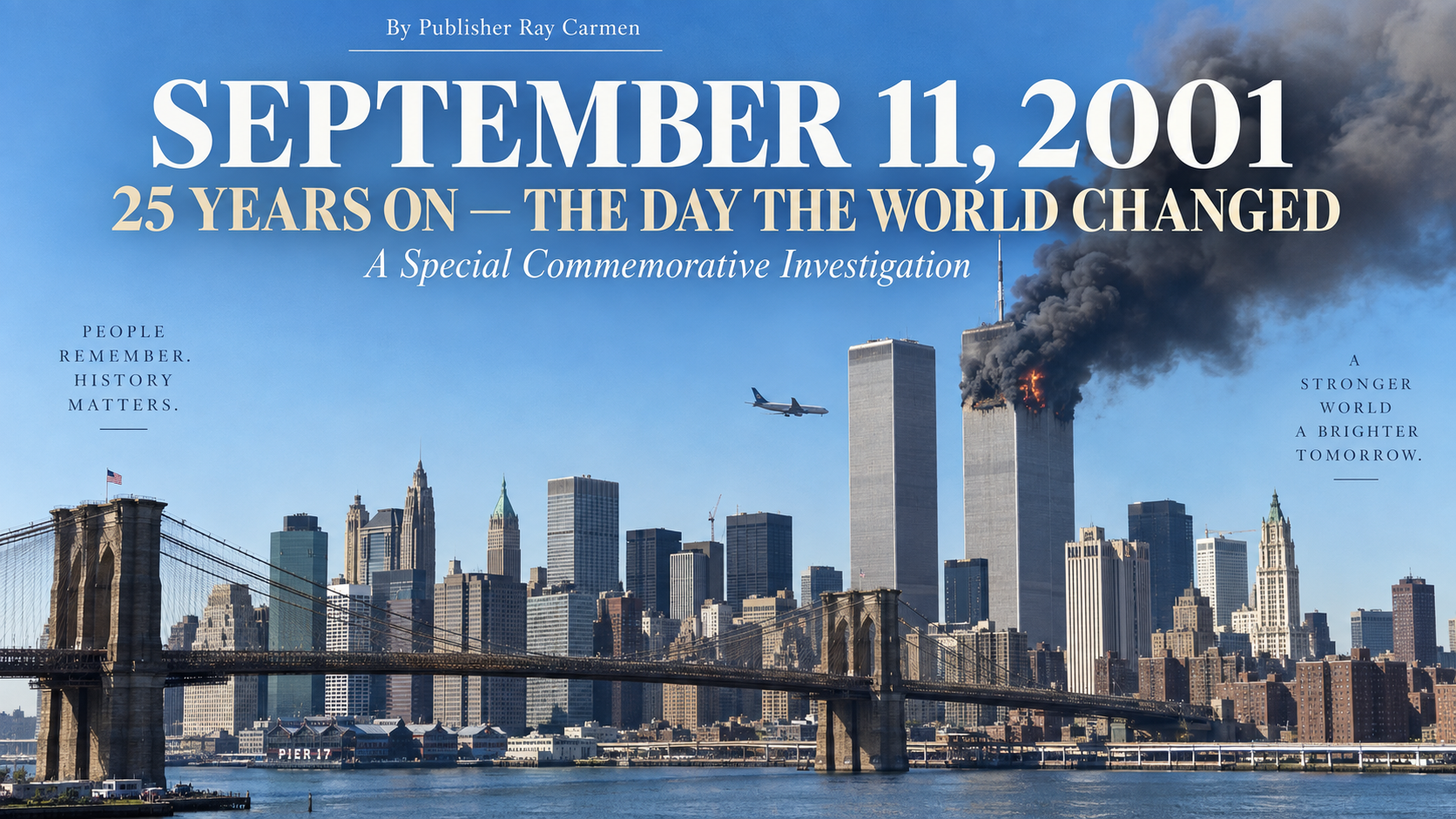
WHY DID IT HAPPEN? WHAT WAS MISSED? WHO HELPED TWO OF THE HIJACKERS SETTLE IN AMERICA — AND WHAT QUESTIONS STILL REMAIN?
By Publisher Ray Carmen
A WORLD OF 7 SPECIAL COMMEMORATIVE INVESTIGATION
Twenty-five years ago, on an extraordinarily clear Tuesday morning, millions of people watched something almost unimaginable unfold above New York.
At 8:46 a.m. on September 11, 2001, American Airlines Flight 11 was deliberately flown into the North Tower of the World Trade Center.
Seventeen minutes later, at 9:03 a.m., United Airlines Flight 175 struck the South Tower.
At 9:37 a.m., American Airlines Flight 77 struck the Pentagon.
At 9:59 a.m., the South Tower collapsed.
At 10:03 a.m., after passengers and crew fought back against the hijackers, United Airlines Flight 93 crashed near Shanksville, Pennsylvania.
At 10:28 a.m., the North Tower collapsed.
By the end of that terrible morning, 2,977 people from more than 90 nations had been killed.
But twenty-five years later, remembering what happened is only part of the story.
The question that continues to hang over September 11 is the most fundamental one of all:
WHY?
THE ROAD TO 9/11
September 11 did not begin on September 11.
Eight years earlier, on February 26, 1993, terrorists detonated a massive truck bomb beneath the World Trade Center.
Six people were killed and more than 1,000 injured.
The FBI later said mastermind Ramzi Yousef had intended the explosion to bring one tower crashing into the other. That failed. But Yousef's uncle, Khalid Sheikh Mohammed, would later become the principal architect of al-Qaeda's aircraft plot that succeeded in destroying both towers in 2001.
By the late 1990s, Osama bin Laden and al-Qaeda had openly turned their attention towards the United States.
Bin Laden's rhetoric drew upon a mixture of extremist religious ideology and political grievances. He railed against the presence of American troops in Saudi Arabia, American policies in the Middle East and American support for Israel.
But grievance does not explain or excuse terrorism.
Al-Qaeda transformed those political complaints into an extremist doctrine that deliberately sanctioned mass murder of civilians.
The 9/11 Commission concluded that bin Laden had created an organisation capable of recruiting, training and deploying terrorists internationally from the sanctuary then provided by Taliban-controlled Afghanistan.
WHY THE TWIN TOWERS?
The targets were no accident.
The World Trade Center represented the extraordinary commercial and financial power of the United States.
The Pentagon represented American military power.
The White House and the US Capitol were also considered as targets while the plot was being developed. The 9/11 Commission found that bin Laden, Khalid Sheikh Mohammed and senior al-Qaeda figures personally discussed the targets for what became known as the “planes operation.”
The terrorists were therefore attacking more than buildings.
They were attacking symbols.
And they understood something chillingly modern: an act witnessed instantaneously on television around the planet could generate fear far beyond the physical location of the attack.
September 11 was terrorism designed for a global audience.
THE WARNING LIGHTS WERE FLASHING
Perhaps the most disturbing part of the story is that the danger did not arrive without warning.
During the spring and summer of 2001, American intelligence agencies were receiving repeated indications that al-Qaeda was preparing something major.
CIA Director George Tenet later described the atmosphere memorably:
“The system was blinking red.”
On August 6, 2001 — only 36 days before the attacks — President George W. Bush received a Presidential Daily Brief carrying the extraordinary title:
“Bin Ladin Determined To Strike in US.”
The briefing referred to bin Laden's intention to bring violence into America and noted that al-Qaeda members had lived or travelled inside the country.
Yet the 9/11 Commission ultimately found that the fragments of warning were never assembled into a sufficiently effective domestic response. Agencies possessed pieces of the puzzle, but America lacked the imagination, information-sharing and institutional coordination required to see the completed picture in time.
That leaves one of history's most agonising questions:
COULD SEPTEMBER 11 HAVE BEEN PREVENTED?
There is no credible evidence that American authorities possessed a complete blueprint stating exactly what would happen on September 11.
But there were warnings.
There were suspects.
There were intelligence reports.
There were signs that al-Qaeda wanted to strike inside America.
And there were bureaucratic barriers that prevented separate pieces of intelligence from being brought together quickly enough.
Twenty-five years later, that failure remains one of the central lessons of 9/11.
THE TWO HIJACKERS — AND A QUESTION THAT HAS NEVER COMPLETELY DISAPPEARED
This is where the story remains particularly intriguing.
Two of the eventual hijackers, Nawaf al-Hazmi and Khalid al-Mihdhar, arrived in Los Angeles on January 15, 2000.
They spoke little English and had limited experience of Western life.
The original 9/11 Commission examined whether they had received assistance after entering America and acknowledged that it could not establish everything that happened during their first weeks in California.
Years later the FBI opened Operation Encore, specifically to investigate how the two men became established in Southern California.
Declassified FBI material identifies Omar al-Bayoumi and Fahad al-Thumairy as important figures in assistance provided to Hazmi and Mihdhar and says investigators examined a wider circle of contacts.
But one sentence in those FBI records is absolutely crucial:
It remained unclear whether any of the individuals involved had advance knowledge of 9/11 or knew the future hijackers' intended role in the attacks.
That distinction must never be lost.
Assisting two men with accommodation, contacts or everyday life is not automatically proof that somebody knew they were preparing mass murder.
And the original 9/11 Commission found no evidence that the Saudi government as an institution, or senior Saudi officials individually, funded al-Qaeda.
Nevertheless, the assistance network remains an area of continuing investigation and litigation.
A fresh Times investigation published on September 10, 2026, as America prepared to mark the 25th anniversary, returned to precisely this question and highlighted evidence and allegations that have emerged since the original Commission completed its work.
Twenty-five years later, some pieces of the puzzle therefore remain disputed or incomplete.
102 MINUTES
The North Tower stood for 102 minutes after being struck.
The South Tower survived for 56 minutes.
Within that tiny window of history occurred thousands of individual stories.
Office workers carried injured colleagues down smoke-filled stairways.
Strangers helped strangers.
Firefighters climbed upwards while thousands were coming down.
Police officers, paramedics and other emergency workers entered buildings from which others were desperately trying to escape.
Passengers aboard Flight 93, having learned through telephone calls what had happened in New York, resisted their hijackers.
Their aircraft crashed into an empty Pennsylvania field rather than reaching its intended target in Washington.
The enormous geopolitical story of September 11 should never obscure these smaller human stories.
Because ultimately 9/11 was not about buildings.
It was about people.
THEN AMERICA WENT TO WAR
The attacks produced consequences on a scale even the terrorists themselves could not physically have inflicted.
The United States invaded Afghanistan in October 2001 after the Taliban refused American demands concerning al-Qaeda and bin Laden.
The “War on Terror” expanded across continents.
Airport security was transformed.
Intelligence agencies were reorganised.
Surveillance powers grew dramatically.
Guantánamo Bay became synonymous with the detention of terrorism suspects.
The CIA established a secret detention and interrogation programme that became one of the most controversial chapters of America's response to September 11.
Former CIA officer John Kiriakou, interviewed by The Times for this week's anniversary coverage, became famous for publicly confirming the agency's use of waterboarding. The later US Senate investigation concluded that coercive interrogation did not produce the uniquely valuable intelligence that advocates had claimed.
And then came Iraq.
The United States and allies invaded Iraq in March 2003.
But it is important when looking back at the post-9/11 era to separate Iraq from responsibility for September 11.
The 9/11 Commission found no evidence that contacts between Saddam Hussein's Iraq and al-Qaeda had developed into a collaborative operational relationship responsible for attacks against America, and an immediate post-9/11 US government review found no compelling case that Iraq had planned or perpetrated September 11.
The debate over the wisdom and consequences of the Iraq War continues to this day.
DID 9/11 CHANGE AMERICA — OR THE WORLD?
Both.
Air travel changed.
Border controls changed.
Intelligence changed.
Wars followed.
Governments acquired new surveillance powers.
Muslim communities in numerous countries experienced suspicion and hostility despite having nothing whatsoever to do with al-Qaeda's crimes.
Foreign policy changed.
Politics changed.
The balance between liberty and security became one of the defining debates of the new century.
Even the psychological geography of cities changed. Before September 11, a skyscraper or aircraft could simply signify progress and modernity.
Afterwards, people saw vulnerability too.
That is why the reverberations of those 102 minutes can still be felt a quarter of a century later.
THE NOSTRADAMUS “TWINS OF YORK” PROPHECY — DID HE REALLY PREDICT 9/11?
One of the strangest stories to emerge after the attacks involved the sixteenth-century astrologer and writer Nostradamus.
Messages circulated around the world claiming he had predicted the destruction of two towers or “two brothers” in New York centuries before it happened.
The story is fascinating.
But it is not true.
The widely circulated passage was not written by Nostradamus.
An important portion originated with Canadian student Neil Marshall, who had written a deliberately vague mock prophecy in 1997 to demonstrate how easily supposed predictions could be interpreted after an event had happened. Additional wording was subsequently added as versions spread after September 11.
Other internet versions stitched together fragments of genuine Nostradamus verses while altering their dates and meanings.
So the famous “Twin Towers” or “Twins of York” prediction belongs to the history of 9/11 mythology — not to the writings of Nostradamus.
The real story is arguably even more revealing.
Within hours of one of the most documented events in human history, misinformation was already travelling around the planet.
That phenomenon would become another defining characteristic of the twenty-first century.
AND SO, 25 YEARS LATER — WHY?
Why did September 11 happen?
Because an extremist organisation led by Osama bin Laden developed an ideological war against the United States.
Because al-Qaeda obtained sanctuary, money, recruits and training.
Because a small number of men were prepared deliberately to murder thousands of strangers.
Because civil aviation security could be exploited.
Because warning signs existed but were fragmented across institutions.
Because the terrorists understood the immense psychological power of attacking globally recognised symbols in front of the world's cameras.
And because, despite years of previous terrorism, the United States had not yet imagined an attack quite like this one.
But there is another question.
DID THE TERRORISTS WIN?
They destroyed the Twin Towers.
They killed 2,977 innocent people.
They inflicted unimaginable grief.
They provoked wars costing enormous quantities of blood and treasure.
They changed security, politics and international relations for a generation.
Yet New York survived.
America survived.
The Pentagon was rebuilt.
Lower Manhattan rose again.
One World Trade Center now stands above the skyline.
Families continued.
Children were born.
Nations remembered.
And every September 11 the names of those who died are spoken again.
Perhaps that is the final answer.
Buildings can be destroyed.
Lives can be taken.
History can be scarred forever.
But terrorism cannot be allowed to own the memory of those it murdered.
THE TOWERS FELL. THE QUESTIONS DID NOT.
Twenty-five years after September 11, 2001, our responsibility is greater than simply remembering where we were when the aircraft struck.
We must understand why it happened.
We must examine what was missed.
We must distinguish evidence from speculation.
We must ask difficult questions of governments, intelligence agencies and history itself.
And above all, we must remember the men, women and children from more than 90 nations whose ordinary Tuesday morning became their last.
September 11 belongs to history.
Its lessons belong to the future.
NEVER FORGOTTEN.