
PRINCESS DIANA - THE PEOPLE’S PRINCESS AND HER ENDURING LEGACY
By Publisher Ray Carmen
From Kensington Palace to the Royal Albert Hall, the remarkable story of a princess whose compassion, elegance and humanity captured the hearts of millions.
THE PRINCESS WHO CAPTURED THE WORLD
Few women in modern history have commanded the affection, admiration and fascination that surrounded Diana, Princess of Wales.
Beautiful, elegant and extraordinarily compassionate, Princess Diana transformed the public image of the British monarchy and became one of the most recognised women in the world.
Yet her greatest achievement was not her royal status, her magnificent wardrobe or her appearances at glittering state occasions.
It was her remarkable ability to connect with ordinary people.
From hospital wards in London to humanitarian missions across continents, Diana possessed an instinctive understanding of human suffering and an extraordinary willingness to offer comfort.
She became known throughout the world as the People’s Princess.
Nearly three decades after her tragic death, her influence remains undiminished.
KENSINGTON PALACE — THE HOME OF A GLOBAL ICON
For many years, Kensington Palace in London was Diana’s home.
Situated beside the magnificent Kensington Gardens, the historic royal residence became closely associated with a woman whose life was followed by millions.
The surrounding neighbourhood, with its elegant Victorian architecture, beautiful gardens and internationally celebrated cultural institutions, provided the setting for many memorable moments in Diana’s life.
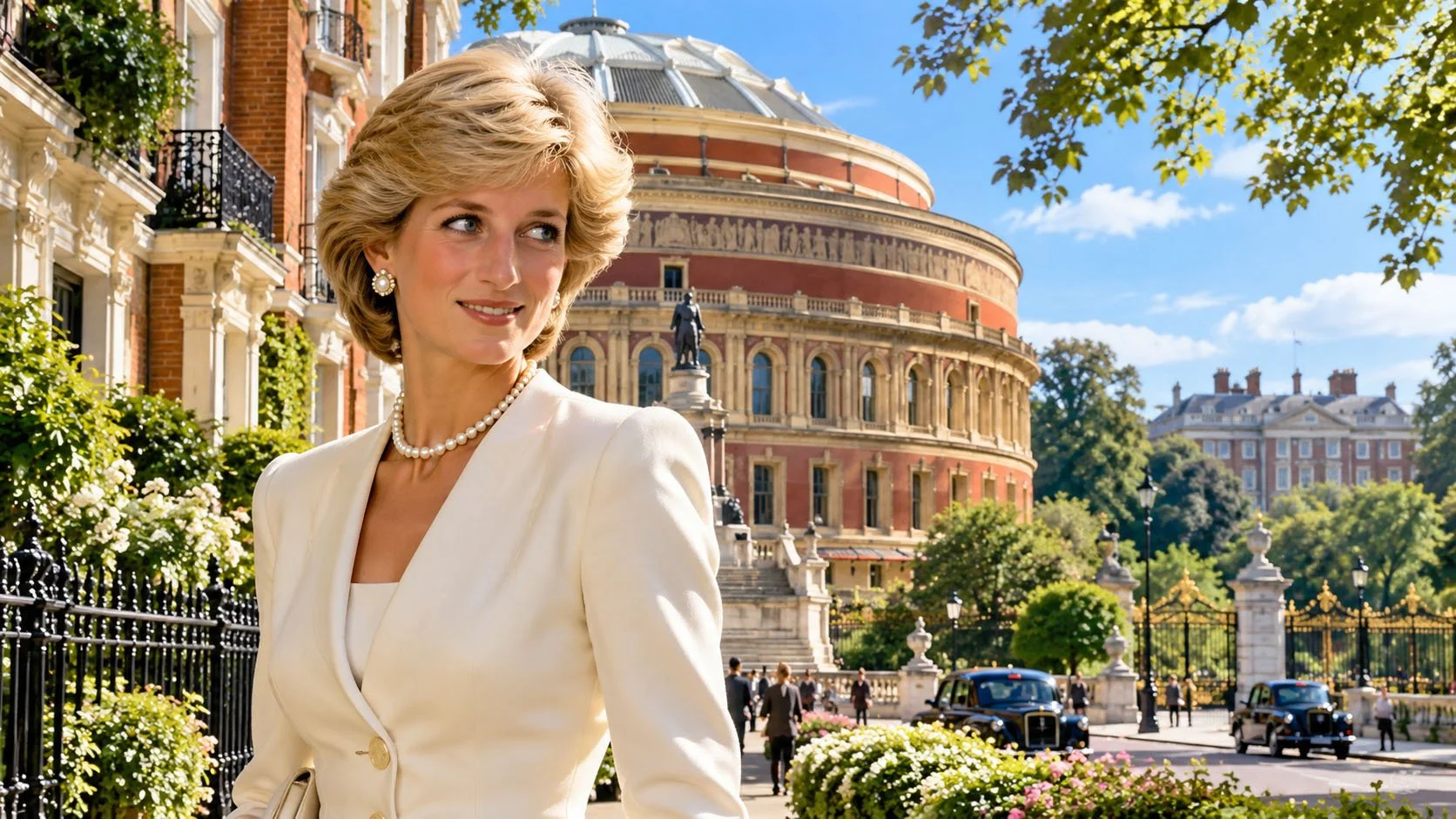
Among its most distinguished landmarks was the Royal Albert Hall, one of Britain’s greatest concert venues.
Just a short distance from Kensington Palace, the magnificent building hosted some of the world’s most celebrated musicians, performers and royal occasions.
It was a neighbourhood where British heritage, international culture and royal history met.
A REMARKABLE CONNECTION WITH CARIBBEAN WORLD MAGAZINE
In 1991, another story was beginning in the same distinguished London neighbourhood.
Caribbean World Magazine was established by Publisher Ray Carmen, with its offices at Albert Hall Mansions, immediately behind the Royal Albert Hall.
Kensington Palace, where Princess Diana lived, was approximately five minutes away on foot.
The coincidence of location and timing was remarkable.
While Diana was establishing herself as an increasingly independent international humanitarian figure, Caribbean World Magazine was beginning a publishing journey that would eventually extend across the Caribbean and beyond.
Both stories were unfolding against the magnificent architectural backdrop of Kensington.
For Caribbean World Magazine, 1991 would become the foundation of a publishing legacy.
For Princess Diana, it was a year of growing international prominence.
1991 — DIANA’S HISTORIC VISIT TO PAKISTAN
In September 1991, Princess Diana undertook her first official solo overseas royal tour, travelling to Pakistan.
It was an important milestone in her public life.
Without Prince Charles accompanying her, Diana demonstrated her ability to represent Britain independently on the international stage.
During the visit, she met political leaders, visited educational and welfare institutions and engaged with communities across the country.
Her appearances attracted enormous public interest.
Diana’s natural warmth, respect for local traditions and willingness to interact personally with people helped strengthen her international reputation.
Her visit to Pakistan marked the beginning of a particularly meaningful relationship with the country, which she would visit twice more during her lifetime.
THE HUMANITARIAN WHO CHANGED ROYAL TRADITION
Princess Diana understood that compassion could achieve what royal ceremony alone could not.
Her humanitarian activities took her into hospitals, hospices, shelters and communities affected by poverty and illness.
At a time when public misunderstanding surrounding HIV and AIDS remained widespread, Diana challenged prejudice by meeting patients with warmth and dignity.
Her willingness to hold hands with people living with HIV helped challenge the mistaken belief that the virus could be transmitted through ordinary physical contact.
She also became an influential campaigner against landmines.
In January 1997, she travelled to Angola, where her widely publicised visit to a landmine-affected area helped draw international attention to the devastating consequences of these weapons.
Her humanitarian work demonstrated that the influence of royalty could extend far beyond ceremonial responsibilities.
It could change attitudes and inspire action.
THE ROYAL ALBERT HALL — A LASTING MEMORY
One of Diana’s most memorable appearances during the final months of her life took place at the Royal Albert Hall.
On 3 June 1997, she attended a gala performance of Swan Lake by the English National Ballet.
Wearing an elegant pale-blue dress designed by Jacques Azagury, Diana captivated photographers and admirers.
Her appearance reflected the confidence and independence she had developed following her divorce from Prince Charles.
The occasion would become one of the defining images of her final summer.
Today, photographs from that evening remain among the most celebrated portraits of the Princess.
The Royal Albert Hall’s own historical archive preserves photographs of her arrival at the performance.
A PRINCESS WHO BELONGED TO THE WORLD
Diana’s popularity was never confined to Britain.
She was admired throughout Europe, Asia, Africa, the Americas and beyond.
Her international appeal crossed cultural, religious and national boundaries.
She was equally comfortable meeting heads of state and comforting a frightened child in hospital.
Her sense of style made her a global fashion icon, but her humanitarian commitments gave her influence a deeper meaning.
In Pakistan, she supported fundraising efforts for the Shaukat Khanum Memorial Cancer Hospital.
During visits in 1996 and 1997, she helped bring international attention to the hospital’s work and its mission of providing cancer treatment.
Her final visit to Pakistan took place in May 1997, only three months before her death.
THE TRAGEDY THAT SHOOK THE WORLD
On 31 August 1997, Princess Diana died following a car crash in Paris.
She was just 36 years old.
News of her death produced an extraordinary outpouring of grief.
Millions mourned a woman whom most had never met but felt they knew personally.
Outside Kensington Palace, flowers accumulated in enormous quantities as members of the public gathered to pay their respects.
Her funeral on 6 September 1997 was watched by vast audiences around the world.
The scale of public mourning demonstrated how deeply Diana had entered the hearts of people across generations and continents.
HER LEGACY LIVES ON
Princess Diana’s influence continues through the humanitarian causes she championed, the memories she created and the example she set.
Her sons, Prince William and Prince Harry, have both supported charitable causes associated with their mother’s legacy.
Her fashion remains influential, her photographs continue to attract worldwide attention, and documentaries and biographies regularly introduce her story to younger generations.
Yet perhaps her greatest legacy lies in something far simpler.
She demonstrated that kindness could be powerful.
That compassion could transcend privilege.
And that even the most famous woman in the world could make another person feel important through a simple gesture of understanding.
A KENSINGTON STORY THAT WILL NEVER FADE
For Caribbean World Magazine, the Kensington neighbourhood where its publishing journey began in 1991 will always hold special significance.
Albert Hall Mansions, the Royal Albert Hall and nearby Kensington Palace formed part of the landscape in which the magazine first took shape.
The proximity to Princess Diana’s home provides a poignant historical connection between the magazine’s beginnings and one of Britain’s most beloved royal figures.
Today, as Caribbean World Magazine continues its digital publishing journey and WORLD OF 7 reaches towards an international audience, those memories of Kensington remain part of its history.
Princess Diana may have departed this world far too early, but her remarkable legacy continues.
She was a princess by marriage.
A humanitarian by conviction.
And a woman whose humanity made her unforgettable.
Diana, Princess of Wales, will forever remain the People’s Princess.