
OMAN REACHES FOR THE STARS
By Publisher Ray Carmen
Private Space Investment Soars 270% as the Sultanate Builds a New High-Tech Frontier
A NEW CHAPTER IN OMAN’S EXTRAORDINARY JOURNEY
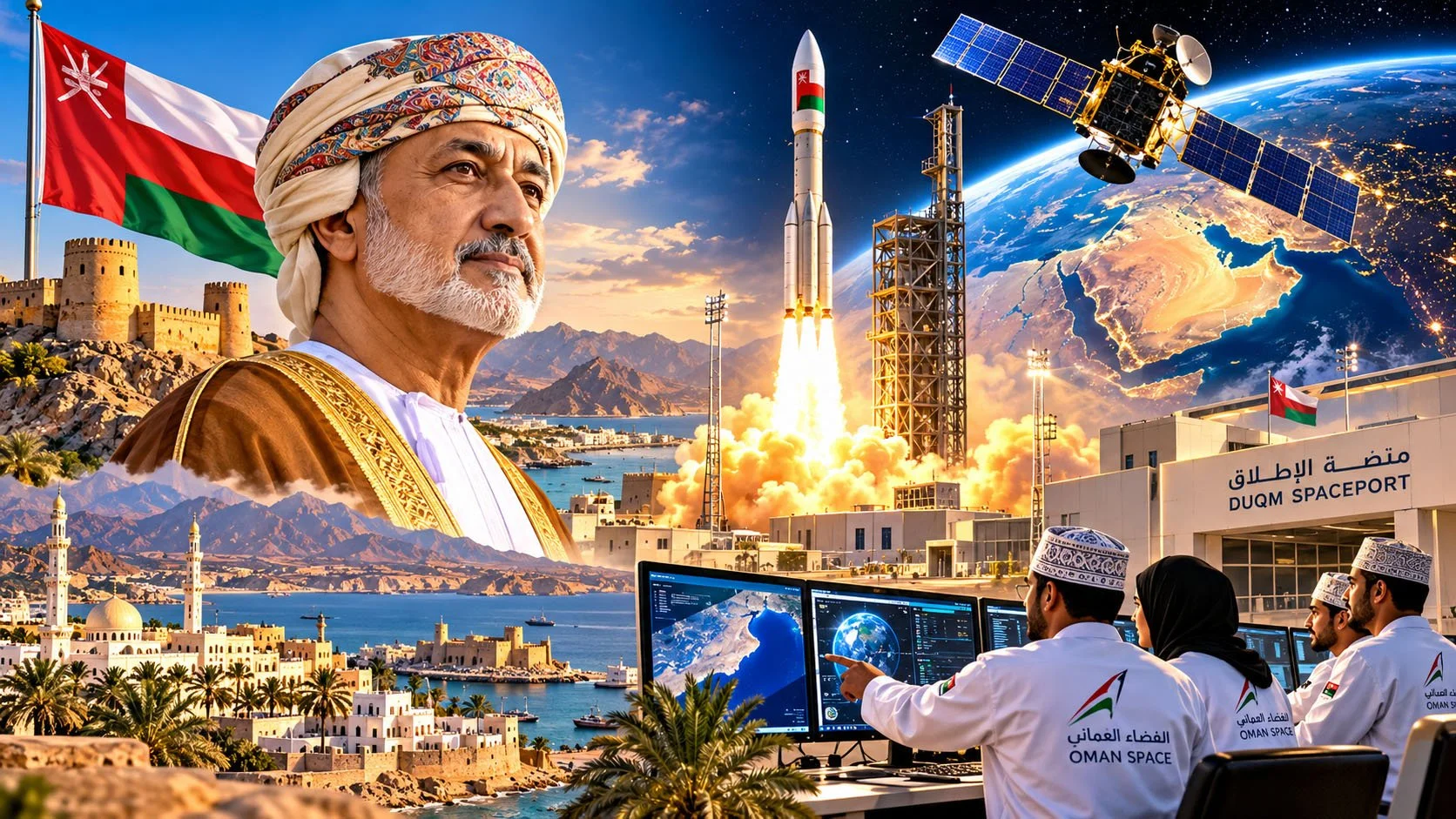
The Sultanate of Oman, celebrated for its magnificent mountains, golden deserts, ancient heritage and breathtaking coastline, is now setting its sights on an entirely new frontier — outer space.
In a remarkable demonstration of technological ambition, Oman’s private-sector investment in space activities has surged by 270 per cent, signalling the country’s determination to become an important participant in the rapidly expanding global space economy.
According to the National Space Programme Achievements Report 2023–2025, private investment increased from OMR 20 million in 2023 to OMR 74 million in 2025.
The figures represent more than an impressive financial achievement. They reflect a strategic transformation as Oman seeks to diversify its economy, develop advanced technologies and establish itself as a regional centre for space applications and services.
A 270 PER CENT INVESTMENT REVOLUTION
The growth of Oman’s space industry has been extraordinary.
In just three years, private-sector investment rose dramatically:
● 2023: OMR 20 million
● 2024: OMR 65 million
● 2025: OMR 74 million
The number of companies operating in the sector increased from 11 in 2023 to 26 in 2025, representing growth of approximately 136 per cent.
Employment across government and private space-related organisations rose from 152 to approximately 400 people during the same period.
These figures reveal an industry progressing beyond its initial development phase towards a more commercially active future.
For a nation traditionally associated with energy, maritime trade and tourism, the emergence of a growing space industry represents a significant new economic opportunity.
DUQM — OMAN’S GATEWAY TO SPACE
One of the most exciting developments is taking place in Duqm, the rapidly developing industrial and economic centre on Oman’s Arabian Sea coast.
Here, the Sultanate is developing infrastructure intended to support experimental rocket launches and future commercial space activities.
The Etlaq spaceport initiative aims to establish Duqm as a regional location for launch services, attracting international partnerships and specialised investment.
An experimental rocket launch took place in 2024, followed by further experimental activity in 2025.
The long-term ambition is to build the infrastructure, expertise and commercial partnerships required for a sustainable launch industry.
If successful, Duqm could become an important new destination in the Middle East’s emerging space economy.
OMANSAT-1 — A NATIONAL SATELLITE AMBITION
Another major milestone is OmanSat-1, the Sultanate’s planned national communications satellite.
In November 2025, Oman signed an agreement with Airbus Defence and Space covering the satellite’s design, manufacture and launch.
The project is intended to strengthen Oman’s communications infrastructure, improve connectivity and support the country’s digital economy.
OmanSat-1 is expected to provide communications coverage across Oman and surrounding regions, supporting government services, businesses and industries including aviation, maritime operations and energy.
The satellite is scheduled to begin operations in 2029.
Its development represents an important step towards greater national control over satellite communications infrastructure.
OMAN LENS-1 — ARTIFICIAL INTELLIGENCE MEETS SPACE
Oman’s ambitions extend beyond communications satellites.
In November 2024, the country launched Oman Lens-1, a satellite incorporating artificial intelligence and remote-sensing technology.
The project demonstrated the growing importance of combining satellite observations with advanced data processing.
Such technologies can support environmental monitoring, agricultural planning, urban development and natural-resource management.
For Oman, with its extensive coastline, mountainous terrain and desert landscapes, satellite-based observation offers potentially valuable practical applications.
It also creates opportunities for Omani engineers, scientists and technology companies to develop specialised expertise.
BUILDING A GENERATION OF OMANI SPACE SCIENTISTS
Behind the impressive investment figures lies an equally important ambition: developing national talent.
Oman’s space programme places considerable emphasis on education, research, engineering and entrepreneurship.
Specialised training programmes have introduced participants to satellite applications, artificial intelligence, remote sensing and advanced digital technologies.
The Oman Space Accelerator has been established to support emerging businesses developing space-related technologies and services.
At Sultan Qaboos University, the Space Engineering Laboratory project is helping develop capabilities in satellite engineering, research and technical training.
The programme also includes initiatives designed to introduce younger students to astronomy and space science.
These investments in education could prove as important as the satellites and launch facilities themselves.
A successful space industry requires not only financial resources but also generations of skilled scientists, engineers and innovators.
OMAN VISION 2040 — LOOKING BEYOND OIL
The development of Oman’s space industry forms part of a much wider national transformation.
Oman Vision 2040 seeks to strengthen economic diversification, encourage innovation, attract investment and create sustainable employment opportunities.
Space technology offers opportunities across several sectors.
Satellite communications can improve connectivity in remote areas.
Earth-observation systems can assist environmental protection and resource management.
Advanced data services can support agriculture, infrastructure, maritime operations and disaster preparedness.
Space-related research can also encourage innovation in artificial intelligence, robotics and advanced engineering.
The objective is not simply to launch rockets or satellites.
It is to create a commercially viable industry capable of contributing to the wider national economy.
THE GULF’S GROWING SPACE AMBITIONS
Oman’s progress comes as countries across the Gulf increasingly recognise the strategic and economic importance of space technology.
The United Arab Emirates has established an internationally recognised space programme, including its Mars exploration mission.
Saudi Arabia is expanding its involvement in space research, satellite technology and international cooperation.
Oman is developing its own position within this competitive regional landscape, with particular emphasis on commercial applications, infrastructure and private investment.
Rather than attempting to replicate every aspect of larger international space programmes, the Sultanate is focusing on areas where it can develop practical capabilities and attract specialised businesses.
Its geographical location, infrastructure ambitions and investment strategy could provide opportunities for future regional and international partnerships.
FROM THE ARABIAN SEA TO THE STARS
There is something particularly compelling about Oman’s emerging space ambitions.
For centuries, Omani navigators crossed the Indian Ocean, establishing trading relationships with distant lands and building a distinguished maritime heritage.
Today, the country is exploring a different kind of frontier.
Where its sailors once navigated by the stars, a new generation of Omani scientists and engineers is developing technologies designed to operate among them.
The transition from maritime exploration to space technology provides a powerful symbol of national ambition.
It also demonstrates how a country with a rich historical identity can embrace technological change without abandoning its cultural heritage.
THE FUTURE — A NEW SPACE ECONOMY
The coming years will be important for Oman’s space industry.
The development of OmanSat-1, the expansion of launch infrastructure at Duqm and the growth of satellite-related businesses will help determine whether the country’s early investment momentum can be sustained.
Challenges remain.
Space technology requires substantial capital, specialised expertise, effective regulation and long-term commercial demand.
International competition is intense, and not every proposed project will necessarily achieve its original timetable.
Nevertheless, the progress recorded between 2023 and 2025 demonstrates that Oman has moved beyond merely discussing its space ambitions.
It is developing infrastructure, attracting investment and building the foundations of a national industry.
THE WORLD OF 7 VERDICT
Oman’s emergence as an aspiring space-industry participant is one of the more intriguing developments in the Middle East’s technological transformation.
A 270 per cent increase in private-sector investment over two years is a significant achievement.
But the greater story lies in what that investment represents.
A nation renowned for its ancient forts, dramatic mountains, golden deserts and Arabian hospitality is preparing to participate in one of the world’s most advanced industries.
Oman is demonstrating that economic diversification can extend far beyond traditional sectors.
Its ambitions now encompass satellites, artificial intelligence, advanced engineering and the infrastructure required for future space exploration.
For the Sultanate, the journey is still in its early stages.
But the direction is unmistakable.
Oman is no longer content simply to admire the stars.
It is preparing to reach for them.