
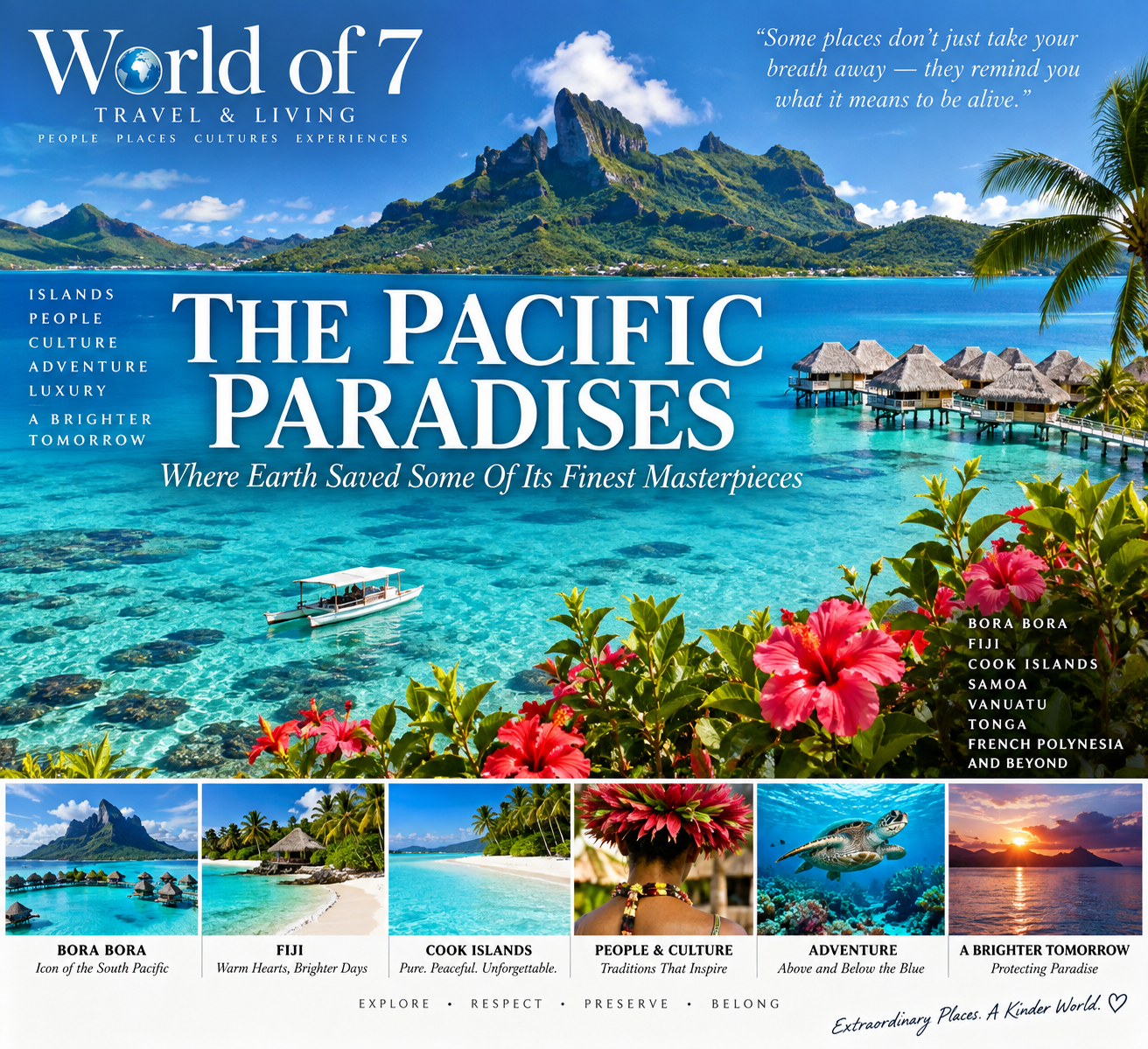
THE PACIFIC PARADISESWhere Earth Saved Some Of Its Finest Masterpieces
By Publisher Ray Carmen
There are places that photograph beautifully — and then there is the Pacific.
Across this immense blue ocean lie islands that seem almost impossibly perfect: volcanic mountains rising from turquoise lagoons, coral gardens alive beneath crystal-clear water, palm-fringed beaches without footprints, waterfalls hidden inside tropical forests and communities whose traditions reach back through generations of Pacific history.
This is a part of the world where nature has been extravagant.
From Bora Bora and Fiji to the Cook Islands, Samoa, Vanuatu and Tonga, the Pacific contains some of the most extraordinary destinations on Earth.
Yet its greatest treasure may not be the beaches or the luxury resorts.
It is the combination of land, ocean, people and culture that gives these islands their soul.
BORA BORA — THE PEARL OF THE PACIFIC
Few names in travel possess the magic of Bora Bora.
At its heart stands dramatic Mount Otemanu, surrounded by a lagoon painted in almost every imaginable shade of blue. Small palm-covered motu sit beyond the shoreline, while overwater bungalows stretch across waters so clear that tropical fish can sometimes be watched from the decks above.
Tahiti Tourisme describes Bora Bora as the “Pearl of the Pacific”, highlighting its turquoise lagoon, white-sand beaches, Polynesian heritage and extraordinary marine environment.
For honeymooners it has become one of the world's great romantic destinations.
For adventurers there is snorkelling, diving, sailing, kayaking, paddleboarding and excursions across the lagoon.
For those wanting to understand the island rather than simply photograph it, there is another Bora Bora: ancient marae, Polynesian dance, handicrafts, music and traditional cuisine.
Luxury may have made Bora Bora famous, but Polynesian culture gives it its identity.
FIJI — WHERE HAPPINESS COMES NATURALLY
Travel west across the Pacific and another magnificent island world appears.
Fiji is not a single tropical paradise but an archipelago of more than 300 islands, encompassing rainforest, mountains, waterfalls, beaches and coral reefs.
Some islands contain sophisticated resorts and private retreats. Others offer small villages, remote beaches and a slower rhythm of life.
But Fiji's great attraction is its people.
The familiar greeting “Bula!” is more than simply hello. It represents the warmth and openness for which Fiji has become famous.
Fijian society itself reflects a fascinating mixture of cultures. Indigenous iTaukei traditions remain central to national life, alongside Indo-Fijian and other communities whose food, customs and religions have contributed to modern Fiji's distinctive identity.
There are reefs to dive, forests to explore and islands on which doing almost nothing becomes an art form.
It is easy to understand why Tourism Fiji's message is:
“Where happiness comes naturally.”
THE COOK ISLANDS — PACIFIC LIFE AT ITS OWN PACE
Then there are the Cook Islands.
Rarotonga combines mountain scenery, beaches, villages and Polynesian culture within a remarkably intimate island setting.
But for many travellers, the great dream lies beyond it.
Aitutaki.
Its vast turquoise lagoon, scattered with white-sand motu and coconut palms, is one of the defining images of the South Pacific.
Cook Islands Tourism emphasises something increasingly precious in modern travel: space.
There are no giant skylines dominating the shore and no need to spend an entire holiday enclosed inside a resort. Visitors are encouraged to explore, meet local Cook Islands Māori communities and experience island life directly.
Lagoon cruises, mountain walks, local markets, fishing and cultural nights provide plenty to do.
But perhaps the Cook Islands' greatest luxury is simply this:
time slows down.
SAMOA — WHERE CULTURE STILL LIVES
In Samoa, paradise comes with extraordinary cultural depth.
The islands contain rainforests, volcanic landscapes, natural swimming holes, waterfalls and beautiful stretches of coastline.
But Samoa's identity rests heavily upon Fa'a Samoa — “the Samoan way.”
Samoa Tourism explains that this community-centred way of life stretches back more than 3,000 years and remains deeply embedded in modern Samoan society.
Tradition here is not confined to a museum.
It is lived through family, village life, ceremony, music, dance, food and hospitality.
Visitors can experience traditional performances and crafts, explore villages or travel inland to spectacular natural landmarks.
Among Samoa's great attractions are waterfalls surrounded by dense tropical vegetation, including the dramatic cascades found across Upolu and Savai'i.
Samoa reminds the traveller that the Pacific is not merely something beautiful to look at.
It is something to understand.
VANUATU — THE WILD PACIFIC
If some Pacific islands whisper, Vanuatu roars.
This Melanesian nation combines tropical beaches with jungle, blue holes, diving, waterfalls and extraordinary volcanic landscapes.
Visitors can go from coral reefs to the rim of an active volcano — sometimes within the same journey.
Vanuatu is also home to deeply rooted traditions.
Across its islands, communities continue to preserve local customs, ceremonies, dances, crafts and stories. Cultural villages allow visitors to learn about traditional cooking, art and ways of life, while Pentecost Island's famous Naghol land diving remains one of the Pacific's most remarkable ceremonies.
Below the surface lies another world.
Vanuatu's reefs, underwater caves and historic wrecks have made it an internationally recognised diving destination.
This is Pacific travel with an adventurous edge.
TONGA — THE KINGDOM OF THE WHALES
There is something beautifully distinctive about Tonga.
Proud of its royal heritage and Polynesian traditions, the island kingdom offers reefs, beaches, villages and a culture that remains central to everyday life.
But each year, enormous visitors arrive from far beyond the islands.
Humpback whales.
After travelling north from Antarctic waters, whales come into Tonga's warmer seas to breed and give birth.
Between approximately July and October, licensed operators offer carefully managed whale-watching and swimming experiences, making Tonga one of the relatively few destinations where visitors can enter the water with humpback whales in their natural environment.
Imagine floating in the deep blue Pacific and hearing the distant song of a humpback beneath the surface.
Some travel memories remain with you forever.
That must surely be one of them.
AND THEN THERE IS THE REST OF THE PACIFIC
Bora Bora, Fiji, the Cook Islands, Samoa, Vanuatu and Tonga are merely gateways.
Beyond them lie Tahiti, Moorea, New Caledonia, Palau, the Solomon Islands, Kiribati, Tuvalu, Niue, Papua New Guinea, the Federated States of Micronesia, the Marshall Islands and scores of smaller islands and atolls.
Each is different.
Some offer sophisticated luxury.
Others possess almost no conventional tourism infrastructure at all.
Some are Polynesian, others Melanesian or Micronesian.
Together they create one of the richest cultural and geographical regions on the planet.
PARADISE WITH A RESPONSIBILITY
Yet the Pacific's beauty carries a message.
Coral reefs, coastal ecosystems, forests and marine wildlife cannot simply be treated as scenery for tourism.
They are living environments upon which island communities depend.
The future of Pacific travel therefore belongs increasingly to visitors and tourism businesses willing to respect local culture, protect marine environments, support island communities and understand that paradise survives only when it is cared for.
The best traveller should leave behind little more than footprints — and take home considerably more understanding than they arrived with.
WHERE THE WORLD FEELS DIFFERENT
Perhaps that is what makes the Pacific so captivating.
Modern life tells us to hurry.
The islands tell us to slow down.
Modern cities compete to build higher.
The Pacific invites us to look outward — towards an ocean horizon that seems to have no end.
And in a world increasingly dominated by technology, traffic and noise, these islands offer something that has become incredibly valuable:
space, silence and wonder.
Stand beside a Fijian beach at sunrise.
Sail across Aitutaki's lagoon.
Watch Mount Otemanu rise above Bora Bora.
Listen to a Samoan village preparing for evening.
Look into the crater of a Vanuatu volcano.
Or enter the waters of Tonga as a humpback whale passes through the blue.
Then you begin to understand why the Pacific occupies such a powerful place in the human imagination.
These are not simply holiday islands.
They are reminders of how magnificent our planet can be.
THE PACIFIC PARADISES
Where Earth saved some of its finest masterpieces.
Explore. Respect. Preserve. Belong.
WORLD OF 7 — TRAVEL & LIVING
The World is Your Oyster.