
TEEN GENIUS BUILDS AI ROBOT TURTLE
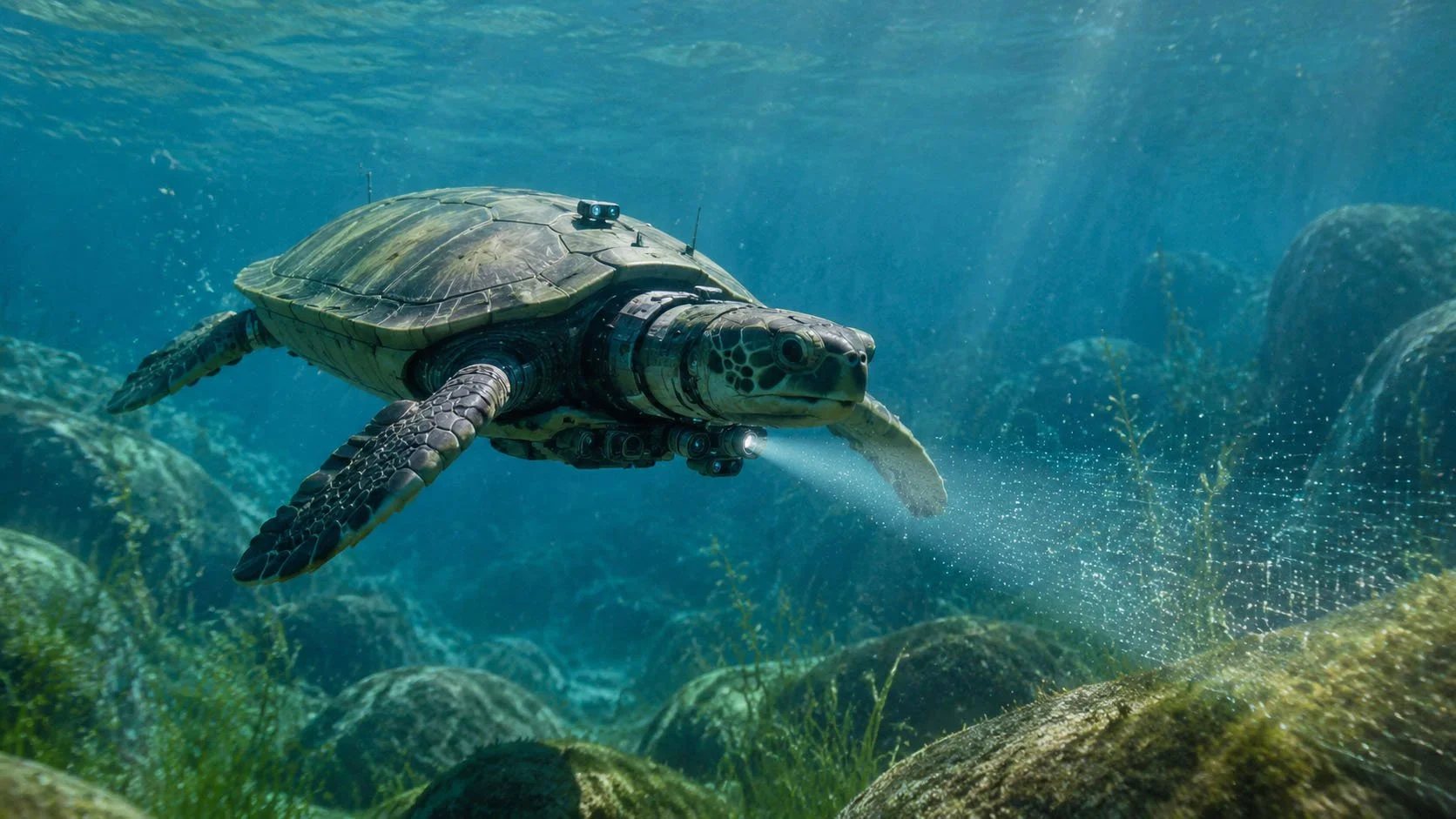
BURT HUNTS MICROPLASTICS
A Canadian schoolboy turned the graceful movement of a snapping turtle into a quiet underwater guardian powered by artificial intelligence
By Publisher Ray Carmen
WORLD OF 7 | TOMORROW’S WORLD • WILDLIFE & NATURE
At only 15, Evan Budz of Burlington, Ontario, set out to create something extraordinary: a robotic turtle that could patrol fragile waters without the noise and disruption caused by many conventional underwater vehicles.
Now 16, the Canadian student has transformed that youthful idea into BURT—the Bionic Underwater Robotic Turtle—and placed himself among the most exciting young environmental inventors of his generation.
INSPIRED BY NATURE
The idea began during a family camping trip in Ontario, where Budz watched a snapping turtle glide through the water with quiet, fluid movement.
He realised that the animal’s natural swimming action could provide a model for an efficient underwater robot—one able to move through coral reefs, lakes and other sensitive habitats while causing minimal disturbance to wildlife.
His early trials were far from perfect. Some prototypes sank straight to the bottom of his grandparents’ swimming pool.
But Budz persisted, refining the body, articulated flippers, depth control and autonomous navigation until BURT could follow a predetermined search pattern without a tether or constant human steering.
AI EYES BENEATH THE SURFACE
BURT carries cameras, sensors and a compact computer. Budz trained artificial-intelligence models to recognise environmental threats including coral bleaching, invasive species and microplastics.
A later underwater 3D holographic imaging system was designed to distinguish tiny plastic fragments from other particles directly in the water.
According to Budz’s reported testing, the microplastic system achieved 94 per cent accuracy and could examine particles as small as 10 microns—far below what the naked eye can see.
Earlier trials of BURT’s visual monitoring system reportedly detected simulated coral bleaching with 96 per cent accuracy.
DETECTION—NOT YET COLLECTION
Viral headlines often say the turtle “hunts” microplastics. That is fair as a description of its search mission, but an important distinction remains: BURT is presently a detection and monitoring platform, not a machine that physically scoops plastic from the ocean.
Its promise lies in finding and mapping pollution quickly, in place, so researchers can understand where contamination is concentrated and respond more effectively.
A PRIZE FOR THE FUTURE
The invention earned Budz the Gordon E. Moore Award for Positive Outcomes for Future Generations at the 2026 Regeneron International Science and Engineering Fair, together with a US$50,000 scholarship.
More than 1,700 students from around the world participated in the fair, making the recognition all the more remarkable.
Budz hopes the technology can eventually support fleets of gentle, turtle-like robots monitoring remote waters and gathering scientific data without damaging the ecosystems they are built to protect.
Laboratory testing for microplastics can be slow, expensive and difficult to deploy in remote locations. An autonomous field system could make environmental monitoring faster and more accessible.
WORLD OF 7 VIEW
The most powerful part of this story is not merely the machine—it is the mind behind it.
A teenager looked at a turtle, saw elegance where others saw only nature, and imagined technology working with the living world rather than against it.
BURT may still be developing, but Evan Budz has already delivered a message to his generation: no one is too young to confront a planetary problem, and the next great protector of our oceans may begin life in a family swimming pool.