
PLANET HUNTING — THE NEXT GREAT QUEST FOR LIFE BEYOND EARTH
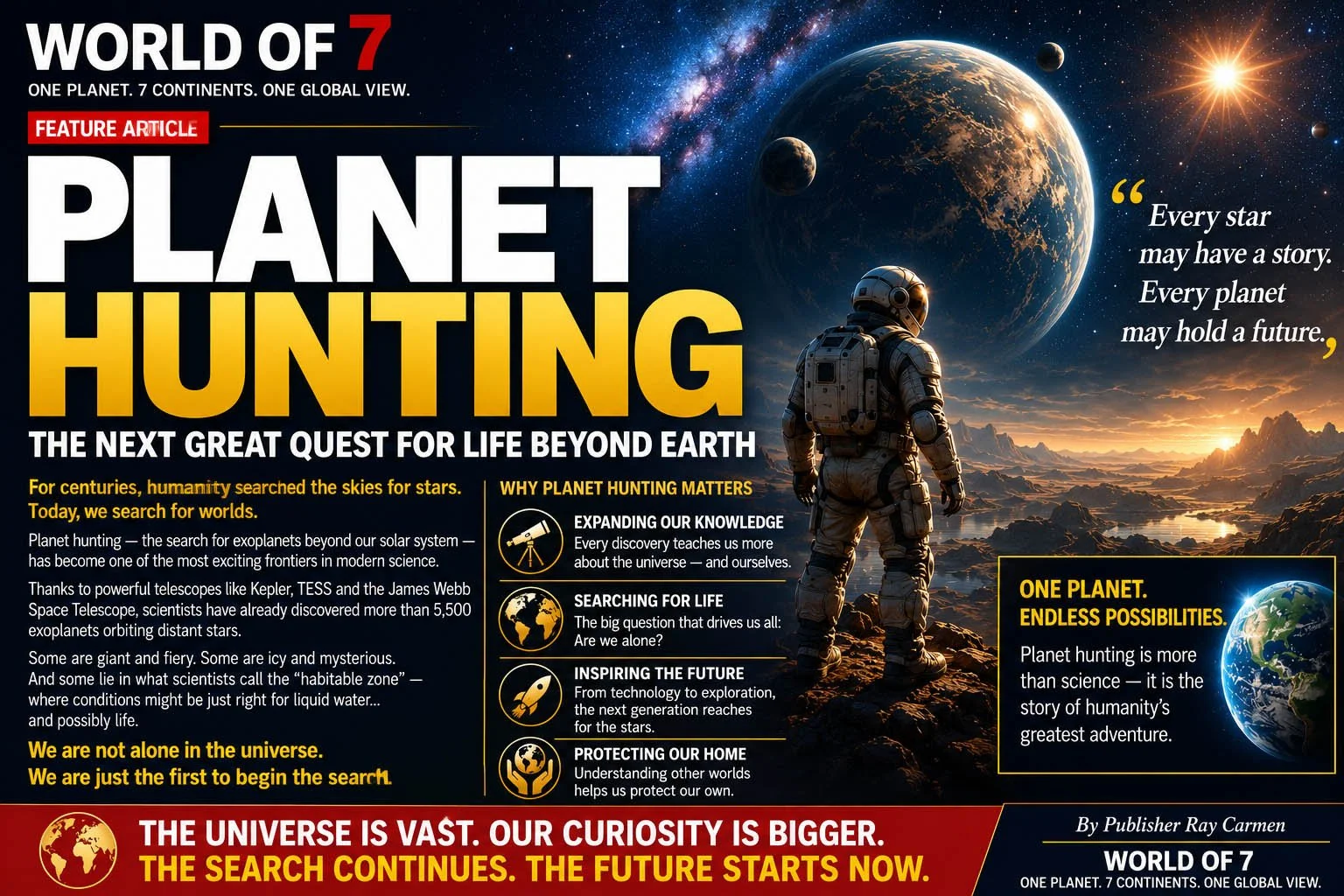
By Publisher Ray Carmen
For thousands of years, humanity looked up at the night sky and wondered whether we were alone.
Today, thanks to extraordinary advances in astronomy and space technology, that question is no longer confined to philosophy. It has become one of the greatest scientific investigations of our age.
Welcome to the fascinating world of planet hunting—the search for planets beyond our own solar system.
These distant worlds, known as exoplanets, orbit stars far beyond our Sun. Since the first confirmed discovery in 1992, astronomers have identified more than 5,000 exoplanets, with thousands more awaiting confirmation. Each discovery brings us one step closer to understanding our place in the universe.
Modern observatories such as NASA’s Kepler Space Telescope, TESS (Transiting Exoplanet Survey Satellite) and the James Webb Space Telescope have transformed our ability to detect these distant worlds. By measuring tiny changes in a star’s brightness or subtle movements caused by an orbiting planet, scientists can identify planets that are hundreds—or even thousands—of light-years away.
The discoveries have been astonishing.
Some exoplanets are enormous gas giants larger than Jupiter. Others are rocky worlds that resemble Earth. There are planets with scorching temperatures hot enough to melt metal, icy worlds locked in perpetual darkness, and mysterious “ocean planets” that may be covered entirely by water.
Perhaps the most exciting targets are planets located within the habitable zone—the region around a star where temperatures may allow liquid water to exist. Since water is considered essential for life as we know it, these planets have become prime candidates in the search for extraterrestrial life.
Planet hunting is about far more than finding another Earth.
Every newly discovered world expands our understanding of how planetary systems form, evolve and survive. Some discoveries challenge long-held scientific theories, while others reveal that the universe is far more diverse than anyone imagined.
The search is also driving remarkable technological innovation. More powerful telescopes, advanced imaging systems, artificial intelligence and sophisticated data analysis are allowing scientists to study distant planets with increasing precision. Future missions may even detect the chemical signatures of life in the atmospheres of nearby worlds.
The question that has inspired generations of explorers remains as compelling today as ever:
Are we alone?
No one yet knows the answer.
But with every new planet discovered, humanity moves one step closer to solving one of the greatest mysteries in history.
Planet hunting is more than a scientific mission.
It is a journey driven by curiosity, imagination and hope—a reminder that the universe is vast, our potential is limitless, and the next great discovery may already be waiting among the stars.
WORLD OF 7
ONE PLANET. 7 CONTINENTS. ONE GLOBAL VIEW.