
NOSTRADAMUS AND BABA VANGA — DID THEY REALLY SEE THE FUTURE?
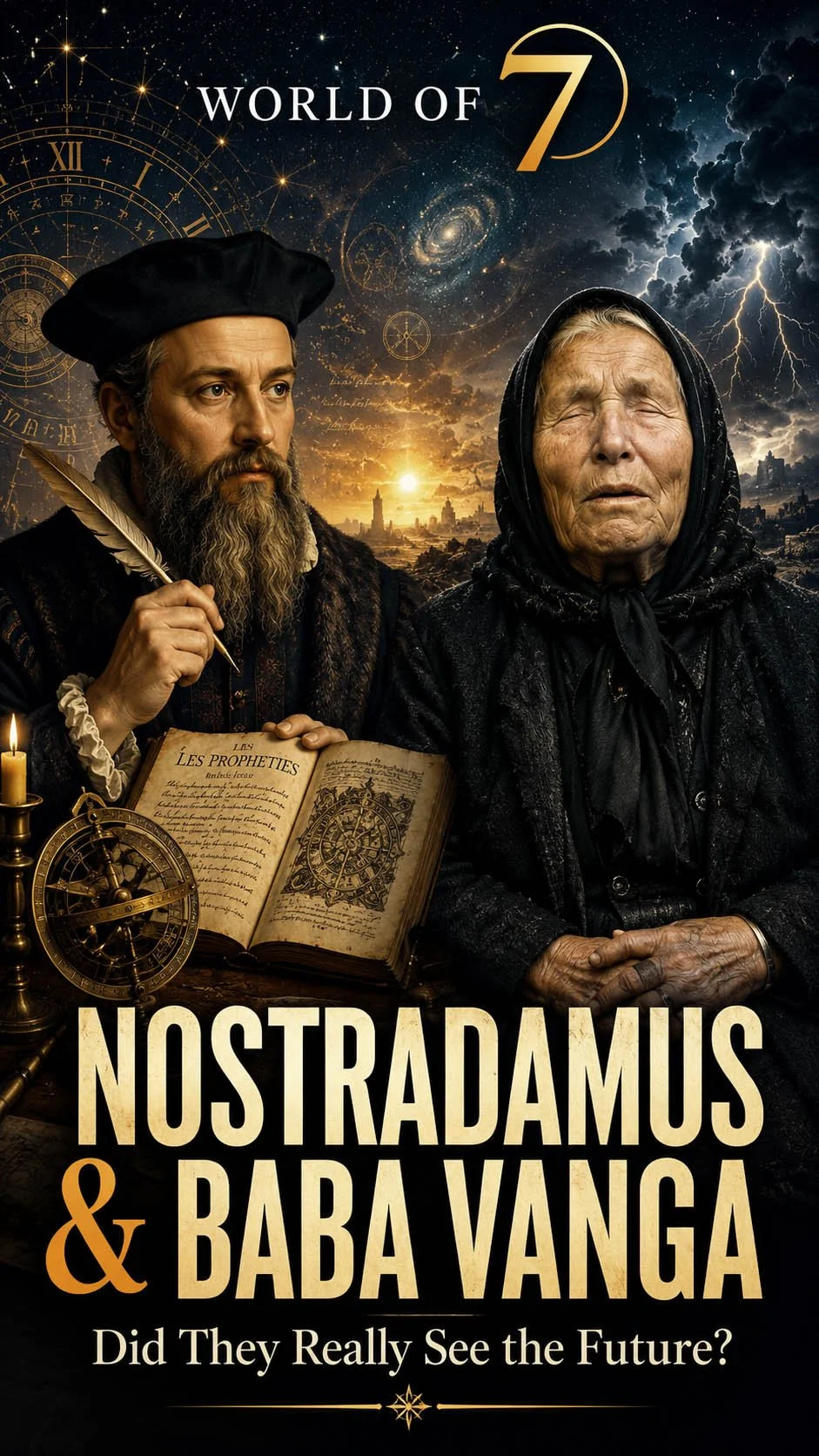
By Publisher Ray Carmen
For centuries, humanity has been fascinated by people who appear to see beyond the present.
Wars, disasters, political upheaval, scientific breakthroughs and even the fate of civilisation itself have all been linked to the mysterious words of two of history’s most famous prophets:
Nostradamus, the 16th-century French astrologer, and Baba Vanga, the blind Bulgarian mystic often called the “Nostradamus of the Balkans.”
Their followers believe they foresaw some of the greatest events in modern history.
Their critics argue that many of their predictions were vague, mistranslated, exaggerated or connected to events only after they happened.
The truth lies somewhere between historical record, spiritual belief, folklore and the extraordinary human desire to know what comes next.
NOSTRADAMUS — THE PROPHET OF THE QUATRAINS
Michel de Nostredame, better known as Nostradamus, was born in France in 1503.
A physician, astrologer and writer, he became famous after publishing Les Prophéties in 1555 — a collection of cryptic four-line verses known as quatrains. The language was deliberately obscure, mixing old French, Latin, symbolism, astrology and historical references.
Over the centuries, supporters have claimed that Nostradamus predicted:
The death of King Henry II of France
The Great Fire of London
The French Revolution
The rise of Napoleon
Adolf Hitler and the Second World War
The atomic bomb
The assassination of John F. Kennedy
The death of Diana, Princess of Wales
The September 11 attacks
Some of the supposed connections appear astonishing when presented after the event.
Yet scholars point out that Nostradamus rarely named exact people, places or dates. His verses were broad enough to be applied to many different events, often through creative translation or selective interpretation. Academic critics describe this as postdiction — fitting old words to events after they have already occurred.
One famous example is the claim that Nostradamus predicted Hitler because he used the word “Hister.” Historians note that Hister was an ancient geographical name associated with the lower Danube, not necessarily a reference to Adolf Hitler.
Even the prophecy said to predict the death of King Henry II was not publicly connected to the king’s death until decades after the event.
That does not mean Nostradamus lacked imagination or insight. His writings reflected a violent age of plague, war, dynastic rivalry and religious conflict. Many of his warnings remain timeless because humanity continues to experience the same fears.
BABA VANGA — THE BLIND MYSTIC OF THE BALKANS
Baba Vanga was born Vangeliya Pandeva Gushterova in 1911 in what is now North Macedonia.
She lost her sight as a child and later became famous throughout Eastern Europe for her alleged ability to foresee personal and world events.
Unlike Nostradamus, Baba Vanga did not leave behind a recognised written book of prophecies.
Most predictions attributed to her were passed down orally through visitors, relatives, followers, journalists and later writers. This makes it extremely difficult to establish which statements she genuinely made and which were added after her death in 1996.
She has been credited with predicting:
The death of Princess Diana
The sinking of the Russian submarine Kursk
The September 11 attacks
The rise of Islamic State
The election of Barack Obama
The Chernobyl disaster
Major earthquakes and tsunamis
Global economic crises
Yet many of these claims cannot be traced to authenticated recordings or documents made before the events occurred.
People who knew Baba Vanga have also said that some of the most dramatic predictions attributed to her were never spoken by her at all.
THE PREDICTIONS THAT FAILED
The legends surrounding both prophets often focus on apparent successes while failed predictions receive far less attention.
Baba Vanga was reportedly credited with predicting that Europe would become almost empty or uninhabitable by 2016.
That did not happen.
She was also linked to claims that a nuclear war would take place between 2010 and 2016 and that the 44th president of the United States would be America’s last.
Those predictions also failed.
Nostradamus’s writings have also been repeatedly connected to end-of-the-world dates and global catastrophes that never arrived.
His famous reference to the year 1999 caused enormous speculation, yet no single agreed event fulfilled the prophecy.
This raises an important question:
Are these genuine visions of the future — or are human beings simply skilled at finding meaning in mysterious language?
WHAT ARE THEY SAID TO HAVE PREDICTED FOR 2026?
As the world moves through 2026, a new wave of sensational claims has appeared across social media and online publications.
Nostradamus is being associated with predictions of:
Escalating international war
Political assassinations
Economic instability
Environmental disasters
Naval confrontation
Social disorder
The decline of powerful leaders
However, Nostradamus did not write a clear, dated list specifically for 2026. The modern claims are based on interpreters selecting ancient quatrains and attaching them to current global concerns.
Baba Vanga is being credited with even more dramatic 2026 predictions, including:
A major conflict involving Europe
A global financial crisis
The growing power of artificial intelligence
Revolutionary medical breakthroughs
Political upheaval in Russia
Contact with extraterrestrial life
The arrival of a huge spacecraft in November 2026
There is no verified written archive proving that Baba Vanga made these exact predictions. Many appear to be modern internet claims repeated from one publication to another without a traceable original source.
WHY DO PEOPLE CONTINUE TO BELIEVE?
The enduring popularity of Nostradamus and Baba Vanga may tell us as much about humanity as it does about prophecy.
People turn to predictions during periods of uncertainty.
When the world faces war, economic fear, disease, political instability or rapid technological change, prophecy offers the possibility that events are part of a larger design.
It makes chaos feel less random.
Their language also leaves space for interpretation. A vague warning about fire, blood, conflict, kings or collapsing empires can be applied to many different centuries.
Every generation therefore believes the prophecy may have been written especially for them.
PROPHETS, SYMBOLS OR MIRRORS?
Perhaps Nostradamus and Baba Vanga truly experienced visions that science cannot explain.
Perhaps some apparent predictions were extraordinary coincidences.
Perhaps later followers reshaped their words into stories more dramatic than anything they originally said.
Or perhaps these two figures became mirrors reflecting humanity’s deepest fears and hopes.
Whatever the explanation, their influence remains undeniable.
Nearly five centuries after Nostradamus published his quatrains, and decades after Baba Vanga’s death, millions of people still study their words whenever the world enters another uncertain chapter.
But the wisest lesson may not be hidden in any prophecy.
The future is not shaped only by mystics, stars or ancient verses.
It is shaped every day by human choices, leadership, courage, compassion and the willingness to learn from the past.
The greatest prediction of all may therefore be the simplest:
What humanity does today will determine the world it inherits tomorrow.
WORLD OF 7
One Planet. Seven Continents. One Human Family.