
By Publisher Ray Carmen
PALESTINE MOURNS 15-YEAR-OLD PLAYER KILLED WHILE PLAYING FOOTBALL
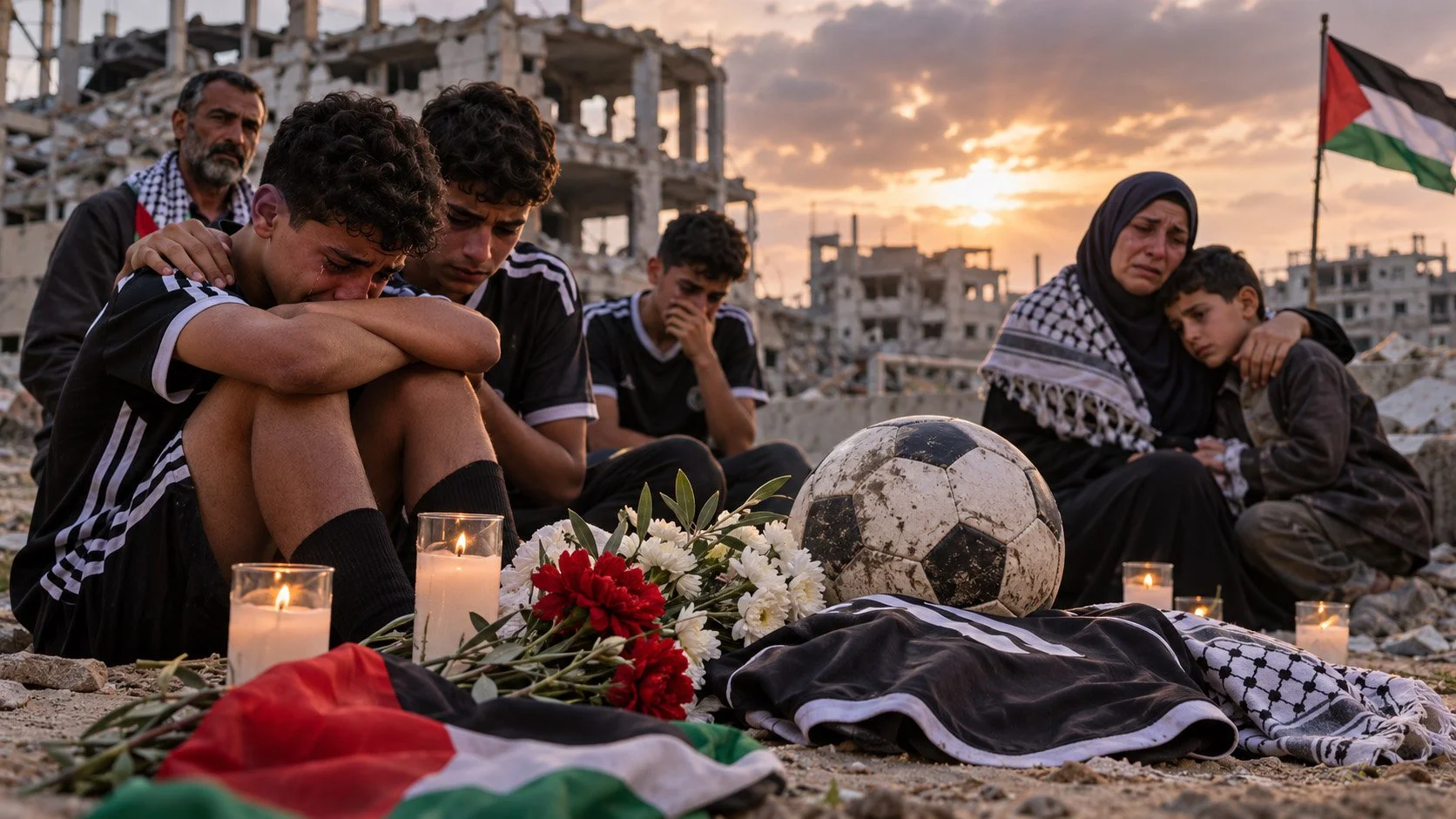
Muhammad Nidal Barbakh dreamed of a future in football. His death has left a sporting community grieving and renewed attention on the devastating impact of war on Gaza’s children.
He was just 15 years old.
An age when most young footballers dream of scoring goals, wearing their country’s colours and perhaps one day walking onto the pitch before thousands of cheering supporters.
For Muhammad Nidal Barbakh, a young Palestinian footballer from Gaza, those dreams ended tragically on 6 November 2026.
According to the Palestinian Football Association, Muhammad was killed by Israeli gunfire while playing football with friends in the al-Mawasi area of Khan Younis, southern Gaza.
He was a player at Al-Najma Sports Academy, where he was remembered as a promising young member of the sporting community.
His death has brought renewed grief to Palestinian football and highlighted the enormous human cost of the conflict.
A BOY WHO LOVED THE BEAUTIFUL GAME
Football is more than a sport.
For millions of children around the world, it represents friendship, ambition, discipline and the simple pleasure of playing.
From the beaches of the Caribbean to the streets of Africa, the football grounds of Europe and the neighbourhoods of Asia, young players share the same dream.
Muhammad was one of them.
He belonged to Al-Najma Sports Academy, an organisation dedicated to developing young sporting talent.
On 6 November, according to Palestinian reports, he was playing football with other children in the Bir 19 area of al-Mawasi when he was struck by gunfire.
The Palestinian news agency WAFA reported that medical sources confirmed his death.
The circumstances described by the Palestinian Football Association identify Israeli forces as responsible for the shooting.
The available reporting does not establish why the gunfire occurred or provide a detailed account from the Israeli military.
What is certain is that a 15-year-old boy lost his life.
PALESTINIAN FOOTBALL IN MOURNING
The Palestinian Football Association publicly mourned Muhammad’s death on 7 November.
His academy also paid tribute to the young player, remembering his enthusiasm for football and the ambitions that would now remain unfulfilled.
For a sporting academy, the loss of a young player is profoundly personal.
Coaches spend years encouraging children, developing their abilities and teaching them the importance of teamwork.
Teammates become friends.
Training sessions become part of everyday life.
A football academy is not simply a place where athletes learn to play.
It is a community.
Muhammad’s death has left that community confronting a loss no sporting achievement can repair.
THE DEVASTATING TOLL ON PALESTINIAN SPORT
The tragedy is part of a much wider crisis affecting Palestinian athletes and sporting institutions.
According to figures cited by the Palestinian Football Association, Muhammad’s death brought the reported number of Palestinian sports figures killed since October 2023 to 1,016.
That figure includes athletes, coaches, referees and sporting administrators.
The association has also documented extensive damage to sporting infrastructure.
A report published in March identified 265 damaged sports facilities in Gaza, including stadiums, football pitches, indoor sports halls and club headquarters.
Of these, 184 were reported completely destroyed and another 81 partially damaged.
These figures, reported by the Palestinian sporting authorities, illustrate the enormous challenges facing organised sport in Gaza.
For children hoping to become footballers, the destruction of pitches and training facilities represents the disappearance of opportunities.
For established athletes, it means interrupted careers.
For coaches, it means the loss of places where young people could develop their abilities.
And for families, it means another part of ordinary community life has been damaged.
WHEN FOOTBALL BECOMES A SYMBOL OF HOPE
Throughout history, football has brought people together across political, cultural and religious divisions.
The sport has created moments of extraordinary unity.
It has given children from modest backgrounds opportunities to achieve international recognition.
It has transformed lives.
For Palestinian youngsters, football can offer an important sense of identity and normality amid difficult circumstances.
Even when surrounded by uncertainty, children still want to play.
They still want to score goals.
They still want to celebrate with friends.
The death of Muhammad Nidal Barbakh is therefore more than the loss of a promising young athlete.
It is a reminder of the childhood experiences that conflict can destroy.
THE WORLD OF FOOTBALL HAS A RESPONSIBILITY
International football organisations have repeatedly emphasised the importance of protecting children and encouraging participation in sport.
Those principles become especially important in conflict zones.
Young athletes should be able to train, compete and dream without fear of violence.
Sporting facilities should be protected wherever possible.
Children should not have to choose between their safety and their desire to play.
The death of a young footballer also raises broader questions about the protection of civilians under international humanitarian law.
All parties to armed conflict are required to respect the applicable rules protecting civilians, including children.
Those protections do not depend on nationality, religion or political allegiance.
They belong to every child.
A FAMILY’S LOSS — A WORLD’S RESPONSIBILITY
Behind the headlines and statistics is a family grieving a son.
Behind the reports of damaged stadiums are children who have lost places to play.
Behind every young athlete killed is a future that will never unfold.
Muhammad might have become a professional footballer.
He might have represented Palestine internationally.
He might have become a coach, inspiring another generation.
Or perhaps football would simply have remained a lifelong passion.
No one can know.
What matters is that he should have had the opportunity to discover his own future.
THE FINAL WHISTLE CAME TOO SOON
Football is often described as the beautiful game because it can unite people who otherwise have little in common.
It crosses borders.
It creates friendships.
It gives children hope.
Muhammad Nidal Barbakh was only 15.
His life should not be remembered solely through the circumstances of his death, but also through the sport he loved and the dreams he was entitled to pursue.
His story is a reminder that the protection of children must remain a priority in every conflict.
Because somewhere in the world today, another young boy is kicking a football, imagining the day he might become a champion.
And every child deserves the chance to finish that game.
IN MEMORY OF MUHAMMAD NIDAL BARBAKH
Aged 15.
His footballing dreams were cut short, but his life deserves to be remembered.