
MARTIN LUTHER KING JR. VS DONALD TRUMP
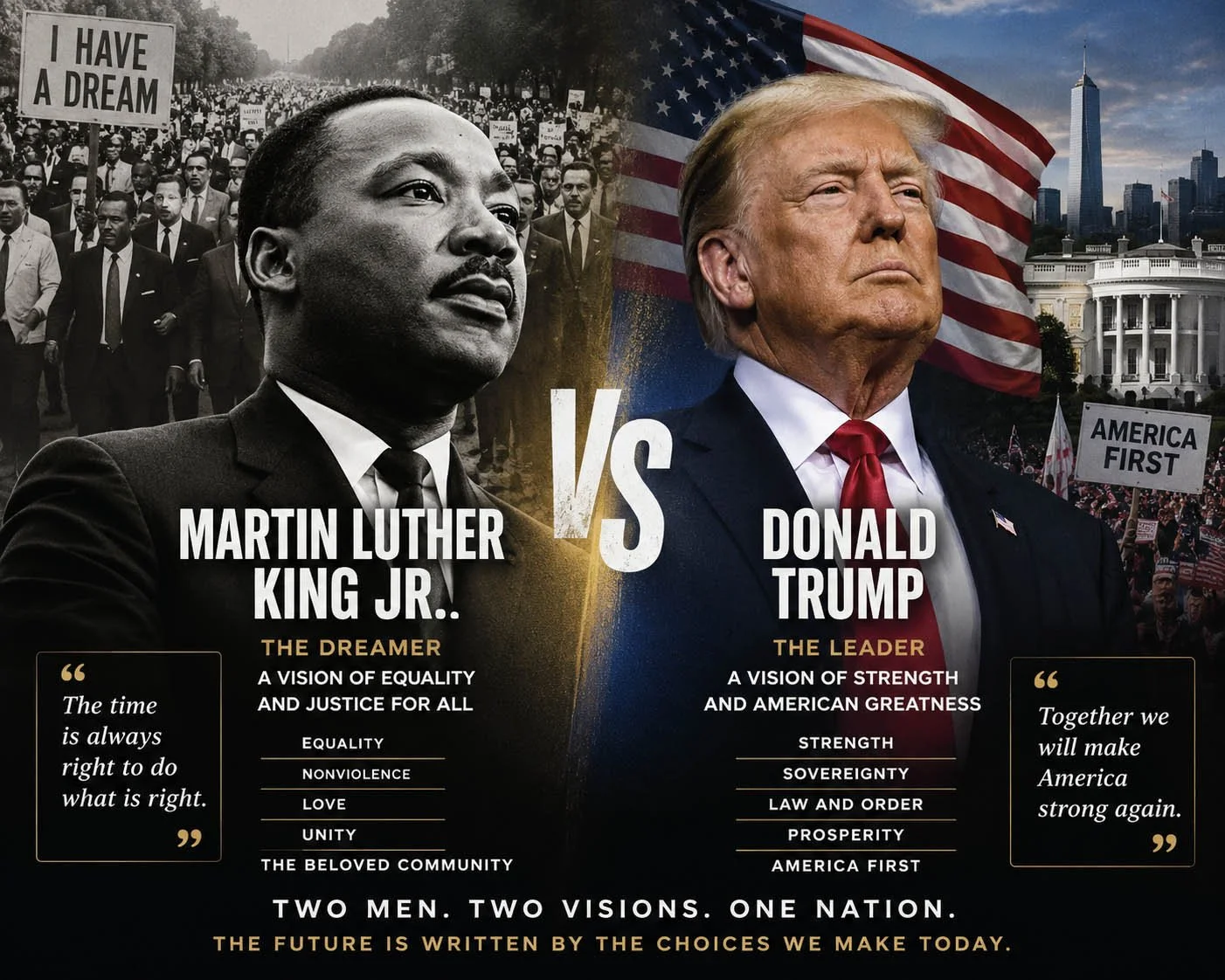
TWO VISIONS OF AMERICA
By Publisher Ray Carmen
They never met. They belonged to different generations, occupied different roles and confronted very different Americas.
Yet Martin Luther King Jr. and Donald Trump have come to represent two sharply contrasting ideas about what America is, whom it should serve and how national greatness should be achieved.
King was a Baptist minister and civil-rights leader who challenged racial segregation through disciplined nonviolent resistance. Trump is a businessman, political movement leader and the 45th and 47th President of the United States, whose programme is built around America First, national sovereignty, border control, economic power and law and order.
This is not a simple contest between a saint and a politician.
It is a clash between two visions of America.
KING’S AMERICA — THE BELOVED COMMUNITY
Martin Luther King Jr. believed that America could become greater by living up to the moral promises contained in its Constitution, its religious traditions and its founding language of equality.
His dream was not merely that Black Americans should be allowed to enter previously segregated schools, restaurants, buses and voting booths.
He envisioned what became known as the Beloved Community — a society in which racism, poverty, violence and humiliation would be overcome through justice, reconciliation and shared human dignity. King’s philosophy treated nonviolence not as weakness, but as a powerful method of confronting injustice while refusing to surrender to hatred.
King was awarded the 1964 Nobel Peace Prize for his nonviolent struggle for civil rights. His movement helped force America to confront legal segregation and contributed to the national pressure that produced landmark civil-rights reforms.
But King was more radical than the comforting version often remembered today.
He did not believe justice would arrive simply because society became more polite.
From a Birmingham jail cell, he defended direct action against unjust systems and rejected demands that Black Americans wait patiently for freedom. His campaigns used marches, boycotts, arrests and moral pressure to force powerful institutions to change.
King also broadened his mission beyond racial segregation.
He challenged economic inequality through the Poor People’s Campaign, which sought jobs, income, housing and dignity for poor Americans of every racial background. He condemned the Vietnam War and argued that military violence abroad was connected to poverty and injustice at home.
For King, America’s greatness depended on its willingness to protect the weak, confront injustice and widen its circle of human concern.
TRUMP’S AMERICA — STRENGTH, SOVEREIGNTY AND CONTROL
Donald Trump’s political vision begins from a very different point.
Where King spoke of transforming the moral character of the nation, Trump speaks of restoring national strength.
His programme emphasises secure borders, stronger law enforcement, expanded energy production, manufacturing, tariffs, military power and a federal government directed towards what he defines as the interests of American citizens first.
Trump’s language is not primarily the language of sacrifice or reconciliation.
It is the language of victory, power, protection and recovery.
He presents America as a nation that has been weakened, exploited or badly governed and promises to make it respected, prosperous and dominant again. His supporters see this as realism: a government’s first duty, they argue, is to defend its citizens, enforce its laws and protect the national interest.
Trump has also made law and order central to his presidency. His administration has expanded federal support for aggressive policing and has argued that public safety requires officers to be freed from political and bureaucratic restrictions.
On race and equality, Trump’s administration has moved to eliminate federal diversity, equity and inclusion programmes and replace them with what it describes as a merit-based, colour-blind approach.
Supporters view this as a fulfilment of the principle that individuals should be judged by character and achievement rather than race.
Critics argue that removing race-conscious remedies can ignore the continuing effects of historic and structural discrimination. The disagreement is therefore not simply about whether equality matters, but about what government must do to achieve it.
DID TRUMP REJECT KING?
Not entirely.
Trump has repeatedly praised Martin Luther King Jr.’s public legacy.
During his January 2025 inauguration, held on Martin Luther King Jr. Day, Trump said his administration would work to make King’s dream a reality. In his 2026 proclamation marking the federal holiday, he honoured King’s contribution to justice, equal rights and human dignity and encouraged Americans to perform acts of service.
Trump also ordered the release of government records connected to King’s assassination, arguing that the American people and the King family deserved greater transparency.
The conflict therefore is not over whether King should be honoured.
Nearly every modern American political movement now claims some part of his legacy.
The deeper question is which King is being remembered.
Is it only the King who dreamed of people being judged by the content of their character?
Or is it also the King who marched against unjust laws, demanded federal intervention, defended civil disobedience, challenged poverty and condemned war?
King’s legacy cannot be reduced to a single sentence.
PROTEST VERSUS ORDER
One of the clearest differences between the two men concerns protest and authority.
King believed unjust laws must sometimes be broken openly and nonviolently to awaken the conscience of society. He accepted imprisonment and personal danger because he believed moral law could stand above local law.
Trump’s approach places greater emphasis on obedience, enforcement and institutional control.
He argues that weak enforcement creates disorder and that strong policing protects innocent citizens.
King asked what should happen when the law itself protects injustice.
Trump asks what happens when the law is no longer firmly enforced.
Both questions matter.
But they lead towards very different political instincts.
ECONOMIC JUSTICE VERSUS ECONOMIC NATIONALISM
King believed civil rights without economic security would remain incomplete.
He called for jobs, income, housing and structural changes that would improve the lives of poor people across racial lines.
Trump also speaks frequently about workers, wages, manufacturing and national prosperity.
But his solution is economic nationalism: tariffs, domestic energy, industrial revival, border enforcement and policies designed to favour American workers and businesses.
King approached poverty as a moral failure demanding redistribution and collective responsibility.
Trump approaches economic decline as a failure of leadership, trade policy, immigration control and national bargaining power.
Both appeal to people who feel forgotten.
But they diagnose the problem differently.
NONVIOLENCE VERSUS POWER
King believed that lasting peace could not be built through domination.
He argued that humanity faced a fundamental choice between nonviolence and destruction and that moral courage was stronger than hatred.
Trump has said he wants to be remembered as a peacemaker and unifier, while simultaneously promising the strongest possible military and a government prepared to use decisive force.
King placed moral persuasion at the centre of power.
Trump places deterrence, strength and negotiation from advantage at its centre.
TWO DIFFERENT MEANINGS OF GREATNESS
Martin Luther King Jr. believed America would become great by becoming more just.
Donald Trump believes America becomes great by becoming stronger, safer, richer and more sovereign.
King asked the nation to enlarge its moral community.
Trump asks it to restore its borders, authority and confidence.
King spoke most powerfully for those excluded from power.
Trump speaks most powerfully to those who believe their country, culture or security has been taken from them.
King’s weapon was organised nonviolence.
Trump’s weapon is political power.
King sought to transform the soul of America.
Trump seeks to restore its dominance.
THE FINAL VERDICT
History has already secured Martin Luther King Jr.’s place as one of the great moral leaders of the modern world.
Donald Trump’s final historical legacy is still being written.
But the comparison between them forces America to confront a question far larger than either man:
What does it truly mean for a nation to be great?
Is greatness measured by military strength, wealth, borders and national power?
Or is it measured by justice, compassion, equality and the treatment of those with the least power?
Perhaps a successful country requires both order and conscience.
But when order loses justice, it can become oppression.
And when moral ideals lack the power to protect society, they can become empty promises.
The future of America may therefore depend on whether it can combine strength with humanity, security with fairness and patriotism with justice.
King’s voice still asks America to become better than it has been.
Trump’s movement demands that America recover what it believes it has lost.
Between those two visions lies the continuing battle for the American soul.
WORLD OF 7
One Planet. Seven Continents. One Human Family.