
DID MAHATMA GANDHI CREATE PAKISTAN? — THE TRUTH BEHIND PARTITION
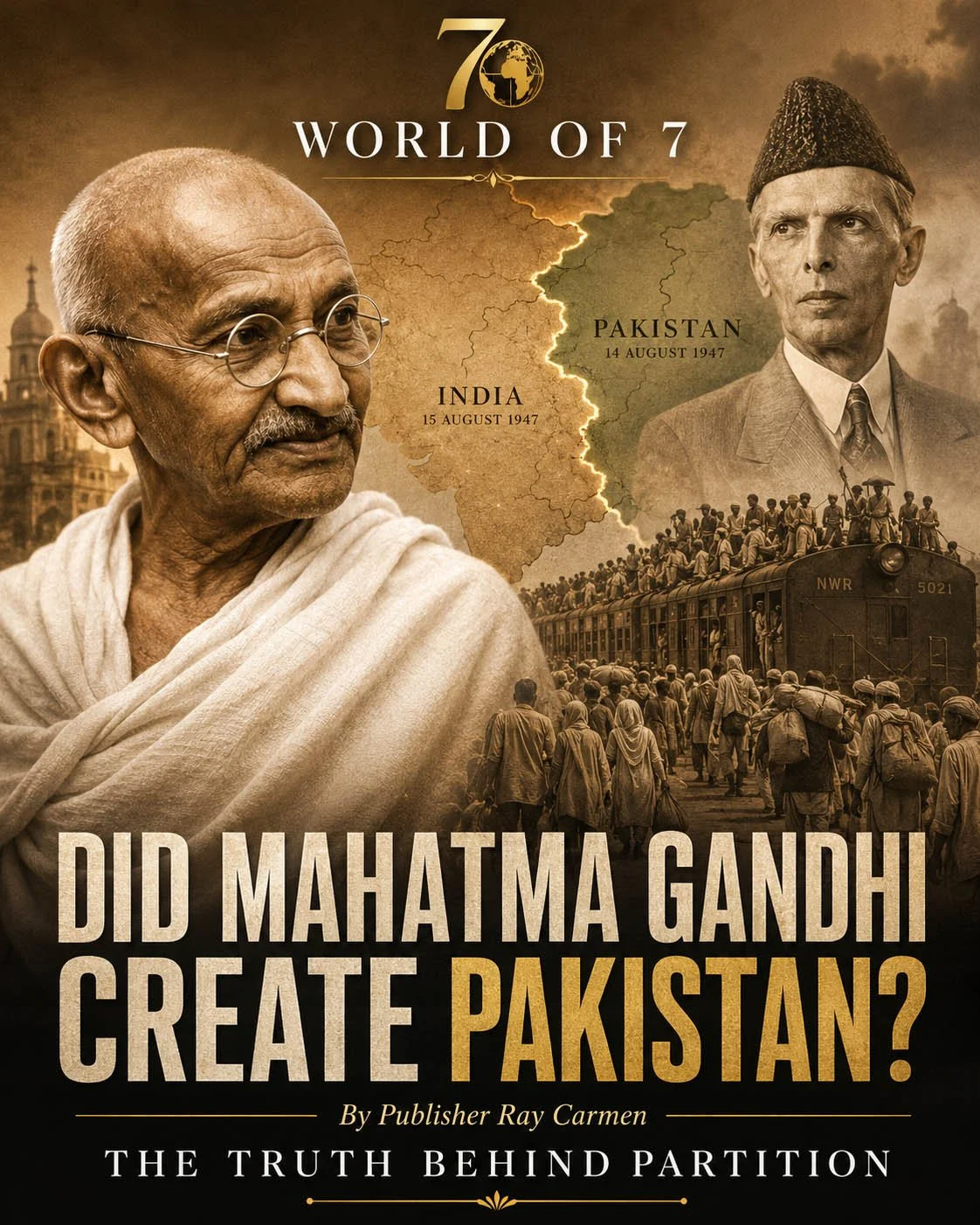
By Publisher Ray Carmen
Nearly eight decades after British India was divided, one question continues to provoke fierce argument across South Asia:
Did Mahatma Gandhi create Pakistan?
The direct historical answer is no.
Gandhi did not invent the idea of Pakistan, lead the campaign for its creation or possess the constitutional authority to divide British India.
In fact, he opposed Partition and spent much of his political life arguing that Hindus, Muslims, Sikhs, Christians and people of every faith could live together within one independent country.
Yet the complete story is far more complicated.
Gandhi’s decisions, his relationship with Muslim leaders, the policies of the Indian National Congress, Muhammad Ali Jinnah’s transformation into the principal advocate of Pakistan, communal fears and Britain’s hurried withdrawal all became part of the chain of events that produced Partition in 1947.
To understand what happened, history must be separated from political mythology.
THE IDEA OF PAKISTAN DID NOT BEGIN WITH GANDHI
The name Pakistan was proposed in 1933 by Choudhary Rahmat Ali, a student at Cambridge, years before the country came into existence.
The decisive political demand emerged through the All-India Muslim League under Muhammad Ali Jinnah.
At its Lahore session in March 1940, the Muslim League adopted what became known as the Lahore Resolution or Pakistan Resolution. It called for Muslim-majority regions in northwestern and eastern British India to be grouped into independent and autonomous political entities.
Although the wording did not initially present a detailed map of a single country called Pakistan, the resolution became the foundation of the Pakistan movement.
It was therefore Jinnah and the Muslim League — not Gandhi — who ultimately organised the successful political campaign for a separate Muslim homeland.
GANDHI BELIEVED INDIA WAS ONE CIVILISATION
Gandhi rejected the argument that Hindus and Muslims constituted two separate nations merely because they followed different religions.
His vision of India was spiritual, cultural and civilisational rather than exclusively Hindu.
He believed that Indian Muslims were as fully Indian as members of any other religious community and that independence would be incomplete without Hindu-Muslim unity.
For Gandhi, dividing the country on religious lines represented a moral and national tragedy.
He repeatedly attempted to reconcile Congress and the Muslim League, and at different moments he supported extraordinary compromises in the hope of keeping India united.
He was even prepared to consider allowing Jinnah to lead a united government if doing so could prevent Partition.
Those efforts failed.
WHY, THEN, IS GANDHI SOMETIMES BLAMED?
Gandhi’s critics argue that some of his strategies unintentionally deepened religious politics.
His support for the Khilafat movement after the First World War was intended to unite Hindus and Muslims against British colonial rule. Critics maintain, however, that connecting the independence struggle with a religious cause strengthened communal identities rather than weakening them.
Others accuse Gandhi and Congress of making repeated concessions to communal political demands without resolving the deeper question of how power would be shared in an independent India.
Some Hindu nationalists later argued that Gandhi placed excessive pressure upon Hindus to accommodate Muslim political concerns.
These criticisms remain intensely debated.
But influencing the political environment is not the same as creating Pakistan.
Gandhi’s intention was consistently to preserve unity, even when his chosen methods produced controversy or failed to achieve their purpose.
JINNAH DID NOT ALWAYS SUPPORT PARTITION
Muhammad Ali Jinnah had once been celebrated as an advocate of Hindu-Muslim unity.
During his earlier political career, he sought constitutional safeguards for Muslims within a united India rather than a separate country.
Over time, however, he became convinced that Muslims would be permanently vulnerable under a political system dominated by the Congress and a Hindu majority.
The experience of provincial politics, the failure of negotiations over constitutional safeguards and growing distrust between Congress and the Muslim League pushed him towards the demand for a separate state.
Jinnah argued that Muslims were not merely a religious minority but a nation entitled to political self-determination.
By the 1940s, the Muslim League had become a mass political force in many Muslim-majority areas, and Jinnah was unwilling to accept independence under a strong central government controlled largely by Congress.
CONGRESS ALSO MADE FATEFUL DECISIONS
It would be misleading to suggest that Partition was imposed by one man alone.
Jawaharlal Nehru, Vallabhbhai Patel and other senior Congress leaders initially opposed division.
But by 1947, they had concluded that accepting Partition might be the only way to achieve independence quickly and prevent British India from descending into prolonged civil conflict.
They feared that a weak federation with competing centres of authority could make the country ungovernable.
Patel increasingly regarded Partition as a painful but necessary solution.
Nehru also accepted the division after negotiations over a united constitutional structure collapsed.
Gandhi was therefore becoming isolated even within the movement he had helped lead.
He could morally oppose Partition, but he could not indefinitely overrule Congress leaders who were preparing to govern an independent state.
BRITAIN’S RESPONSIBILITY CANNOT BE IGNORED
British colonial policy had long classified, counted and politically organised communities according to religion.
Separate electorates, constitutional divisions and competition for representation contributed to the development of communal politics.
The British also left India with extraordinary speed.
In February 1947, Prime Minister Clement Attlee announced that power would be transferred no later than June 1948. Lord Mountbatten subsequently accelerated the timetable, and independence arrived in August 1947 — approximately ten months earlier than the original deadline.
The British Parliament passed the Indian Independence Act on 18 July 1947, creating the two independent dominions of India and Pakistan and dividing Punjab and Bengal between them.
The borders were drawn by a commission headed by British lawyer Sir Cyril Radcliffe, who had never previously visited India.
The final boundary decisions were revealed only as independence was taking place.
Millions of people suddenly discovered that their homes were located on the opposite side of a new international frontier.
PARTITION BECAME A HUMAN CATASTROPHE
Pakistan became independent on 14 August 1947, followed by India on 15 August.
The birth of the two nations was accompanied by one of the largest movements of people in modern history.
Millions of Hindus and Sikhs travelled towards India while millions of Muslims moved towards Pakistan.
Communities that had lived beside one another for generations were overtaken by fear, revenge and organised violence.
Entire trains arrived carrying only the bodies of murdered passengers.
Homes were abandoned, women were abducted, families disappeared and centuries-old communities were destroyed.
Estimates of the number killed vary widely, but the death toll reached into the hundreds of thousands, while approximately 15 million people were displaced.
Gandhi did not celebrate independence amid the official ceremonies in New Delhi.
He remained in Calcutta, attempting to stop communal violence and restore peace between Hindus and Muslims. His intervention helped produce a temporary calm in a city that had recently experienced terrible bloodshed.
DID GANDHI AGREE TO PARTITION?
Gandhi never embraced Partition as a desirable outcome.
But when Congress and the Muslim League accepted the political arrangements leading to division, he did not launch a final mass movement to prevent them.
This has led some critics to argue that his opposition became symbolic rather than decisive.
Gandhi understood, however, that forcing unity upon communities already facing widespread violence could produce an even greater catastrophe.
By 1947, he stood before a terrible reality.
He could reject the political settlement, but he could not compel Jinnah, Congress, Britain and millions of frightened citizens to accept his vision of a united India.
His moral influence remained enormous.
His direct control over the final constitutional decisions did not.
THE CONTROVERSIAL PAYMENT TO PAKISTAN
Another source of anger was Gandhi’s insistence that India should honour the financial settlement made with Pakistan following Partition.
India had agreed that Pakistan would receive a share of the financial assets inherited from British India.
When part of the payment was delayed during the conflict over Kashmir, Gandhi argued that India must fulfil its commitment.
He believed that a new nation should not begin its life by breaking an agreement, regardless of political hostility.
His position was portrayed by opponents as favouring Pakistan over India.
To Gandhi, it was not support for Pakistan against India.
It was a matter of honour, justice and the moral character of the Indian state.
This controversy contributed to the atmosphere of hatred surrounding him before he was assassinated by Nathuram Godse on 30 January 1948.
NO SINGLE PERSON CREATED PARTITION
Pakistan emerged from a convergence of forces:
British colonial rule and constitutional engineering.
The Muslim League’s demand for Muslim political sovereignty.
Jinnah’s leadership of the Pakistan movement.
Congress’s refusal to accept arrangements that could have created an extremely weak central government.
The collapse of trust between political leaders.
Communal mobilisation and violence.
The hurried British withdrawal.
And the fear among millions of ordinary people that they could become unsafe minorities in a future dominated by another community.
Gandhi was part of this history, but he was not the architect of Pakistan.
He attempted to prevent division and failed.
Jinnah demanded Pakistan and succeeded.
Congress reluctantly accepted Partition.
Britain legally and territorially implemented it.
The people of the subcontinent then paid the greatest price.
GANDHI’S GREAT FAILURE — NOT HIS CREATION
The most accurate conclusion is not that Gandhi created Pakistan.
It is that Gandhi could not prevent Pakistan from being created.
That distinction matters.
His dream of a united India rested upon the belief that religious identity did not have to determine nationality.
Jinnah’s Pakistan movement rested upon the fear that Muslims could not safely entrust their political future to a Hindu-majority democracy without powerful constitutional protection or sovereignty of their own.
History ultimately moved in Jinnah’s direction.
But the violence of Partition also fulfilled Gandhi’s darkest warning: once neighbours begin seeing one another primarily as rival religious nations, political division can become a human tragedy.
A LESSON FOR INDIA AND PAKISTAN TODAY
The question should not be used simply to decide which nation was right or which leader should carry all the blame.
India and Pakistan were both born from the end of colonial rule.
Both inherited the trauma of Partition.
Both lost citizens, homes, communities and opportunities for peace.
Gandhi did not create Pakistan.
Jinnah did not single-handedly destroy India.
Nehru did not alone order Partition.
And Britain did not leave behind a simple conflict that could be explained through one person’s ambition.
The division of British India was the product of competing national visions, political failures, colonial structures, communal fears and decisions made under immense pressure.
Nearly eighty years later, the most valuable question may therefore be not:
Who should we blame for creating Pakistan?
But rather:
What can India and Pakistan learn from the tragedy that created them both?
History should not be turned into another weapon between two neighbouring nations.
It should become a warning.
Because the greatest tribute to those who died during Partition would be for future generations to reject hatred, understand the full truth and ensure that such a tragedy is never repeated.
WORLD OF 7 — Exploring history beyond borders, myths and political divisions.