
SIR SADIQ KHAN: LONDON’S MAYOR ON THE WORLD STAGE
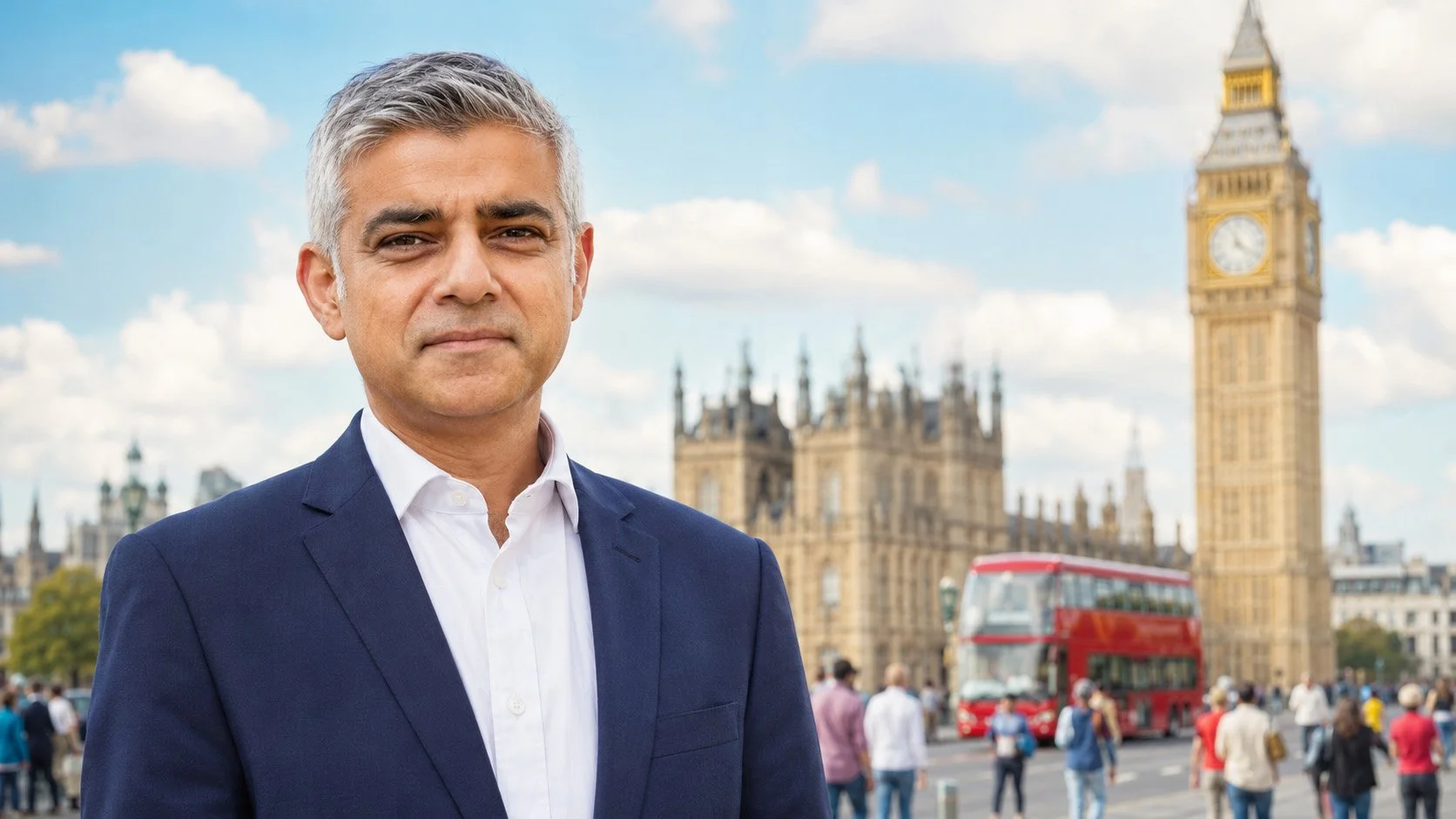
From a south London council estate to an historic third term at City Hall — followed by a knighthood and nomination to the House of Lords.
By Publisher Ray Carmen
Sir Sadiq Khan’s political story is inseparable from London’s idea of itself: diverse, ambitious, resilient and permanently evolving.
The son of Pakistani immigrants — his father was a bus driver and his mother a seamstress — Khan rose through law, local government and Parliament to become Mayor of London in 2016. Londoners returned him to office in 2021 and, in May 2024, elected him for an unprecedented third term.
His rise has carried enormous symbolic importance, but his career cannot be understood through symbolism alone. Khan has become one of the world’s most recognisable metropolitan leaders, responsible for representing a city whose influence stretches far beyond Britain.
FROM TOOTING TO CITY HALL
Born and raised in London, Khan attended state school in Tooting before studying law and becoming a solicitor specialising in human rights.
He served as a councillor in the London Borough of Wandsworth from 1994 until 2006 and entered Parliament as the Labour MP for Tooting in 2005. He subsequently held ministerial positions, including Minister of State for Transport, becoming the first Muslim and first Asian politician to attend the British Cabinet.
In 2016, Khan was elected Mayor of London. His victory made him the first Muslim mayor of a major Western capital and demonstrated the extraordinary possibilities offered by one of the world’s most multicultural cities.
A RECORD THIRD MANDATE
The 2024 mayoral election confirmed Khan as the first person to win three terms as Mayor of London.
His victory over Conservative challenger Susan Hall was significant because it followed eight years of intense political scrutiny. Londoners were debating the cost of living, housing, crime, public transport and the controversial expansion of the Ultra Low Emission Zone.
Khan’s re-election was not a blank cheque, but it demonstrated remarkable political durability. Enough Londoners concluded that his commitment to inclusion, environmental action and public investment offered a stronger future than a change of direction.
He said his third term was not about making political history but about shaping London’s future and making the capital a “byword for opportunity.”
A KNIGHTHOOD — AND THEN A PEERAGE NOMINATION
Khan was appointed a Knight Bachelor in the 2025 New Year Honours for political and public service. The honour gave him the formal title Sir Sadiq Khan.
But another major distinction followed.
On 16 July 2026, outgoing Prime Minister Sir Keir Starmer nominated Khan for a life peerage as part of his final list of political appointments.
The nomination means Khan is expected to become a member of the House of Lords, where life peers can scrutinise legislation, contribute to debates and vote on proposed laws.
A life peerage is not hereditary and will not pass to Khan’s children.
There is also an important distinction concerning his title. Until the peerage is formally created through Letters Patent and its territorial designation is announced, Sir Sadiq Khan remains the correct official form of address. Once that process is completed, he will receive his formal House of Lords title and may properly be addressed as “Lord Khan” or by whatever territorial title is granted.
The peerage nomination represents recognition of a public career spanning local government, Parliament, ministerial office and a record-breaking mayoralty.
THE BIG-CITY AGENDA
Khan has described his programme as an effort to create a fairer, safer and greener London.
His administration has championed free school meals for primary-school pupils, affordable and social housing, assistance for renters, skills training, apprenticeships, youth services and measures designed to keep public transport accessible.
These policies address one of London’s most serious challenges: the fear that the ordinary people who operate and sustain the capital may no longer be able to afford to live there.
Housing remains perhaps his greatest test. Khan has promised a major programme of council-house construction, but demand remains enormous. Delivery depends upon available land, finance, planning decisions, cooperation from London’s boroughs and support from the national government.
His supporters see a mayor using every available power to increase housing. His critics argue that the results still fall short of the scale and urgency of London’s crisis.
CLEAN AIR — AND POLITICAL HEAT
Few policies have defined Khan’s willingness to spend political capital more clearly than the expansion of the Ultra Low Emission Zone.
ULEZ became one of Britain’s most controversial environmental measures. Khan argued that reducing dangerous air pollution was a public-health necessity. Opponents said the daily charge placed an unfair burden upon families and small businesses relying on older vehicles.
Research published by City Hall and Transport for London reported that roadside nitrogen-dioxide pollution in London fell significantly between 2016 and 2023, with the capital improving faster than the rest of the United Kingdom.
However, the political controversy revealed the central challenge facing environmental reform: even when the long-term benefits are widely shared, the immediate costs can feel extremely personal.
SAFETY, TRUST AND MAYORAL POWER
Policing is another area in which the Mayor of London is both powerful and constrained.
The mayor establishes strategic priorities and controls significant funding, but operational decisions remain the responsibility of the Metropolitan Police.
Nevertheless, Londoners judge the mayor personally on knife crime, neighbourhood safety, violence against women and girls, and public confidence in the police.
Khan’s administration has invested in neighbourhood policing, youth programmes and London’s Violence Reduction Unit. Critics continue to argue that serious violence and visible disorder require clearer and faster results.
Public safety will therefore remain one of the decisive measures of his third term.
LONDON AS A GLOBAL CAPITAL
Khan has increasingly presented himself as an international ambassador for London.
In 2025, he became the first Mayor of London to lead a trade mission to Africa, visiting Lagos, Accra, Johannesburg and Cape Town. City Hall subsequently announced plans for a London–Africa business summit.
In 2026, Khan led trade missions to Singapore and Tokyo, promoting London as a centre for finance, technology, tourism, real estate, sport and the creative industries.
This international activity is not simply ceremonial. London competes with New York, Paris, Singapore, Dubai and other global cities for investment, talent and international attention.
A successful mayor must therefore be both civic leader and economic ambassador — speaking for local communities while promoting the capital throughout the world.
THE POWER — AND THE PITFALLS
Khan’s supporters see resilience: a Muslim mayor repeatedly elected in one of the world’s most diverse cities, defending pluralism while pursuing policies on transport, clean air, housing and social opportunity.
His opponents see a long-serving politician whose record must be measured against continuing concerns about crime, taxation, housing shortages and the affordability of London life.
Both perspectives deserve consideration.
Great-city leadership cannot be reduced to symbolism, but symbolism is not meaningless. Khan’s presence at City Hall tells a powerful story about who can belong, lead and represent modern Britain.
His record must nevertheless be examined with the same seriousness applied to every powerful public official.
A LONDON STORY STILL BEING WRITTEN
Sir Sadiq Khan has already travelled an extraordinary distance — from the son of a London bus driver to human-rights lawyer, Member of Parliament, government minister, three-term mayor, knight and nominee for a life peerage.
His legacy, however, remains unfinished.
It will ultimately be judged by whether London’s international success produces greater security in the everyday lives of its residents: an affordable home, a safe street, clean air, reliable transport and a genuine route to opportunity.
The larger question is whether, under Khan’s leadership, the journey he made can become possible for millions more.
WORLD OF 7
One Planet. Seven Continents. One Weekly Global View.