
HOOVER DAM FACES 70% POWER CAPACITY DROP AS AMERICA’S WATER CRISIS DEEPENS
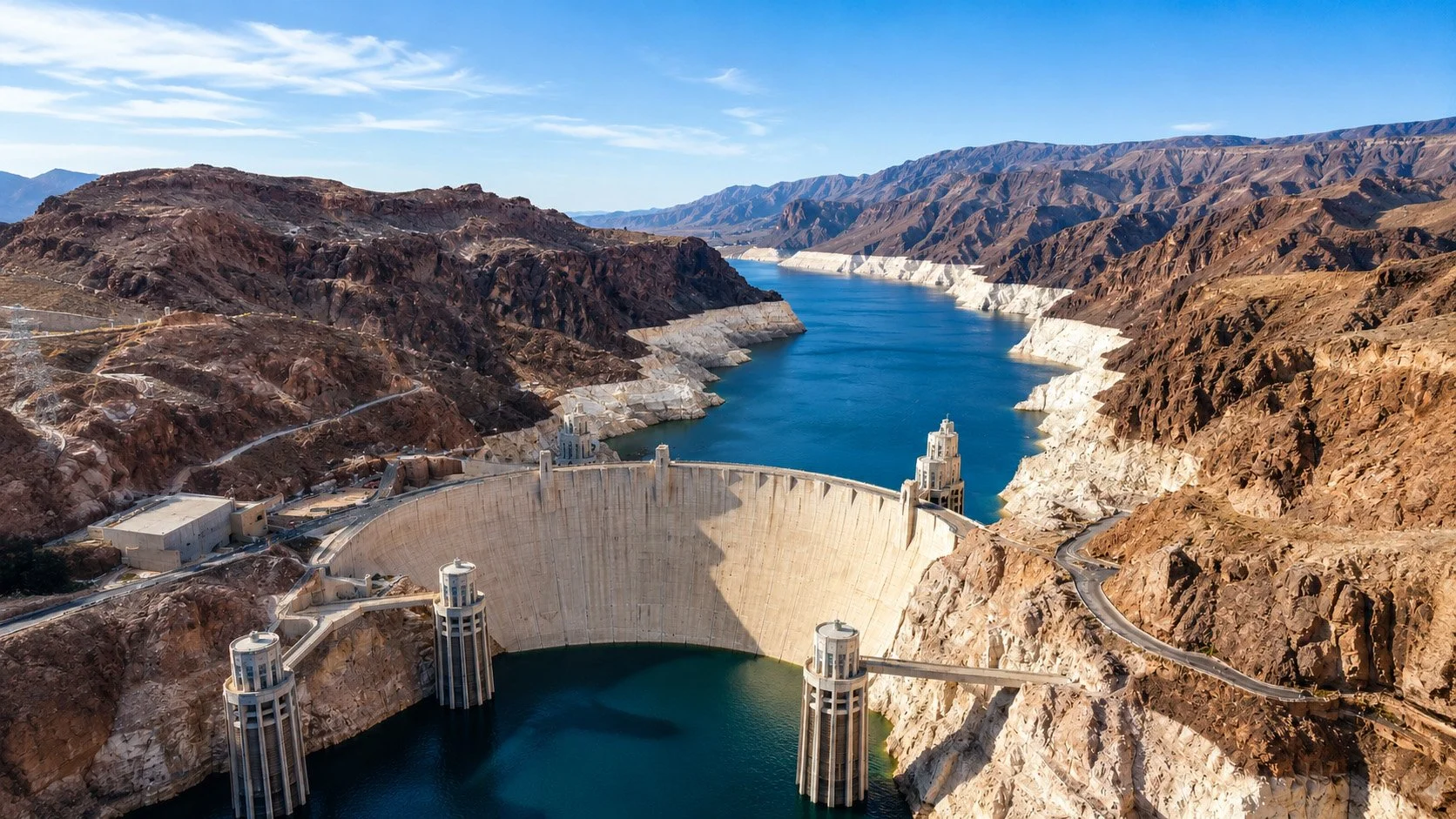
Falling water levels at Lake Mead are threatening one of America’s greatest engineering landmarks — and could sharply reduce Hoover Dam’s ability to generate electricity.
By Publisher Ray Carmen
For nearly a century, Hoover Dam has stood as one of America’s greatest engineering achievements, harnessing the Colorado River to provide water and hydroelectric power across the Southwest.
Today, however, the dam is facing a very different challenge.
The water behind it is disappearing.
If Lake Mead falls to approximately 1,035 feet above sea level, Hoover Dam could lose around 70 per cent of its generating capacity, according to assessments by the US Bureau of Reclamation.
The reason is simple: hydroelectricity depends on water.
As the reservoir falls, there is less water pressure available to drive Hoover Dam’s turbines. At very low levels, many of the dam’s older turbines cannot operate efficiently, leaving only newer units capable of working under reduced-water conditions.
FROM WATER CRISIS TO ENERGY CRISIS
Lake Mead — created by Hoover Dam — is the largest reservoir in the United States and a vital part of the Colorado River system.
Its water supports cities, agriculture and communities across the American Southwest.
But prolonged drought, heavy demand, rising temperatures and changing climate conditions have placed enormous pressure on the river system.
The distinctive white “bathtub rings” now visible around Lake Mead have become one of the most dramatic symbols of America’s growing water crisis.
And the consequences extend beyond water supplies.
A major reduction in Hoover Dam’s electricity output would force energy providers to rely more heavily on other sources of power across Nevada, Arizona, California and the wider region.
It would not mean the Southwest suddenly loses electricity — America’s power grid draws energy from many different sources — but it would remove an important source of flexible hydroelectric generation at a time when electricity demand remains high.
CAN HOOVER DAM ADAPT?
America is already trying to protect the dam’s future.
Modern wide-head turbines are capable of generating electricity at lower reservoir levels, and further upgrades are intended to help Hoover continue operating even as Lake Mead declines.
But technology can only go so far.
No turbine can produce hydroelectricity without sufficient water.
Hoover Dam was built as a monument to mankind’s ability to control nature.
Nearly a century later, it is becoming something else as well:
a warning that even the greatest engineering achievements remain dependent upon the natural world around them.
As Lake Mead falls, Hoover Dam may become one of the clearest symbols yet of the growing connection between water, energy and climate in modern America.
WORLD OF 7 — THE WORLD IS YOUR OYSTER