
CHINA’S 100-TON UNMANNED VESSEL COMPLETES 4,206KM DEEP-SEA VOYAGE
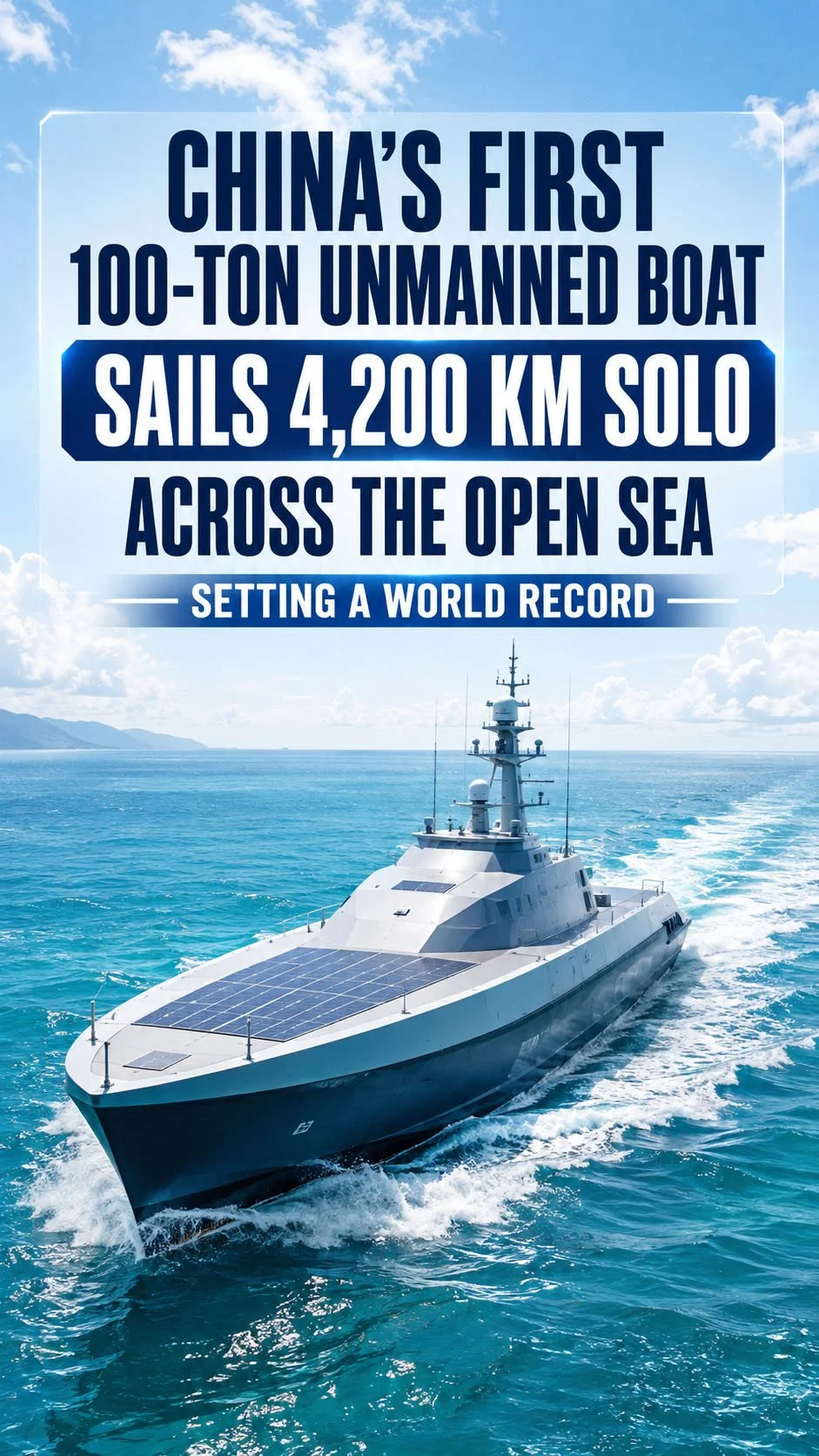
A 248-hour round trip between Zhoushan and Sanya pushed autonomous navigation through fog, darkness and crowded sea lanes—but the “solo world record” headline needs one important qualification.
By Publisher Ray Carmen
THE VOYAGE THAT TURNED HEADS
A vessel with no conventional crew at the controls has completed one of China’s most ambitious autonomous sea trials yet.
China Daily reported on 30 July 2026 that the country’s first domestically produced 100-metric-ton-class unmanned surface vessel had finished a round trip between Zhoushan in Zhejiang province and Sanya in Hainan province.
The reported distance was 4,206 kilometres. The mission lasted 248 hours and took the vessel through high sea conditions, thick fog, low visibility at night and busy shipping traffic.
Those are precisely the conditions that separate a laboratory demonstration from a serious test at sea.
The headline number is striking, but another figure is even more important: autonomous navigation accounted for 96.57% of the voyage.
In other words, the boat handled almost all of the journey autonomously, though not literally every moment of it.
A SHIP THAT COULD SEE, DECIDE AND AVOID
According to Beikun Intelligence, the vessel’s developer, the craft can detect approaching ships and begin an automatic collision-avoidance strategy within 3.7 kilometres.
The company said the system maintains a safe distance of at least 0.55 kilometres before smoothly returning to its planned route.
That behaviour depends on more than a single autopilot.
The vessel combines intelligent assisted navigation, an intelligent engine room and an energy-management system. Zhejiang Artking, Beikun Intelligence’s parent company, says those core systems were developed domestically.
Together, the systems are designed to perceive the surrounding environment, choose a safe path, stabilise the vessel’s heading and distribute power according to changing conditions.
The voyage was therefore a test of the whole platform—sensors, software, propulsion and endurance working as one.
WHY THE 100-TON SCALE MATTERS
Small unmanned boats have been demonstrated for years. A 100-ton-class platform is a different proposition.
Greater size can support more power, longer endurance and a wider range of mission equipment, making autonomous vessels potentially useful for ocean surveying, environmental monitoring, offshore inspection and operations in waters that may be dangerous for human crews.
The technology is not simply about removing people from a bridge.
It is about building a vessel capable of understanding risk in a constantly moving environment, where weather, waves, fishing boats and commercial traffic can change the situation in seconds.
THE RECORD CLAIM, CAREFULLY STATED
China Daily described the journey as a record for autonomous navigation by an unmanned vessel on a deep-sea voyage and as China’s first ultra-long-distance deep-sea autonomous navigation mission of its kind.
WORLD OF 7 has not found an independent international record body confirming a universal “world record” category for this voyage.
The most accurate publication wording is therefore “a reported deep-sea autonomous-navigation record” rather than an unqualified world record.
The same care applies to the word “solo”.
The craft was unmanned and navigated autonomously for 96.57% of the mission, but the published figure does not support saying that 100% of the 4,206-kilometre trip was autonomous.
WHAT THIS COULD CHANGE
If systems like this prove reliable over repeated voyages, they could change how countries and companies inspect coastlines, map seabeds, monitor marine conditions and reach remote waters.
Unmanned vessels can remain at sea without the accommodation, fatigue limits and life-support needs of a conventional crewed ship.
But autonomy at sea also raises hard questions about regulation, responsibility, cybersecurity and how an unmanned craft should communicate its intentions to other vessels.
A successful trial is a major technical milestone. Turning that milestone into routine, safe operation will require transparent standards and many more hours at sea.
FINAL WORD
China’s 4,206-kilometre voyage is impressive not because a machine simply followed a line on a map, but because it reportedly kept making decisions through fog, darkness, rougher water and live traffic.
The future of shipping may not arrive with an empty bridge overnight—but this voyage shows that it is already moving beyond the harbour.
WORLD OF 7 VERDICT
A genuine autonomous-navigation milestone, reported with one essential correction: the voyage was 96.57% autonomous, so “almost entirely autonomous” is more accurate than “completely solo”.
FACT CHECK
VERIFIED WITH QUALIFICATION.
China Daily reported a 4,206km round trip lasting 248 hours, with autonomous navigation accounting for 96.57% of the voyage.
Its record description is source-based. An independently adjudicated universal world-record listing was not located.