
57 COUNTRIES — ONE EXTRAORDINARY HUMAN TAPESTRY
By Publisher Ray Carmen
The phrase “57 Muslim countries” is widely used—but what does the number actually mean?
The figure refers to the 57 member states of the Organisation of Islamic Cooperation, known as the OIC. It is a membership total, rather than an exact count of Muslim-majority countries.
That distinction matters because the OIC includes both overwhelmingly Muslim nations and religiously diverse societies. The most accurate description is therefore: the 57 member states of the Organisation of Islamic Cooperation.
Together, these countries form one of the world’s most remarkable cultural communities.
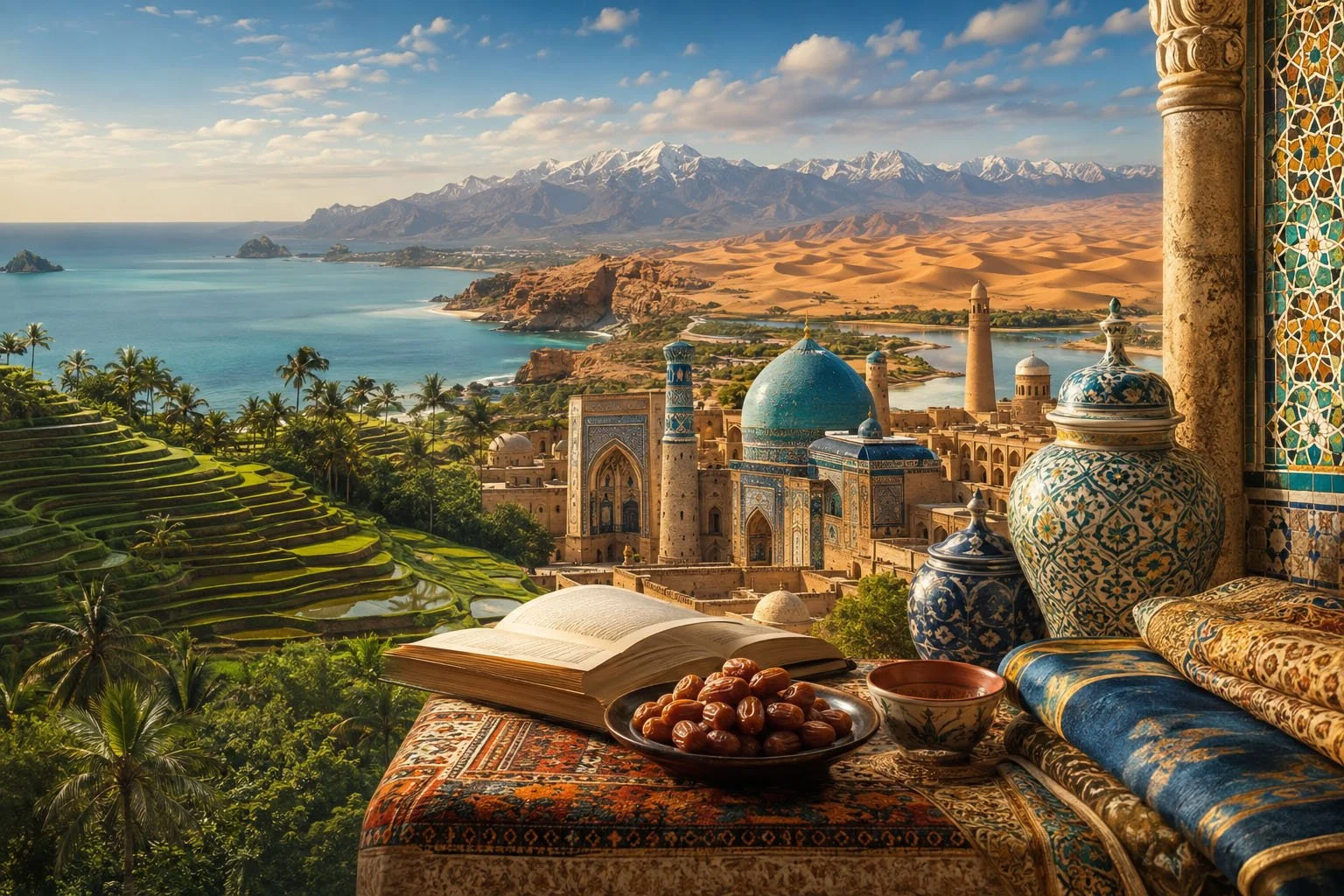
Their geography stretches from the Atlantic shores of West Africa to the tropical islands of Southeast Asia, and from Central Asia’s mountains and steppes to the deserts of Arabia and North Africa. OIC members also include Albania in Europe and Guyana and Suriname in South America.
The Muslim world extends far beyond the Middle East. Indonesia has the world’s largest Muslim population, while Pakistan and Bangladesh are also among its most populous nations. India, although neither an OIC member nor Muslim-majority, is home to one of the world’s largest Muslim communities.
This enormous world contains hundreds of languages, including Arabic, Turkish, Persian, Urdu, Bengali, Malay, Bahasa Indonesia, Hausa, Swahili, Somali, French, English, Uzbek and Kazakh.
Its cultural traditions are equally varied. Moroccan tilework, Indonesian batik, Uzbek ceramics, Malaysian woodcarving and West African weaving each reflect distinctive local histories.
Food provides another delicious window into this diversity: Senegalese thieboudienne, Moroccan tagine, Egyptian koshari, Turkish breads, Uzbek plov, Pakistani biryani, Malaysian nasi lemak and Indonesian rendang.
Across many of these societies, hospitality remains deeply valued. Tea, coffee, dates, bread and communal meals frequently express welcome, generosity and belonging.
The Muslim world has also made an immense contribution to human knowledge. Historic centres such as Baghdad, Cairo, Fez, Timbuktu and Bukhara became meeting places for scholars working in mathematics, medicine, astronomy, literature and philosophy.
The figure 57 is therefore correct—provided we explain what it represents.
These are 57 OIC member states connected through heritage and cooperation, but they cannot be reduced to one language, culture or way of life.
Their true story is the astonishing variety within them: islands and deserts, ancient cities and modern skylines, scholarship and craftsmanship, music, food and countless expressions of community.
WORLD OF 7 — ONE PLANET. 7 CONTINENTS. ONE WEEKLY GLOBAL VIEW.