
By Publisher Ray Carmen
America honours the late Egyptian president with the Congressional Gold Medal, recognising a historic act of statesmanship that changed the Middle East forever.
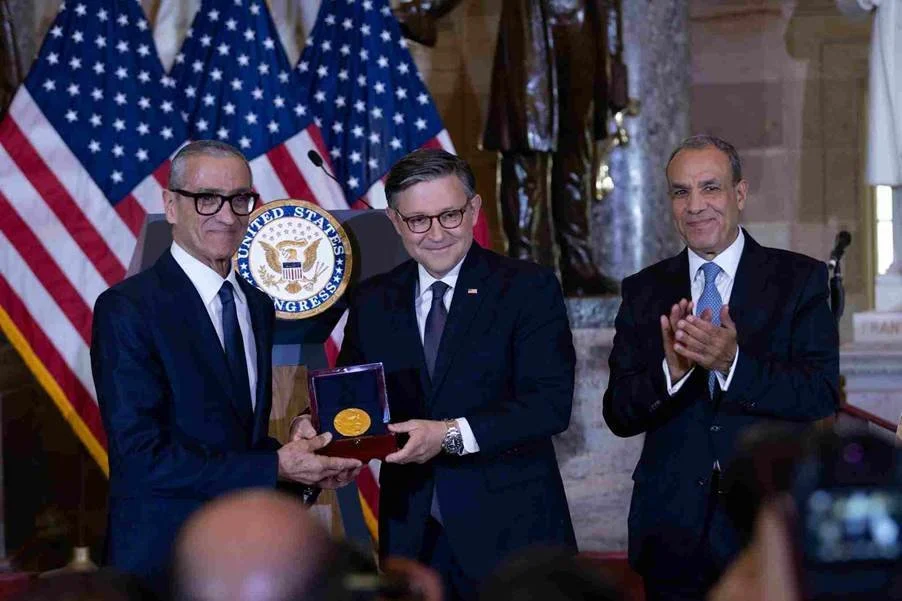
L-R: Gamal Sadat, Speaker Mike Johnson, Dr H.E. Dr. Badr Abdelatty
Nearly half a century after he extended a hand of peace to Israel, the late Egyptian President Anwar El-Sadat has been honoured with one of America’s highest civilian distinctions — the Congressional Gold Medal.
At a prestigious ceremony held at the United States Capitol in Washington, D.C., on 18 November, the medal was presented to his son, Gamal El-Sadat, in recognition of his father’s historic leadership in securing the landmark 1979 Egypt-Israel Peace Treaty.
A historic moment in Washington
Approximately 250 guests attended the ceremony, including members of Congress, Egyptian diplomats, international dignitaries and prominent business figures.
Among those present were US Speaker of the House Mike Johnson, Egyptian Foreign Minister Dr Badr Abdelatty and Egyptian businessman and philanthropist Shafik Gabr, who supported the decade-long campaign to secure the honour.
For the Sadat family, the occasion was both a celebration of his achievements and a deeply personal moment of remembrance.
“Today has been an incredibly poignant day for my family and for Egypt. My father loved Egypt and its people. He was determined no more blood should be shed between either Egypt or Israel,” said Gamal El-Sadat.
“Almost 50 years on, we continue to benefit from the peace he courageously achieved. This honour is testament to his bravery, his vision, and his enduring legacy as an international symbol of peace.”
The journey that changed history
In November 1977, Anwar Sadat stunned the international community by becoming the first Arab leader to visit Israel.
His historic address to the Israeli parliament in Jerusalem marked a dramatic departure from decades of hostility.
Working alongside Israeli Prime Minister Menachem Begin and US President Jimmy Carter, Sadat helped negotiate the Camp David Accords in September 1978.
That same year, Sadat and Begin jointly received the Nobel Peace Prize.
On 26 March 1979, Egypt and Israel signed their landmark peace treaty at the White House, making Egypt the first Arab nation to formally establish peace with Israel.
It was a diplomatic breakthrough that many had considered impossible.
The courage to choose dialogue
Sadat’s decision came at enormous political and personal cost.
His initiative attracted fierce opposition both at home and across the Arab world, with critics concerned that a separate peace agreement would leave the Palestinian question unresolved.
Nevertheless, Sadat remained committed to his diplomatic course.
Egyptian businessman and philanthropist Shafik Gabr reflected on the enduring significance of his achievements.
“President Sadat achieved something extraordinary. He recognised that lasting peace could only be achieved by focusing on humility and engaging face to face with the other side, understanding them and finding both common ground and common interest.
“Almost five decades later, the agreement he helped secure still stands. At a time when conflict continues to devastate communities around the world, his legacy is a powerful reminder of what courage, dialogue and mutual understanding can achieve.
“We must learn from his example if we are to build a more peaceful future.”
A legacy that outlived its architect
On 6 October 1981, Anwar Sadat was assassinated in Cairo.
He was just 62 years old.
Yet the historic agreement he helped establish survived his death, successive governments, regional upheavals and decades of political uncertainty.
The Egyptian-Israeli peace treaty remains in force.
The wider ambition of a comprehensive Middle Eastern peace, however, remains unfinished. The Palestinian people’s aspirations for statehood, dignity, security and self-determination continue to demand meaningful international attention, alongside the need for security and peaceful coexistence throughout the region.
A message for the seven continents
The Congressional Gold Medal is more than a posthumous recognition of an Egyptian statesman.
It offers an opportunity for leaders across the world to reflect on the possibilities of diplomacy, the consequences of war and the courage required to pursue reconciliation.
From Africa to Asia, Europe to the Americas and beyond, humanity continues to face the challenge of resolving its differences without destroying the lives of innocent people.
Anwar Sadat’s legacy reminds us that dialogue need not be a sign of weakness, that former enemies need not remain enemies forever, and that political courage can alter the course of history.
The greatest legacy a leader can leave behind is not the territory conquered, but the generations spared the suffering of war.
WORLD OF 7
ONE WORLD. SEVEN CONTINENTS. INFINITE STORIES.