
THE WORLD OF TROPICAL FRUITS & NUTS
By Publisher Ray Carmen
Sun-ripened, rain-washed and gloriously colourful, tropical fruits and nuts connect orchards, islands, markets and kitchens across the world.
There is no single taste of the tropics.
There is the perfume of mango, the bright tang of passion fruit, the creamy calm of coconut, the delicate sweetness of mangosteen and the buttery richness of cashews and macadamias.
Together, they create one of the world’s most exciting edible landscapes.
A WORLD OF FLAVOUR
Across the Caribbean, Central and South America, Africa, Asia, Australia and the Pacific, tropical produce is far more than refreshment.
Fruit marks the seasons, fills market stalls and appears in family recipes passed from one generation to the next.
Mangoes, bananas, pineapples, papayas and coconuts may be familiar around the world, but they are only the beginning.
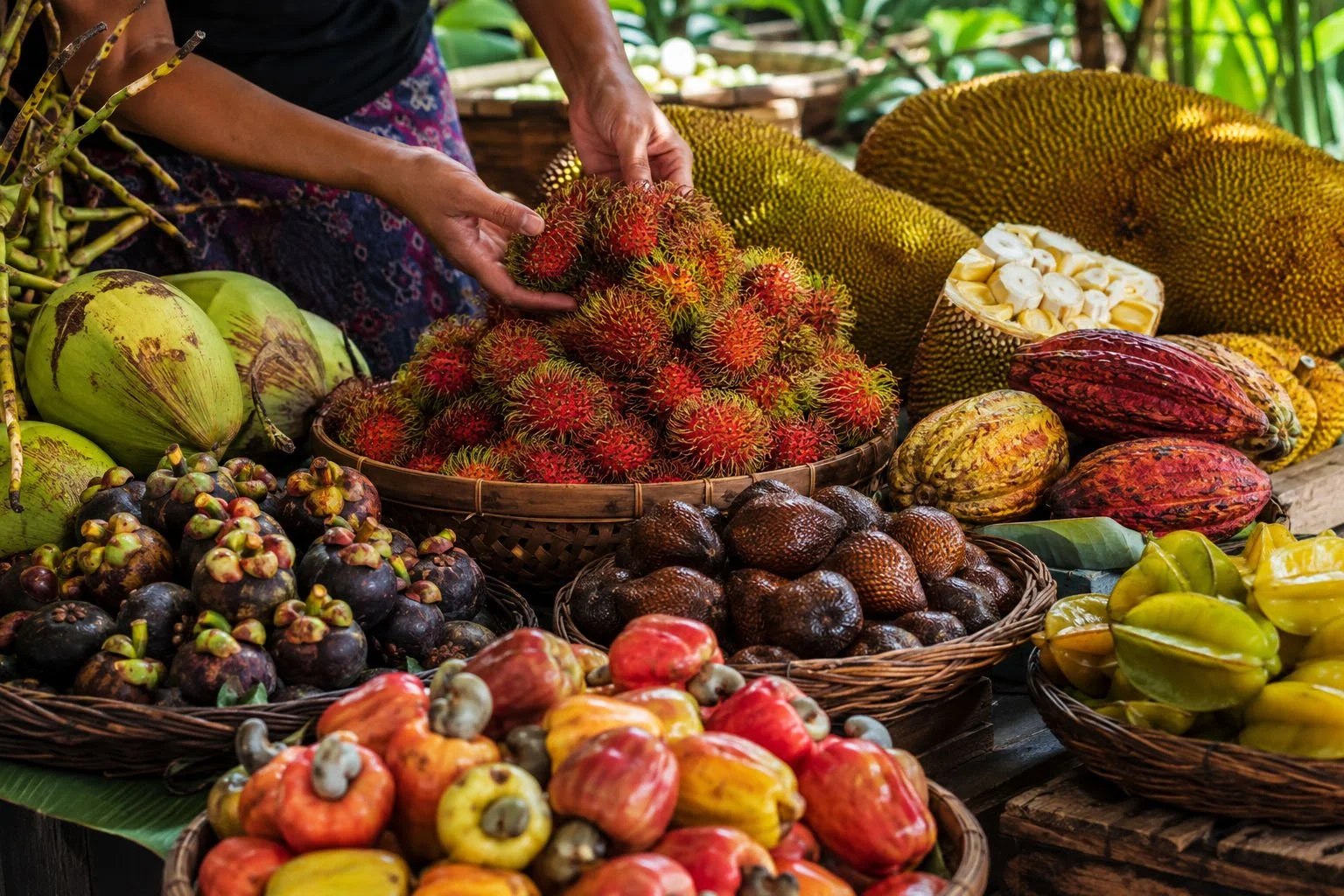
There is rambutan in its crimson fringe; jackfruit, enormous and fragrant; soursop with its soft, tart flesh; star fruit with its crisp freshness; breadfruit, roasted or fried as a nourishing staple; and durian, whose powerful aroma inspires both devotion and debate.
Many varieties rarely travel beyond their place of origin. They ripen quickly, bruise easily and often taste best close to the tree.
FRUIT WITH A SENSE OF PLACE
Tropical fruit possesses intensely local character.
A mango grown in India may taste completely different from one cultivated in Jamaica, Mexico, Kenya or the Philippines. Each variety has its own balance of fragrance, sweetness, acidity and texture.
Traditional varieties also preserve agricultural history and genetic diversity. They remind us that perfect appearance is not the same as perfect flavour.
The finest fruit may be irregular, freckled and so ripe that its juice runs down the wrist.
In tropical markets, choosing fruit is an art. Colour offers one clue, but fragrance, firmness and season reveal the fuller story. Each basket becomes a lesson in place, ripeness and memory.
THE NUTS THAT ARE NOT ALWAYS NUTS
Tropical “nuts” bring some delightful botanical surprises.
The coconut is the seed of a fibrous fruit. The cashew kernel grows outside its juicy cashew apple. Brazil nuts develop inside a heavy, woody fruit produced by towering Amazonian trees. Macadamias hide behind remarkably hard shells.
In the kitchen, their character matters more than their classification.
Coconut provides water, milk, cream, oil and toasted sweetness. Cashews become sauces, sweets and velvety creams. Macadamias offer a luxurious crunch, while Brazil and pili nuts bring deep, buttery richness.
FROM ORCHARD TO TABLE
Chefs are increasingly treating tropical produce with the seriousness once reserved for wine.
Green mango is folded into sharp salads. Pineapple is grilled with chilli and lime. Breadfruit is roasted, cacao pulp is fermented and mangosteen is served almost untouched.
Nuts may be toasted, smoked, pressed into milk or ground into sauces.
The best dishes allow the ingredients to lead. When fruit is perfectly ripe and nuts are freshly toasted, very little decoration is required.
A FUTURE WORTH CULTIVATING
The future of tropical fruits and nuts depends upon protecting the environments and communities that produce them.
Climate pressure, plant disease, habitat loss and unstable markets threaten harvests and livelihoods. Sustainable farming, crop diversity, responsible trade and fairer returns for growers are essential.
Consumers can help by buying seasonally, exploring unfamiliar varieties and choosing produce grown and traded with care.
Every tropical fruit carries a journey—from flower to rainstorm, from patient hands to crowded market, and from local memory to tables around the world.
Cut one open and the world appears: vivid, generous and full of flavour.
ONE PLANET. ENDLESS FLAVOURS. A WORLD WAITING TO BE TASTED.