
FROM SAND TO SALAD: DUBAI’S MILLION-KILO VERTICAL FARM
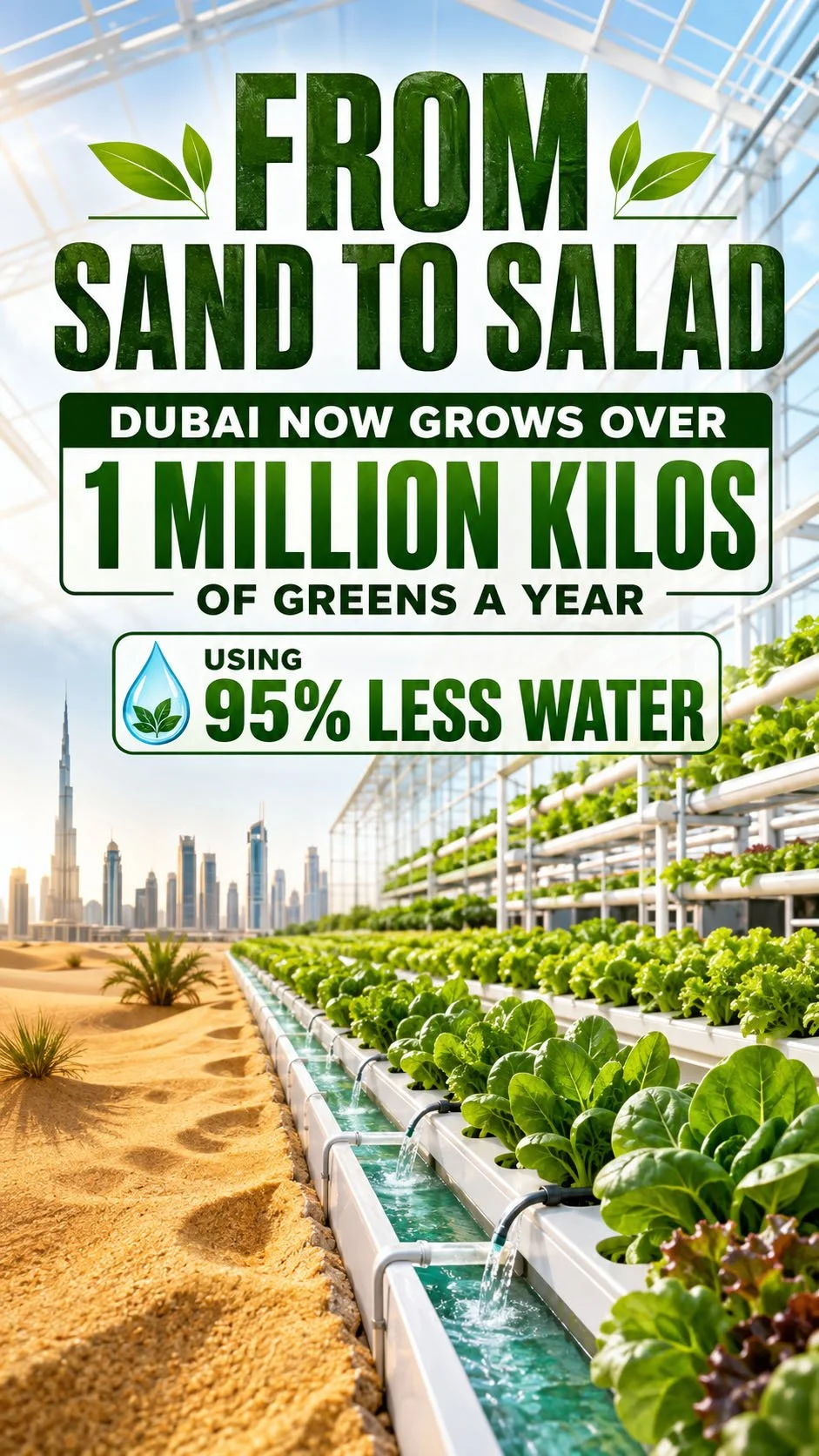
Inside the high-tech facility designed to produce more than one million kilograms of leafy greens a year while using 95% less water than conventional agriculture.
By Publisher Ray Carmen
A GREEN WALL IN THE DESERT
Dubai is famous for building where the landscape says building should be difficult.
At Bustanica, near Al Maktoum International Airport at Dubai World Central, that same instinct has been applied to food.
The indoor hydroponic facility covers 330,000 square feet and was opened in July 2022 after a reported US$40 million investment.
According to Emirates, it was designed to produce more than one million kilograms of leafy greens a year—roughly three tonnes a day—while using 95% less water than conventional agriculture.
This is farming without open fields, fertile soil or seasonal weather.
Instead, crops grow in stacked, carefully controlled rooms where water, nutrients, temperature and light can be managed throughout the year.
THE WATER LOOP
The heart of the operation is a closed-loop water system.
Water is delivered directly to the plants, circulated through the growing system and recovered when it vaporises. That allows the same resource to be used repeatedly instead of being lost into dry ground or the atmosphere.
Emirates said the design can save more than 250 million litres of water each year compared with traditional outdoor farming producing the same volume.
In a region where freshwater security matters as much as food security, that figure explains why vertical farming has attracted such attention.
FARMING WITHOUT SOIL
Bustanica grows leafy crops including lettuce, arugula, mixed salad greens, spinach, parsley and kale.
The operator says the continuous indoor production cycle avoids pesticides and herbicides, protects crops from outdoor pests and enables clean produce to move quickly into local retail and catering supply chains.
Some of the greens are served on Emirates and other airline flights.
The brand has also been sold through major UAE retailers, shortening the distance between farm and plate in a market that has historically depended heavily on imported food.
WHY DUBAI IS DOING THIS
The United Arab Emirates faces severe heat, limited arable land and scarce freshwater.
Indoor agriculture cannot replace every conventional crop, but it can help produce delicate, high-value greens close to the people who will eat them.
Local production can also reduce exposure to disrupted shipping routes, extreme weather abroad and long refrigerated supply chains.
In 2024, Emirates Flight Catering completed its acquisition of Bustanica, making the operation fully UAE-owned and tying it even more closely to the country’s food- and water-security ambitions.
THE BIGGER ENVIRONMENTAL QUESTION
Using 95% less water is a powerful achievement, but water efficiency is not the entire environmental equation.
Indoor farms require electricity for pumps, climate control and, in many systems, artificial lighting.
Their overall footprint depends on the energy source, equipment efficiency, construction and the conventional supply chain they replace.
That does not erase the water saving.
It simply means the most responsible conclusion is also the most complete one: Bustanica demonstrates how technology can produce large volumes of fresh greens in an arid climate, while the full sustainability picture depends on more than one headline percentage.
FINAL WORD
From the air, Dubai’s desert still looks like one of the least likely places to grow salad at industrial scale.
Inside Bustanica, that limitation becomes the point.
The farm does not wait for the desert to turn green—it creates a controlled green world of its own, one recycled drop at a time.
WORLD OF 7 VERDICT
The million-kilo and 95%-less-water figures are supported as Bustanica’s published annual capacity and efficiency claims.
The story is real, but “capacity to produce” is more precise than presenting the number as an independently audited annual harvest total.
FACT CHECK
VERIFIED WITH CONTEXT.
Emirates and Bustanica state that the 330,000-square-foot facility has the capacity to produce more than one million kilograms of leafy greens annually—approximately three tonnes daily—while using 95% less water than conventional agriculture.
These are operator-published capacity and comparison figures, not an independent production audit.