
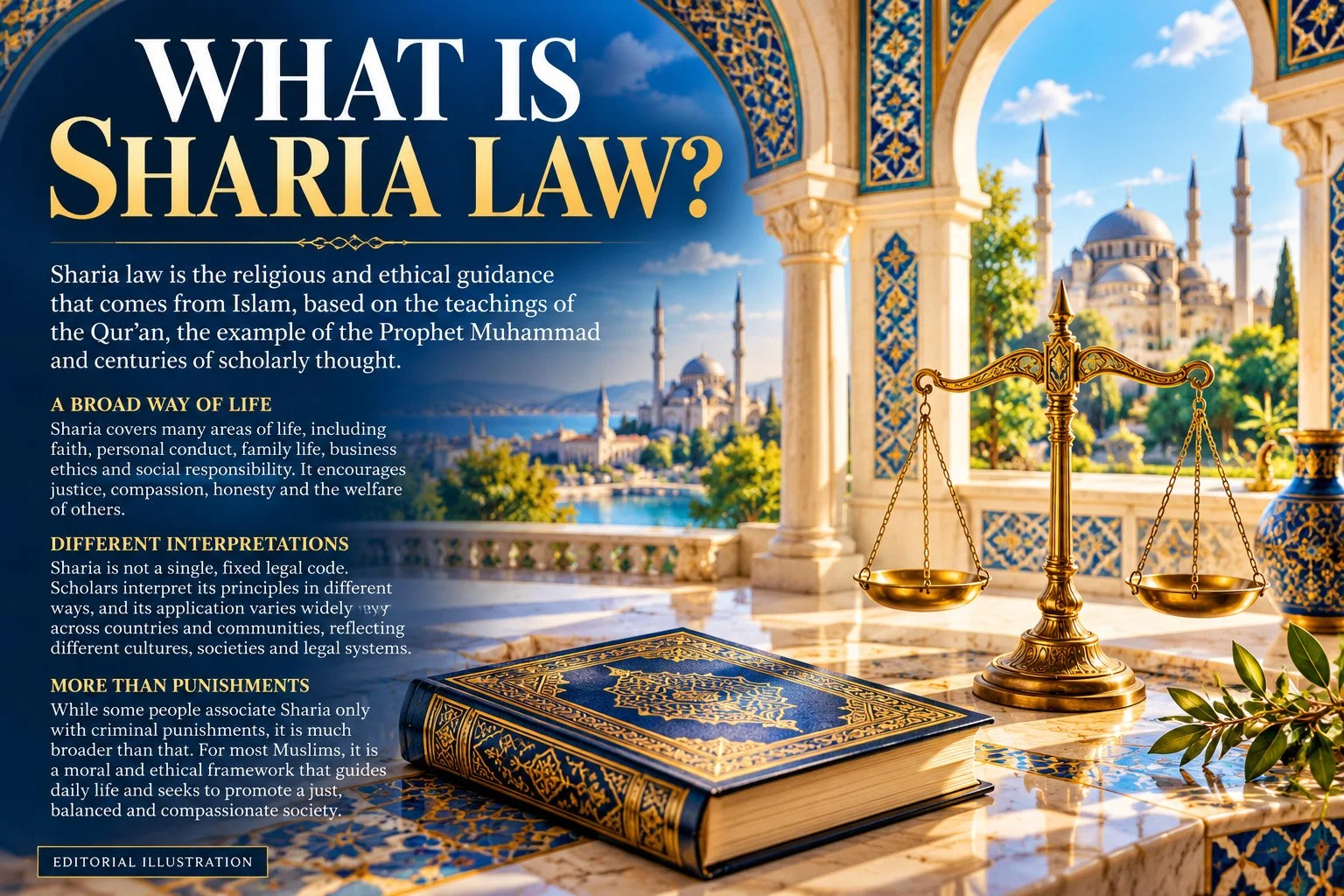
Understanding Islamic principles, the many interpretations of religious law, and what it means in Britain and beyond
By Publisher Ray Carmen
Sharia is often discussed in headlines but rarely explained in full. For Muslims, it can shape daily worship and ethics; for governments, its legal role can differ dramatically. Understanding that distinction is the starting point for an informed conversation.
What does Sharia mean?
The Arabic word Sharia is commonly understood as “the path” or “the way”, traditionally associated with a path to water. In Islam, it refers broadly to divine guidance for how to live, encompassing religious duties, ethical behaviour and, in some interpretations, legal obligations.
Calling it simply a criminal code is misleading. For many Muslims its most immediate expression is prayer, fasting during Ramadan, charity, personal integrity and care for others.
Where does it come from?
The Qur’an and the Sunnah — the example and teachings associated with the Prophet Muhammad — are foundational sources. Muslim scholars also interpret these sources through methods such as consensus, analogy and independent reasoning.
A distinction matters: Sharia is often described by believers as God’s ideal guidance; fiqh is human jurisprudence, the scholars’ effort to understand and apply it. Because interpretation is human, fiqh can differ across centuries, communities and schools of thought.
What does Sharia cover in ordinary life?
It can address worship, charity, diet, marriage, divorce, inheritance, commercial dealings, debt and the treatment of neighbours and strangers. Islamic finance, for example, uses interpretations of Sharia that discourage interest-based lending and certain forms of excessive uncertainty.
Its ethical vocabulary includes justice, honesty, compassion and social responsibility. Yet disagreement exists over how these values translate into modern laws, individual rights and public policy.
Is there one Sharia law for the whole world?
No. The four major Sunni schools of jurisprudence — Hanafi, Maliki, Shafi‘i and Hanbali — and the Ja‘fari tradition followed by many Shia Muslims have different methods and rulings. Reformist, traditionalist and other contemporary Muslim thinkers also disagree on how ancient texts should be interpreted today.
National systems differ too. Some countries incorporate interpretations of Islamic law primarily into family matters, while others use them more widely, sometimes including criminal law. Still others maintain largely civil or secular legal systems. There is no single worldwide Sharia statute book.
Why is Sharia controversial?
Public controversy often centres on gender equality, freedom of religion, freedom of expression and criminal penalties. Some governments have enforced harsh punishments in the name of Sharia; these practices face serious human-rights criticism. Laws governing marriage, divorce and inheritance can also give women and men different rights.
Muslims do not hold one uniform position on these questions. Some defend classical legal interpretations, while others argue for approaches centred on equality, consent and contemporary human-rights standards. Criticising a government’s law is not the same as making a judgement about every Muslim or Islamic religious practice.
Does Sharia law operate in Britain?
In England and Wales, Sharia has no jurisdiction as a separate legal system. Parliament confirmed again in March and June 2026 that decisions of Sharia councils are not legally binding and that national law prevails whenever there is a conflict.
Independent Sharia councils do exist and typically provide religious advice, particularly on Islamic marriage and divorce. But they are not state courts and cannot replace civil courts. The distinction matters especially where a couple has had only a religious marriage ceremony: legal recognition and the protection of civil family law may depend on whether the marriage was validly registered or solemnised under the applicable law.
The UK’s 2018 independent review raised concerns about women’s experiences and possible discriminatory practices in some councils, while also recognising the importance of religious freedom. The governing principle remains equal protection under civil law.
The bigger picture
To understand Sharia, it helps to ask three separate questions: What does a particular Muslim believe? What interpretation does a scholar or community follow? And what law does a particular country actually enforce? Those answers are not interchangeable.
In essence, Sharia is a broad Islamic moral and religious tradition, not one identical set of state laws imposed everywhere. Explaining it carefully means recognising both its everyday spiritual importance to believers and the genuine debate over how religious principles should — or should not — become public law.