
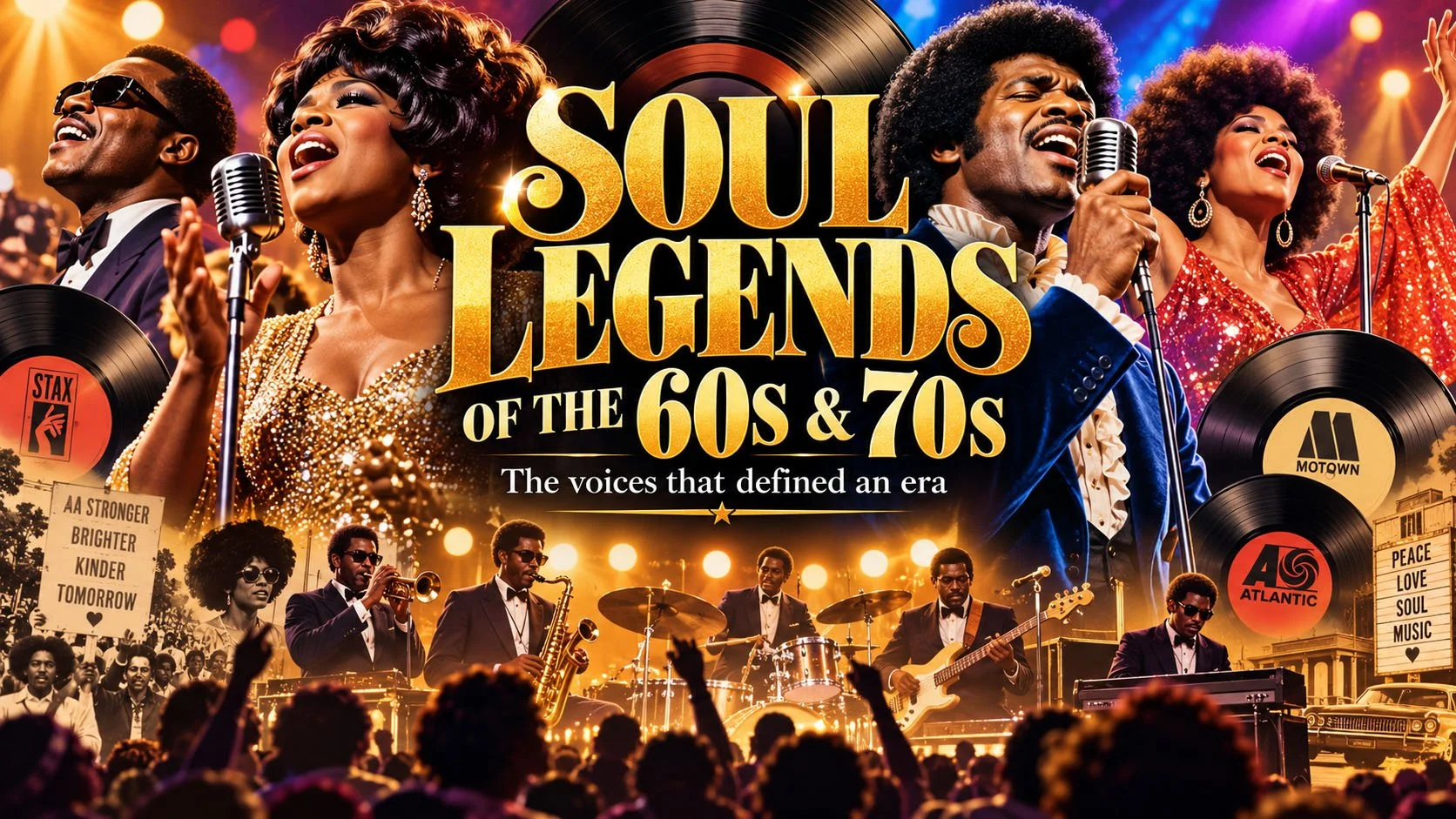
THE VOICES THAT DEFINED AN ERA
By Publisher Ray Carmen
They sang of love, heartbreak, freedom, equality and hope. Their voices transformed popular music, crossed racial and cultural boundaries, and gave the world songs that remain unforgettable more than half a century later.
WHEN MUSIC HAD A SOUL
There was something extraordinary about the music of the 1960s and 1970s.
A single voice could fill a room with emotion.
A melody could transport listeners into another world.
And a song could become an anthem for an entire generation.
This was the golden age of soul music.
From the recording studios of Detroit to the musical heart of Memphis, from the churches of the American South to the international concert stages, an extraordinary collection of singers changed popular music forever.
Their names became legendary.
Aretha Franklin.
Otis Redding.
Marvin Gaye.
Stevie Wonder.
Diana Ross.
Sam Cooke.
Al Green.
Gladys Knight.
The Temptations.
The Four Tops.
And so many more.
Their music was not simply entertainment.
It was an expression of human experience.
Love. Pain. Joy. Freedom. Dignity. Hope.
These were the emotions that gave soul music its extraordinary power.
THE BIRTH OF A MUSICAL REVOLUTION
Soul music emerged from a remarkable combination of African American gospel, rhythm and blues, jazz and blues traditions.
Its roots were deeply connected to the Black American experience.
Gospel music contributed emotional intensity and powerful vocal expression.
Rhythm and blues supplied irresistible rhythms.
Jazz brought musical sophistication.
And the blues gave soul music its extraordinary ability to communicate sorrow, longing and resilience.
By the early 1960s, this musical combination was reaching an increasingly international audience.
It would become one of the most influential developments in modern popular culture.
MOTOWN — THE SOUND OF YOUNG AMERICA
In Detroit, a young entrepreneur named Berry Gordy established Motown Records in 1959.
What followed was a musical revolution.
Motown created a distinctive sound combining memorable melodies, polished arrangements, driving rhythms and extraordinary vocal performances.
Its artists became international stars.
The Supremes, led by Diana Ross, delivered unforgettable hits including Baby Love and Stop! In the Name of Love.
The Temptations brought magnificent vocal harmonies to recordings such as My Girl and Papa Was a Rollin’ Stone.
The Four Tops captivated audiences with Reach Out I’ll Be There.
Smokey Robinson and the Miracles created some of the most beautiful love songs of the era.
And a young Stevie Wonder emerged as one of the most remarkable musical talents of his generation.
Motown demonstrated that Black American artists could achieve enormous international commercial success while maintaining a distinctive musical identity.
Its influence reached Britain, Europe, the Caribbean and beyond.
ARETHA FRANKLIN — THE QUEEN OF SOUL
Few voices in the history of popular music have possessed the extraordinary emotional power of Aretha Franklin.
Born in Memphis and raised in Detroit, she developed her musical abilities through the gospel tradition.
Her recordings combined technical brilliance with an unmistakable sense of conviction.
In 1967, Respect became one of the defining songs of the decade.
Originally recorded by Otis Redding, Aretha transformed the song into a powerful declaration of dignity and self-worth.
It became associated with both the civil rights and women’s movements.
Her performances of Chain of Fools, Think and I Say a Little Prayer further established her international reputation.
Aretha Franklin did not merely sing songs.
She made audiences feel every word.
OTIS REDDING — THE HEART OF MEMPHIS SOUL
Otis Redding possessed one of the most distinctive voices in American music.
His performances were passionate, direct and deeply emotional.
Working closely with Stax Records in Memphis, he helped define the sound of Southern soul.
Songs such as Try a Little Tenderness and I’ve Been Loving You Too Long demonstrated his extraordinary ability to communicate vulnerability.
His recording of (Sittin’ On) The Dock of the Bay became an enduring classic.
Tragically, Redding died in a plane crash in December 1967, aged just 26.
The song was released after his death and became his first American number-one pop hit.
His career was painfully short.
His musical influence remains immense.
MARVIN GAYE — THE VOICE OF LOVE AND CONSCIENCE
Marvin Gaye brought elegance, tenderness and emotional sophistication to soul music.
His early Motown recordings included memorable romantic performances and celebrated duets with Tammi Terrell.
But in 1971, he released an album that transformed the possibilities of popular music.
What’s Going On explored war, poverty, racial injustice and environmental concerns.
It demonstrated that soul music could address the most serious questions facing society.
Later recordings such as Let’s Get It On and Sexual Healing revealed other dimensions of his extraordinary artistry.
Marvin Gaye’s voice could be gentle, passionate, questioning or deeply troubled.
He helped establish the soul album as a powerful form of artistic expression.
STEVIE WONDER — THE MUSICAL GENIUS
Stevie Wonder began his career as a child prodigy at Motown.
By the 1970s, he had become one of the most innovative musicians in the world.
His remarkable command of keyboards, harmonica, songwriting and production helped redefine popular music.
Albums including Talking Book, Innervisions and Songs in the Key of Life demonstrated extraordinary musical imagination.
Superstition became a funk masterpiece.
You Are the Sunshine of My Life celebrated romantic devotion.
Isn’t She Lovely expressed the joy of fatherhood.
And Living for the City confronted social injustice.
Stevie Wonder united musical sophistication with an extraordinary ability to reach ordinary listeners.
His songs continue to inspire audiences across generations.
THE TEMPTATIONS — HARMONY AT ITS FINEST
The Temptations became one of Motown’s most successful vocal groups.
Their elegant choreography, immaculate presentation and magnificent harmonies made them international favourites.
Songs including My Girl, Ain’t Too Proud to Beg and Just My Imagination remain among the most beloved recordings of the era.
During the late 1960s and early 1970s, the group also embraced more experimental and socially conscious material.
Their evolving sound reflected the changing cultural atmosphere of America.
They helped demonstrate that a vocal group could combine sophisticated entertainment with artistic innovation.
AL GREEN — THE VOICE OF ROMANCE
Few soul singers could communicate romantic tenderness quite like Al Green.
His smooth, expressive voice became one of the defining sounds of the early 1970s.
Working with producer Willie Mitchell in Memphis, Green recorded a remarkable series of hits.
Let’s Stay Together became an international favourite.
Tired of Being Alone captured the loneliness of lost love.
And Love and Happiness combined irresistible rhythm with emotional warmth.
His recordings remain essential listening for admirers of classic soul.
GLADYS KNIGHT — THE EMPRESS OF SOUL
Gladys Knight’s extraordinary voice brought warmth, strength and emotional honesty to every performance.
With the Pips, she recorded a succession of memorable songs.
I Heard It Through the Grapevine became an important early hit.
Neither One of Us (Wants to Be the First to Say Goodbye) revealed the group’s remarkable sensitivity.
And Midnight Train to Georgia became one of the defining recordings of the 1970s.
Her vocal performances demonstrated that emotional storytelling was at the heart of great soul music.
THE MUSIC THAT CHANGED SOCIETY
The rise of soul music coincided with profound political and social change.
The American civil rights movement challenged racial segregation and discrimination.
Artists increasingly used their music to express demands for dignity, equality and justice.
Songs became associated with public demonstrations, community gatherings and movements for change.
The Staple Singers brought gospel-rooted messages of hope and empowerment to a wider audience.
Curtis Mayfield explored social responsibility, racial inequality and the struggles of urban life.
Marvin Gaye questioned war and injustice.
Aretha Franklin gave powerful musical expression to dignity and independence.
Soul music helped bring important social conversations into popular culture.
FROM AMERICA TO BRITAIN AND THE CARIBBEAN
Soul music quickly travelled beyond the United States.
In Britain, American soul recordings found enthusiastic audiences in clubs, dance halls and concert venues.
Motown and Northern soul became important parts of British musical culture.
Across the Caribbean, soul music was embraced by audiences who appreciated its emotional intensity, romantic melodies and powerful rhythms.
Its influence could be heard in reggae, lovers rock and other Caribbean musical traditions.
Artists and producers drew inspiration from American soul while developing their own distinctive sounds.
The connection between soul and Caribbean music became part of a wider international musical exchange.
What began in American recording studios had become a global cultural movement.
THE RECORD LABELS THAT MADE HISTORY
Three great recording traditions helped shape the golden age of soul.
MOTOWN — DETROIT
The home of polished arrangements, unforgettable melodies and extraordinary vocal groups.
STAX — MEMPHIS
A centre of powerful Southern soul, celebrated for its gospel influence, driving rhythms and remarkable musicians.
ATLANTIC RECORDS — NEW YORK
A major force in rhythm and blues and soul, associated with artists including Aretha Franklin, Ray Charles and Wilson Pickett.
During the 1970s, Philadelphia International Records also became enormously influential, introducing the sophisticated Philadelphia soul sound.
Together, these labels and their artists helped transform popular music.
SEVEN SOUL CLASSICS THE WORLD WILL NEVER FORGET
1. Aretha Franklin — Respect (1967)
An unforgettable declaration of dignity and independence.
2. Otis Redding — (Sittin’ On) The Dock of the Bay (1968)
A timeless expression of reflection and longing.
3. Marvin Gaye — What’s Going On (1971)
A powerful musical appeal for understanding and social change.
4. Al Green — Let’s Stay Together (1971)
One of the most beautiful romantic soul recordings ever made.
5. The Temptations — My Girl (1964)
A magnificent celebration of love and vocal harmony.
6. Stevie Wonder — Superstition (1972)
An irresistible masterpiece of rhythm, innovation and musical imagination.
7. Gladys Knight & the Pips — Midnight Train to Georgia (1973)
An extraordinary story of love, loyalty and sacrifice.
THE VOICES WILL NEVER FADE
More than half a century has passed since many of these remarkable recordings first reached the charts.
Yet their appeal remains undiminished.
Their songs continue to accompany weddings, celebrations, romantic evenings and moments of personal reflection.
Young musicians discover their recordings.
Established performers reinterpret their classics.
And audiences continue to appreciate the extraordinary artistry of the original performers.
The soul legends of the 1960s and 1970s did something remarkable.
They transformed personal emotions into music that could be understood around the world.
Their recordings crossed national boundaries.
They challenged cultural divisions.
And they demonstrated that a great voice could express feelings shared by humanity itself.
For WORLD OF 7, their legacy deserves to be celebrated.
THE MUSIC WAS EXTRAORDINARY.
THE VOICES WERE UNFORGETTABLE.
THE LEGENDS WILL LIVE FOREVER.