
THE SONS & DAUGHTERS OF CANADA
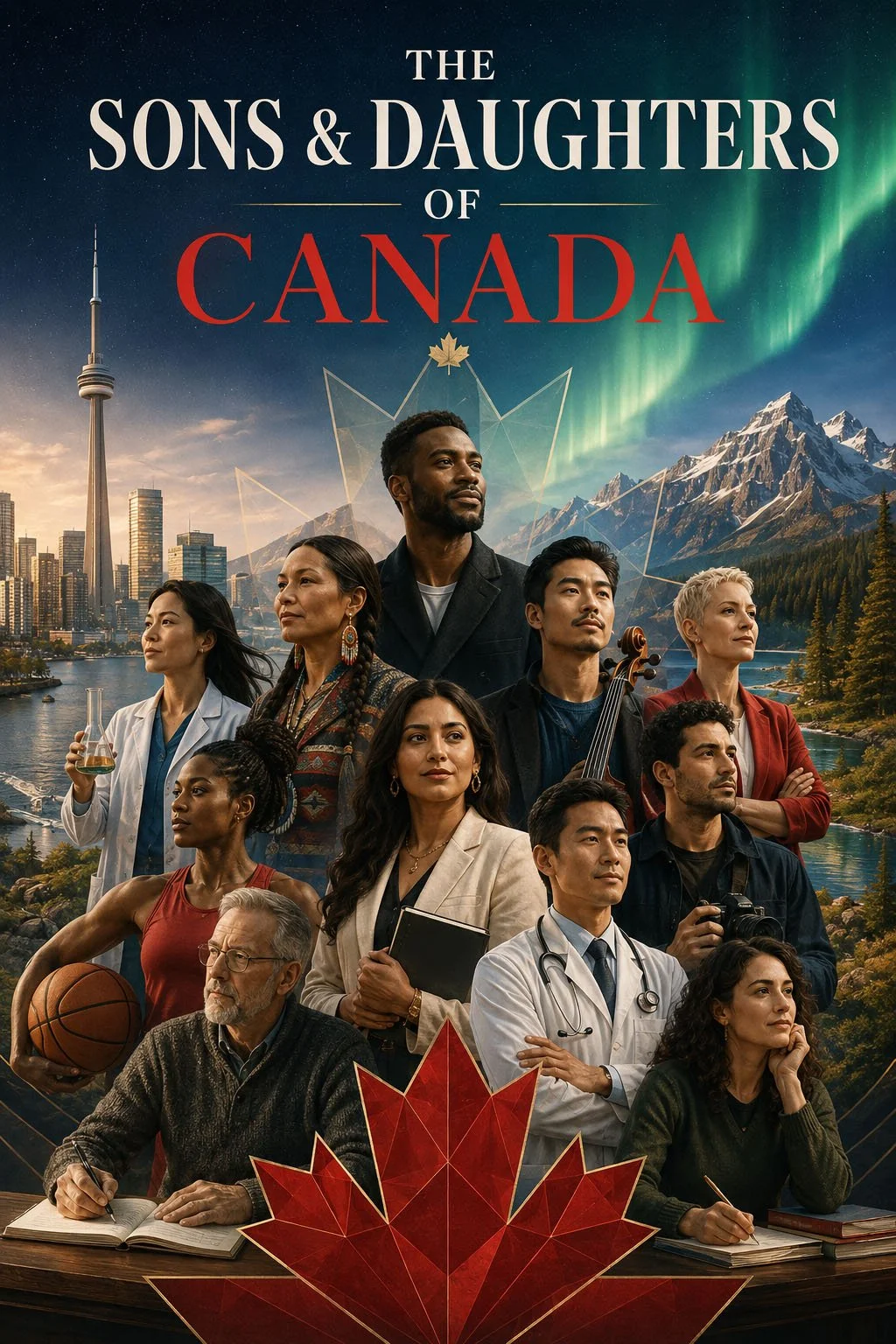
From Courage and Creativity to Sporting Glory, Scientific Discovery and Global Influence
By Publisher Ray Carmen
Canada is a nation shaped by enormous distances, contrasting landscapes and many different histories. From Atlantic fishing communities and Quebec’s francophone cities to the Prairies, the Pacific coast and the North, its identity has never come from one place, one language or one type of person.
Its most celebrated sons and daughters reflect that diversity. They are Indigenous and immigrant, Black and white, French-speaking and English-speaking, rural and metropolitan. Some were born in Canada; others arrived as children or adults and built their lives there. Many carried their talent abroad, becoming part of a Canadian diaspora whose influence reaches into almost every corner of the world.
Together, their achievements tell the story of a country whose global impact has often been far greater than its population might suggest.
COURAGE THAT BECAME A NATIONAL MOVEMENT
Few Canadians represent courage more powerfully than Terry Fox.
After losing his right leg to cancer, Fox began the Marathon of Hope in 1980. His ambition was to run across Canada while raising money for cancer research. Starting in St John’s, Newfoundland, he ran almost a marathon every day on an artificial leg.
His journey ended near Thunder Bay when the cancer returned, but the movement he created did not stop. Terry Fox Runs have since raised hundreds of millions of dollars for cancer research around the world.
Fox did not complete his physical journey across Canada, yet his legacy became something even greater. He transformed personal suffering into collective action and showed that heroism is not always measured by reaching a finish line. Sometimes it is measured by how many people continue the journey after you.
Viola Desmond demonstrated another kind of courage.
In 1946, the African Nova Scotian businesswoman challenged racial segregation by refusing to leave a whites-only section of a cinema. She was arrested and convicted following an incident that became a landmark in Canada’s civil-rights history.
Recognition arrived slowly, but Desmond’s story eventually moved from the margins into the centre of national memory. Her portrait now appears on the Canadian ten-dollar note, making her the first Canadian woman to be featured alone on a regularly circulating banknote.
Terry Fox and Viola Desmond came from different backgrounds and confronted different challenges. What connects them is their refusal to accept that the world had to remain as it was.
A COUNTRY HEARD AROUND THE WORLD
Canada’s musical influence is extraordinary.
Montreal-born Oscar Peterson became one of the greatest pianists in the history of jazz. His breathtaking technique, rhythmic imagination and generosity as a performer earned admiration across generations. Peterson also confronted racism throughout his career, using his music and public voice to affirm dignity and equality.
Leonard Cohen transformed poetry, spirituality, love and human imperfection into songs that travelled across languages and decades. Joni Mitchell became one of modern music’s most influential songwriters, expanding the possibilities of melody, harmony and personal storytelling.
Céline Dion rose from Charlemagne, Quebec, to become one of the most internationally successful singers of her generation. Her career demonstrated the global strength of francophone Canadian culture and the power of a voice capable of crossing linguistic and national borders.
Shania Twain carried Canadian country music to a vast international audience. The Weeknd became one of the defining pop and R&B artists of his era, while Drake helped establish Toronto as a major centre of global hip-hop culture.
Canada’s cultural reach also includes Neil Young, k.d. lang, Bryan Adams, Alanis Morissette, Michael Bublé and generations of classical, folk, Indigenous and Caribbean-Canadian musicians.
These artists did not succeed by becoming identical. Their international influence grew from the confidence to bring their own experiences, accents, communities and musical traditions into the wider world.
INDIGENOUS ART, MEMORY AND SOVEREIGNTY
Any celebration of Canadian achievement must recognise that First Nations, Inuit and Métis histories began long before Canada existed.
Indigenous excellence should not be treated as a decorative part of a national story. It represents living cultures, sovereign peoples and intellectual traditions that survived despite dispossession, residential schools and attempts at forced assimilation.
Inuit artist Kenojuak Ashevak became one of the most internationally recognised figures in modern Inuit art. Working in Kinngait, Nunavut, she created flowing images of birds, animals and transformed beings. Her celebrated prints helped introduce audiences around the world to the strength and originality of Inuit visual culture.
Artists such as Norval Morrisseau, Daphne Odjig and Bill Reid expanded the international understanding of Indigenous art while remaining connected to distinct cultural traditions and communities.
E. Pauline Johnson brought her Kanien’kehá:ka and English heritage into poetry and performance. Tom Longboat became one of the world’s leading distance runners in the early twentieth century, overcoming racism and institutional barriers.
Their stories remind us that Indigenous achievement must be presented with accuracy and respect. Canada cannot simply claim Indigenous greatness without also acknowledging the conditions Indigenous people were forced to overcome.
SPORT: FROM THE ICE TO THE WORLD STAGE
Canada’s sporting identity is often associated with ice hockey, and few athletes are more closely connected to the game than Wayne Gretzky.
Known as “The Great One,” Gretzky redefined hockey through anticipation, vision and playmaking. His records and influence made him one of the most important athletes in the history of professional sport.
But Canada’s sporting story extends far beyond hockey.
Christine Sinclair became international football’s all-time leading scorer and captained Canada through multiple Olympic campaigns. Her leadership helped carry the national women’s team to Olympic gold and moved women’s football towards the centre of Canadian sporting culture.
Donovan Bailey delivered one of Canada’s most unforgettable Olympic moments at Atlanta in 1996. He won the 100 metres in a then-world-record time of 9.84 seconds and later anchored the Canadian team to victory in the 4x100-metre relay. Born in Jamaica and raised in Canada, Bailey represented a modern national story shaped by migration, confidence and excellence under pressure.
Clara Hughes achieved the rare distinction of winning Olympic medals in both cycling and speed skating. She later used her public platform to speak openly about mental health, helping to change the national conversation around illness, vulnerability and recovery.
Steve Nash, raised in Victoria, British Columbia, won consecutive NBA Most Valuable Player awards. His intelligence, vision and precision helped inspire Canada’s rapidly growing basketball culture.
The wider Canadian sporting constellation includes Hayley Wickenheiser, Sidney Crosby, Marie-Philip Poulin, Alphonso Davies, Andre De Grasse, Bianca Andreescu, Penny Oleksiak, Summer McIntosh, Mike Weir, Jacques Villeneuve, Marnie McBean, Alwyn Morris and Daniel Igali.
Their victories belong not only to the individuals on the podium. Behind them stand families, coaches, teachers, community clubs and volunteers who turned early promise into world-class performance.
LITERATURE, FILM AND THE POWER OF STORY
Canadian writers have made the country’s landscapes, anxieties and social questions part of world literature.
Margaret Atwood’s novels, poetry and essays have influenced international conversations about gender, power, ecology and freedom. Her stories often use imagined futures to illuminate choices being made in the present.
Michael Ondaatje brought lyrical intensity and cultural complexity to fiction and poetry. Yann Martel’s Life of Pi became an international publishing phenomenon, while Lucy Maud Montgomery’s Anne of Green Gables introduced generations of readers to Prince Edward Island.
Canada’s film and television influence is equally significant.
Ontario-born filmmaker James Cameron combined cinematic storytelling with technical innovation to create some of the most commercially successful films in history. Denis Villeneuve became internationally celebrated for visually ambitious and intellectually serious cinema.
Sarah Polley built a career as an actor, writer and director whose work explores memory, family, women’s lives and personal freedom. David Cronenberg became one of cinema’s most distinctive and influential directors.
Canadian performers including Michael J. Fox, Christopher Plummer, Donald Sutherland, Ryan Reynolds, Keanu Reeves, Rachel McAdams and Sandra Oh achieved international recognition while maintaining important connections to Canada’s creative community.
SCIENCE THAT CHANGED HUMAN LIFE
Some of Canada’s greatest contributions cannot be measured in medals, ticket sales or applause. They are found in hospitals, laboratories and technologies used every day.
Frederick Banting shared the 1923 Nobel Prize in Physiology or Medicine for the discovery of insulin. Developed through a Toronto research team and refined through collaboration, insulin transformed diabetes from a rapidly fatal disease into a manageable condition for millions of people.
Physicist Donna Strickland shared the 2018 Nobel Prize in Physics for work on chirped pulse amplification, a method used to create extremely powerful, ultra-short laser pulses. The technology has important scientific, medical and industrial applications.
Roberta Bondar became Canada’s first woman in space in 1992. A physician, scientist and photographer, she later connected space exploration with environmental education and a deeper understanding of the Earth.
Geneticist and broadcaster David Suzuki made environmental science accessible to the wider public. His career demonstrated that discovery alone is not enough; scientific knowledge must also be communicated so that people understand what is at stake.
Canada’s scientific and technological story also includes the Canadarm teams, researchers in artificial intelligence, medical pioneers, engineers and innovators whose names may be less famous than the systems they helped transform.
ENTERPRISE, INVENTION AND GLOBAL AMBITION
Canada has also produced inventors and entrepreneurs whose ideas reshaped international industries.
James Naismith invented basketball, creating a game that would become one of the world’s most popular sports.
Joseph-Armand Bombardier developed vehicles capable of travelling across snow and helped establish a Canadian engineering company with global reach.
Mike Lazaridis co-founded Research In Motion, the company behind BlackBerry. Its devices helped make secure mobile email a global business category. Lazaridis later invested heavily in theoretical physics and quantum research, using commercial success to support long-term scientific discovery.
Canada’s entrepreneurial story continues through technology, finance, aviation, entertainment, food, fashion and clean energy. Yet invention is only the beginning. Lasting success requires investment, education, infrastructure and the confidence to build Canadian ideas at international scale.
THE DIASPORA ADVANTAGE
The sons and daughters of Canada do not cease to belong when they cross a border, and those who arrive in Canada do not begin their stories from nothing.
Migration brings languages, traditions, professional knowledge and international networks. It strengthens music, sport, science, entrepreneurship and public life.
Many Canadian careers have been shaped by several countries at once. Some individuals were born abroad and developed their talents in Canada. Others were born in Canada and found their largest opportunities elsewhere.
Their stories are best understood as bridges rather than possessions. Canada may be an important part of their identity, but so are the families, cultures and international institutions that helped them grow.
A LIVING NATIONAL STORY
The Sons & Daughters of Canada cannot be reduced to a list of famous names.
Canada’s real strength lies in the wider community behind achievement: the teacher who recognises a gift, the parent working additional hours, the local coach opening a gym early, the community preserving its culture and the researcher continuing despite years without recognition.
For every internationally celebrated Canadian, there are thousands of future scientists, athletes, artists, writers, entrepreneurs and community leaders whose work is only beginning.
A meaningful national success story must therefore look in two directions. It should honour those who have already made history while creating space for those who have not yet been seen.
Canada’s greatest sons and daughters do more than make the world take notice. They change what the next generation believes is possible.