
JOHNNIE COCHRAN : THE COURTROOM LEGEND WHO BECAME A GLOBAL NAME
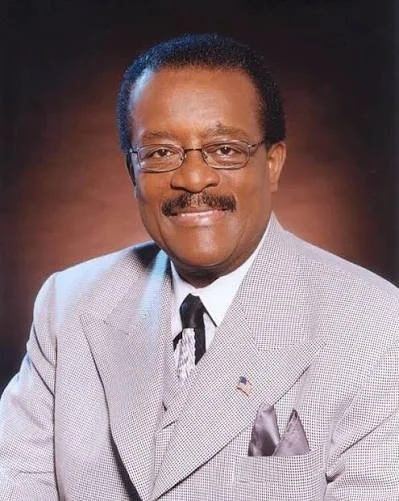
The celebrated American defence attorney whose courtroom brilliance, commanding presence and role in the O. J. Simpson trial made him one of the most recognisable lawyers of the modern era.
By Publisher Ray Carmen
Few lawyers ever become household names. Fewer still step beyond the courtroom to become part of popular culture.
Johnnie L. Cochran Jr. did both.
Born in Louisiana in 1937 and raised largely in Los Angeles, Cochran built a legal career that would eventually place him among the most famous defence attorneys in American history.
Charismatic, immaculately presented and exceptionally persuasive before a jury, he developed a reputation for combining meticulous preparation with the kind of courtroom theatre that could turn complicated legal arguments into memorable human stories.
But behind the celebrity was a lawyer whose career was deeply connected to questions of civil rights, police conduct, justice and equality before the law.
FROM PROSECUTOR TO DEFENCE LAWYER
Cochran began his legal career in Los Angeles and spent time working as a prosecutor before establishing himself in private practice.
His experience on both sides of the courtroom gave him an understanding of how prosecutors constructed cases — knowledge that would later become a formidable weapon when he stood before juries as a defence attorney.
Over the years, his practice increasingly attracted clients involved in difficult, controversial and highly publicised cases.
Cochran possessed something that could never be learned entirely from law books: he understood people.
He knew that juries did not simply listen to evidence. They watched personalities, considered motives and reacted to the wider story being presented before them.
And few attorneys understood how to present that story better.
THE TRIAL THAT CHANGED EVERYTHING
In 1995, Johnnie Cochran became known around the world as a leading member of the defence team representing O. J. Simpson, the former American football star and television personality who was tried for the murders of Nicole Brown Simpson and Ronald Goldman.
The televised proceedings became one of the most closely followed criminal trials of the twentieth century.
Cochran worked alongside a formidable collection of attorneys who became known as Simpson’s “Dream Team.”
Yet it was Cochran who emerged as one of the most memorable figures in the courtroom.
His questioning, presentation style and closing arguments became international television moments.
One sentence in particular entered American popular culture:
“If it doesn’t fit, you must acquit.”
The phrase referred to the prosecution’s evidence involving a glove and became perhaps the most famous line associated with the trial.
Simpson was ultimately acquitted of the criminal charges, although he was later found liable in a separate civil case.
The verdict remains debated decades later, but Cochran’s performance ensured that his own name would forever be associated with one of the most famous trials in modern legal history.
MORE THAN THE O. J. SIMPSON TRIAL
It would be easy to define Cochran solely by the Simpson case.
That would considerably underestimate his career.
Long before the television cameras of the Simpson trial arrived, Cochran had established himself as an attorney willing to challenge powerful institutions, particularly in cases involving alleged police misconduct and civil rights.
During his career he represented both celebrities and ordinary individuals, eventually becoming sought after by some of America’s best-known public figures.
His client list over the years included musicians, entertainers, athletes and people whose cases had become national news.
Yet Cochran frequently argued that the fundamental purpose of the justice system was not merely to serve the wealthy or famous.
Justice, he believed, had to remain accessible to those without power as well.
MASTER OF THE COURTROOM
Part of Cochran’s extraordinary appeal was his ability to communicate.
He could take technical evidence and transform it into language a jury could understand.
He understood rhythm.
He understood timing.
And he understood that a courtroom argument needed both legal substance and emotional clarity.
Cochran could be forceful without appearing uncontrolled, theatrical without losing authority and passionate while remaining sharply focused upon the case before him.
For aspiring trial lawyers, his performances became studies in advocacy.
For television audiences, he became the image of the confident American defence attorney — elegant suit, measured voice and complete command of the room.
A LEGACY THAT OUTLIVED THE COURTROOM
Johnnie Cochran died in Los Angeles on 29 March 2005, aged 67, following a brain tumour.
But his influence did not disappear with him.
His name remains part of legal history, and the law firm he helped build continued carrying the Cochran name after his death.
More importantly, his career continues to provoke discussion about the role of the defence lawyer in society.
A defence attorney’s responsibility is not to decide guilt or innocence. That belongs to the court.
The advocate’s responsibility is to ensure that the evidence is challenged, constitutional protections are respected and the prosecution proves its case to the standard required by law.
Cochran understood that principle completely.
THE MAN WHO MADE THE COURTROOM HIS STAGE
There have been lawyers with extraordinary legal knowledge.
There have been lawyers with enormous personalities.
There have been lawyers capable of commanding television audiences.
Johnnie Cochran possessed all three qualities.
Whether admired for his advocacy or remembered through the controversies surrounding the cases he defended, his place in modern legal history is secure.
He helped transform the public perception of the courtroom lawyer and demonstrated the extraordinary power of language when placed in the hands of a gifted advocate.
Nearly every generation produces celebrated lawyers.
Very few become legends.
Johnnie Cochran was one of them.