
SINGAPORE BUILT A WILDLIFE BRIDGE TO HELP ANIMALS CROSS SAFELY
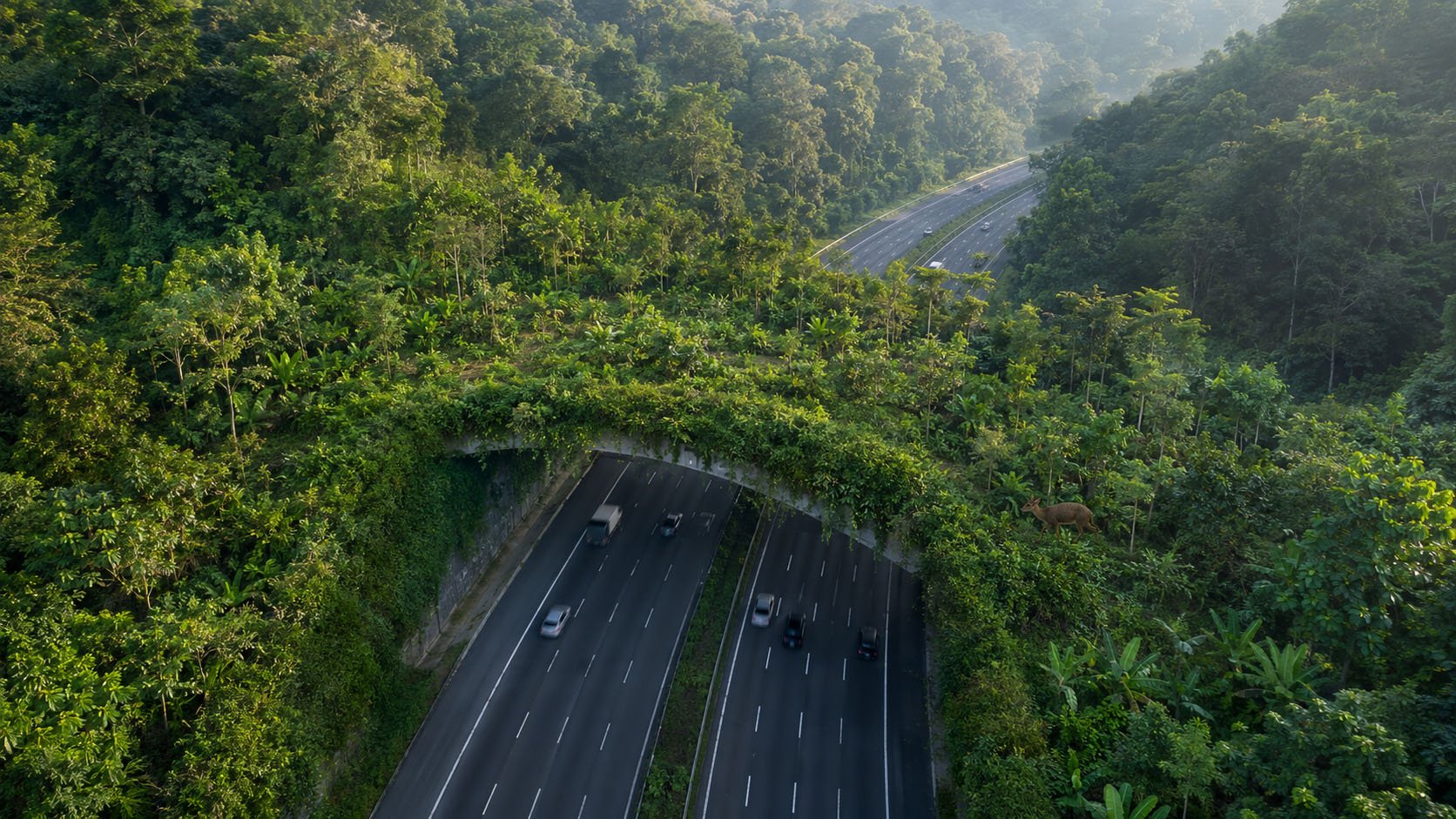
A living bridge above a six-lane expressway has reconnected two precious rainforest reserves—and given endangered wildlife a safer road to survival
By Publisher Ray Carmen
Across one of Singapore’s busiest expressways, a bridge has become a forest.
Trees rise from deep layers of soil. Shrubs form protective walls of vegetation. Birds, butterflies and small mammals move through a green corridor suspended above the traffic below.
This is Eco-Link@BKE, Southeast Asia’s first ecological bridge and one of the most remarkable examples of wildlife-friendly engineering in the modern urban world.
The bridge crosses the Bukit Timah Expressway and reconnects the Bukit Timah Nature Reserve with the much larger Central Catchment Nature Reserve.
For people driving beneath it, Eco-Link@BKE may appear to be an unusually green overpass. For Singapore’s wildlife, it is something far more important: a road back to a forest that had been divided for decades.
WHEN A ROAD DIVIDED THE FOREST
The construction of the Bukit Timah Expressway split a once-connected forest landscape into two separate reserves.
For human beings, the road brought speed and mobility. For wildlife, it became a dangerous barrier.
Animals attempting to move between the forests risked being struck by vehicles. Others simply remained on one side, leaving populations isolated from potential mates, feeding grounds and wider habitats.
Over time, that isolation can weaken animal populations. When wildlife is confined to a limited area, genetic diversity may decline and the long-term risk of local extinction may increase.
Singapore’s challenge was therefore clear: how could two important forests be reconnected without interrupting the expressway running between them?
The answer was to build a bridge for nature.
AN HOURGLASS OF LIVING GREEN
Completed in 2013, Eco-Link@BKE was designed in an hourglass shape. It opens widely into the forests at both ends and narrows to approximately 50 metres at its centre.
Unlike an ordinary road bridge, its surface carries deep layers of soil capable of supporting tropical trees and other native vegetation.
More than 3,000 native plants were used to establish a lowland forest habitat across the structure. Tall trees form an upper layer, while saplings, shrubs and ground vegetation provide shelter, food and protected movement for different species.
The result is not simply a concrete bridge covered with decorative plants. It is a carefully restored ecological corridor designed to feel like a continuation of the forest.
As the vegetation matured, the structure became increasingly difficult to distinguish from the nature reserves surrounding it.
THE ANIMALS RETURN
Wildlife monitoring has shown that the bridge is being used.
Animals recorded on or around Eco-Link@BKE include the common palm civet, lesser mousedeer, Sunda pangolin, long-tailed macaque and wild boar. Birds, butterflies, bats, reptiles and other invertebrates have also benefited from the restored connection.
More than 100 fauna species have been sighted on the ecological overpass.
Between 2018 and 2021, approximately 100 species were recorded using the bridge, including 31 species detected there for the first time during that monitoring period.
In October 2023, the critically endangered Raffles’ banded langur was observed using Eco-Link@BKE for the first time—a powerful sign that the living corridor had become part of the forest’s natural movement system.
These animals do not understand engineering plans, biodiversity strategies or urban policy. They simply recognise a safe path through the trees.
That may be the project’s greatest success.
A BRIDGE HUMANS CANNOT VISIT
Eco-Link@BKE is not a public attraction or recreational walkway.
Access is strictly supervised and generally limited to research and ecological monitoring. Keeping people away reduces noise and disturbance and allows shy, nocturnal and threatened animals to use the bridge naturally.
Camera traps and wildlife surveys help researchers understand which species are crossing, how populations are moving and whether additional conservation measures may be needed.
The absence of crowds is part of the design. This is a bridge created for animals, and their needs come first.
ENGINEERING WITH NATURE
Eco-Link@BKE represents a different way of thinking about development.
Roads, railways and expanding cities often fragment habitats into smaller and more vulnerable islands. Wildlife crossings offer one way to repair some of that damage.
They do not erase every environmental cost, and they cannot replace the protection of large, healthy habitats. But when they are carefully designed, planted and monitored, they can restore connections that would otherwise be lost.
Singapore has since developed other forms of ecological connectivity, including additional wildlife crossings, nature corridors and roadside measures intended to guide animals towards safer routes.
Eco-Link@BKE remains the pioneering symbol: a place where transport infrastructure and rainforest conservation meet above the same road.
WORLD OF 7 VIEW
The most extraordinary thing about Eco-Link@BKE is its simplicity.
Human beings built a road that divided a forest. Then they built a bridge that allowed the forest to reach across it again.
Above the traffic, roots spread through the soil, branches reach towards the light and animals quietly cross from one world to another.
The bridge carries no cars and welcomes no tourists. Its travellers move on paws, wings and tiny feet.
In one of the world’s most modern cities, Singapore has demonstrated that progress does not always have to push nature aside.
Sometimes progress means giving nature a way back.