
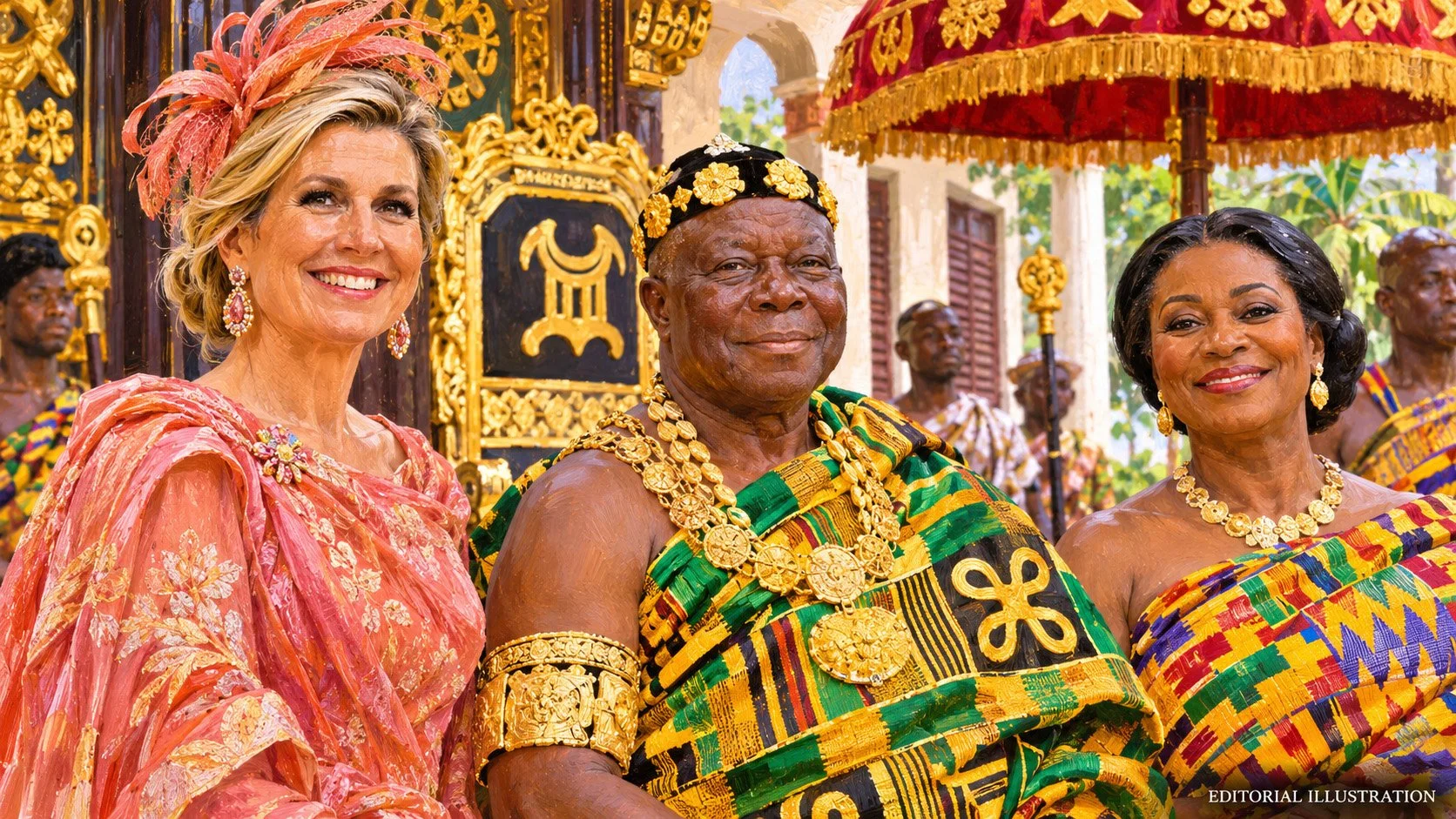
QUEEN MÁXIMA RETURNS TO THE ASANTE KINGDOM
By Publisher Ray Carmen
From the royal palaces of Europe to the golden traditions of West Africa, an extraordinary encounter in Ghana celebrates friendship, cultural heritage and the enduring influence of African royalty.
A ROYAL WELCOME IN THE HEART OF GHANA
There are royal occasions that capture attention through grandeur, and others that leave a lasting impression through their cultural significance.
On 4 November 2026, Queen Máxima of the Netherlands visited the historic Manhyia Palace in Kumasi, Ghana, where she was welcomed by the Asantehene, Otumfuo Osei Tutu II, the revered King of the Asante Kingdom.
The meeting brought together two very different royal traditions.
One represented the constitutional monarchy of the Netherlands.
The other embodied the centuries-old institution of the Asante monarchy, one of Africa’s most celebrated traditional kingdoms.
Against a backdrop of rich cultural heritage, ceremonial traditions and royal hospitality, the encounter demonstrated how monarchy continues to connect people across continents.
THE KINGDOM OF GOLD
The Asante Kingdom occupies an extraordinary place in African history.
Established in the late seventeenth century, the kingdom developed into a powerful political, military and commercial force in West Africa.
Its prosperity was closely associated with gold, trade and a sophisticated system of traditional governance.
At the centre of Asante identity stands the Golden Stool, known as Sika Dwa Kofi.
According to Asante tradition, the sacred stool descended from heaven during the reign of the kingdom’s founding ruler, Osei Tutu I.
It symbolises the collective soul and unity of the Asante people.
Unlike an ordinary royal throne, the Golden Stool is regarded as sacred and is never used as a seat.
Today, the Asantehene remains a highly respected traditional authority within modern Ghana.
Although Ghana is a republic, its traditional rulers continue to exercise important cultural and community leadership.
THE ASANTEHENE — A KING OF EXTRAORDINARY HERITAGE
Otumfuo Osei Tutu II became the sixteenth Asantehene in April 1999.
His reign has been associated with education, cultural preservation, development initiatives and efforts to promote peace.
The Asantehene’s influence extends beyond the ceremonial splendour of the royal court.
Through educational and charitable initiatives, he has supported opportunities for young people and communities.
His position illustrates the continuing importance of traditional leadership in contemporary African society.
The Manhyia Palace itself remains a powerful symbol of Asante identity.
Its ceremonies, traditional clothing, gold ornaments and royal customs preserve a heritage that has endured through centuries of political and social change.
QUEEN MÁXIMA — FROM ARGENTINA TO THE DUTCH THRONE
Queen Máxima’s personal story is equally remarkable.
Born Máxima Zorreguieta in Buenos Aires, Argentina, in 1971, she studied economics before developing a career in international finance.
In 2002, she married Willem-Alexander, then Prince of Orange.
When her husband became King of the Netherlands in April 2013, Máxima became Queen consort.
Her international work has increasingly focused on financial inclusion and financial health.
Through her involvement with the United Nations, she has advocated improving access to financial services and helping individuals and families develop greater financial resilience.
Her November 2026 visit to Ghana formed part of this wider international mission.
A FRIENDSHIP REVISITED AFTER 24 YEARS
One of the most fascinating aspects of the Kumasi encounter was its historical connection.
Queen Máxima and the Asantehene had previously met in 2002.
Their reunion in November 2026 therefore brought together two royal figures whose paths had first crossed nearly a quarter of a century earlier.
During her visit to Manhyia Palace, the Queen was welcomed by the Asantehene and Lady Julia Osei Tutu.
The occasion included the presentation of traditional kente cloth, one of Ghana’s most recognisable cultural treasures.
The gesture reflected the warmth of the welcome and the importance of cultural exchange.
It was more than a ceremonial meeting.
It was an opportunity to renew a relationship between royal traditions from Europe and Africa.
KENTE — THE CLOTH OF KINGS
Few textiles in the world carry the cultural significance of Ghana’s kente.
Traditionally associated with Asante royalty, kente is woven in intricate patterns using vibrant colours and distinctive designs.
Its origins are closely linked to the communities of the Asante region, particularly Bonwire, which remains celebrated for its weaving traditions.
Different colours and patterns may communicate ideas associated with royalty, prosperity, spirituality and social identity.
Gold frequently symbolises wealth and royal status.
Green can represent growth and renewal.
Black may signify maturity, spiritual strength or ancestral connections.
Kente has travelled far beyond Ghana.
Today, it is recognised internationally as a powerful expression of African heritage and cultural pride.
Its presentation during Queen Máxima’s visit symbolised the enduring importance of Ghanaian traditions.
GHANA AND THE NETHERLANDS — A SHARED HISTORY
The relationship between Ghana and the Netherlands stretches back centuries.
Dutch merchants established a presence along the West African coast during the era of European maritime expansion.
The historical relationship included commerce, colonial competition and Dutch participation in the transatlantic slave trade.
That difficult history remains an important part of the relationship between the two countries.
Today, Ghana and the Netherlands maintain diplomatic, commercial and development ties.
Cooperation includes agriculture, trade, investment and other areas of economic development.
Queen Máxima’s visit reflected a contemporary relationship increasingly focused on economic opportunity and financial wellbeing.
A QUEEN WITH A GLOBAL MISSION
Although the royal reception attracted attention, Queen Máxima’s visit to Ghana had a substantial economic purpose.
In her United Nations role, she has promoted financial health and access to responsible financial services.
For many families and small businesses, financial security depends on practical opportunities.
These include access to savings, appropriate credit, reliable payment systems and financial information.
Ghana has made significant progress in digital financial services, particularly through mobile money.
Nevertheless, challenges remain in ensuring that financial products are affordable, accessible and beneficial to consumers.
Queen Máxima’s international work highlights the importance of helping people not merely obtain financial services, but use them to improve their lives.
TWO ROYAL TRADITIONS, ONE SHARED MESSAGE
The meeting at Manhyia Palace demonstrated that royalty takes many forms.
In the Netherlands, the monarchy operates within a modern European constitutional system.
In Ghana, the Asantehene represents a traditional institution deeply rooted in cultural identity, history and community leadership.
Their roles are different.
Their histories are different.
Yet both institutions retain considerable symbolic importance.
Their meeting offered a striking illustration of how cultural traditions can coexist with modern international cooperation.
THE BEAUTY OF ROYAL DIPLOMACY
Royal encounters often attract attention because of their ceremony.
The magnificent clothing.
The elaborate jewellery.
The traditional greetings.
The extraordinary settings.
But beyond the splendour lies a deeper significance.
Such occasions can encourage cultural understanding and create opportunities for dialogue.
Queen Máxima’s reception in Kumasi celebrated the heritage of the Asante people while drawing attention to contemporary questions of economic development.
It also offered an international audience a glimpse into one of Africa’s most distinguished royal traditions.
WHEN AFRICA AND EUROPE MEET
From the historic halls of Manhyia Palace to the royal residences of the Netherlands, the encounter between Queen Máxima and Otumfuo Osei Tutu II represented a meeting of history and modernity.
It celebrated the enduring splendour of Asante culture.
It renewed a royal acquaintance dating back to 2002.
And it highlighted the importance of international cooperation in addressing economic challenges.
Above all, it reminded the world that cultural heritage remains a powerful bridge between nations.
Two continents.
Two royal traditions.
One memorable encounter.
And in the historic city of Kumasi, the golden heritage of the Asante Kingdom welcomed a Queen from Europe.