
THE WORLD’S LONGEST TRAIN JOURNEY
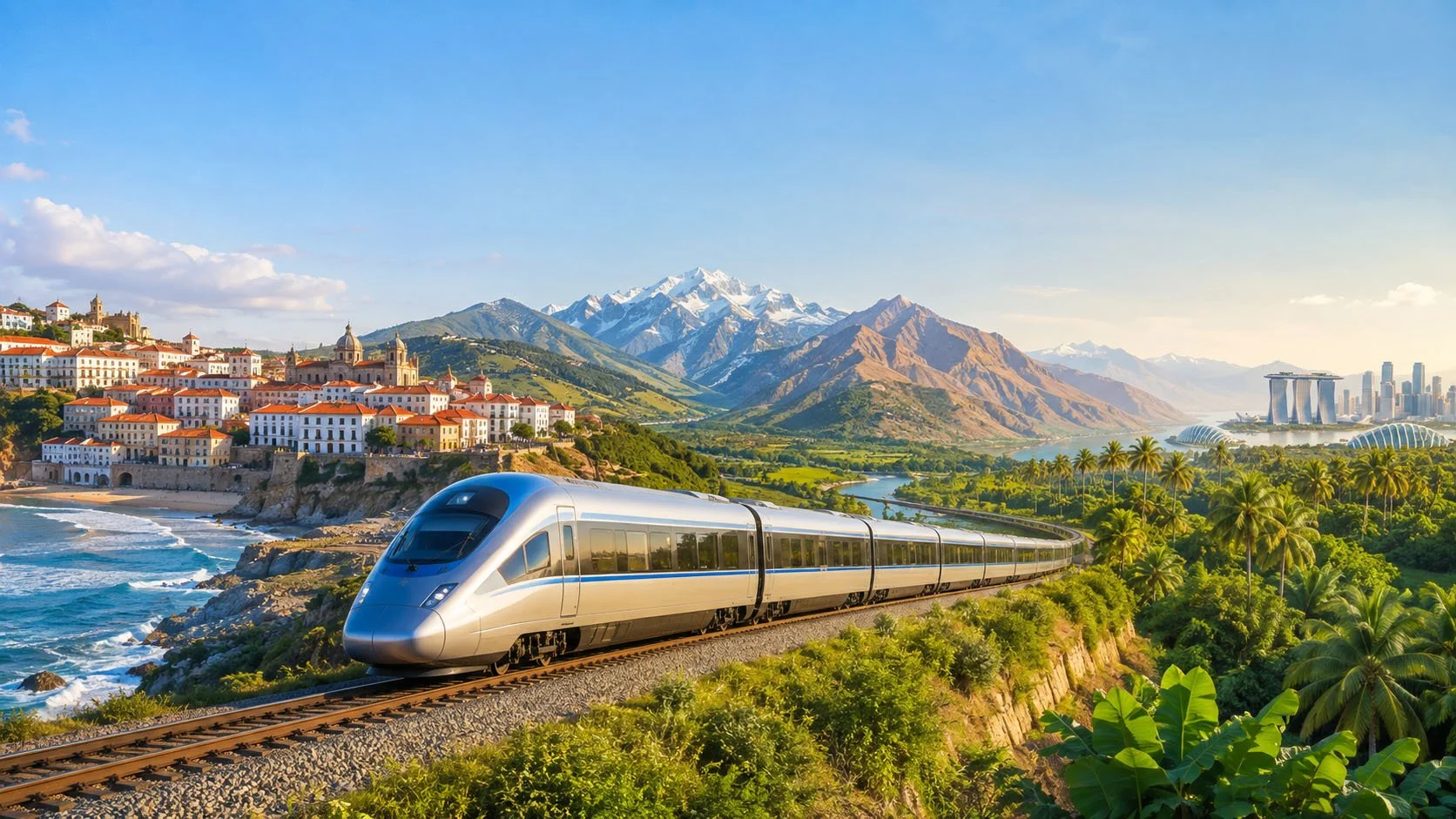
PORTUGAL TO SINGAPORE — THE GREAT RAIL DREAM
By Publisher Ray Carmen
Imagine boarding a train beside Portugal’s sunlit Atlantic coast and continuing east until the palms and skyscrapers of Singapore rise beyond the window.
It sounds like the ultimate slow-travel adventure: approximately 18,755 kilometres of railway, commonly described as crossing 13 countries and eight time zones.
This extraordinary journey would carry travellers from the western edge of Europe through some of the world’s greatest cities, across the immense Eurasian continent and into the tropical landscapes of Southeast Asia.
Yet there is an important distinction behind the spectacular headline: this is not one direct train. It is a theoretical rail itinerary involving numerous separate services, tickets, transfers and border crossings—and the complete journey is not currently bookable from beginning to end.
A JOURNEY THAT CAPTURES THE IMAGINATION
The celebrated route is usually said to begin in Lagos, a historic coastal city in Portugal’s Algarve.
From Lagos, travellers would continue through Lisbon and onwards to Spain, France and the great railway capitals of continental Europe.
The theoretical itinerary would then turn towards Eastern Europe and Russia before joining either the Trans-Siberian or Trans-Mongolian railway network. From there, the journey would enter China and travel south through Kunming, Laos, Thailand and Malaysia before finally reaching Singapore.
Travelling continuously, with the necessary connections and overnight stops, the journey has been estimated to take approximately 21 days. Anyone wishing to explore the countries along the way could easily turn it into a magnificent two or three-month adventure.
There would be around 20 changes of train, making the journey considerably more complicated than simply purchasing one ticket and settling into a cabin for three weeks.
THE RAILWAY THAT COMPLETED THE DREAM
The Portugal-to-Singapore route gained worldwide attention following the opening of the China–Laos Railway in December 2021.
The approximately $6 billion railway connected the Chinese city of Kunming with Vientiane, the capital of Laos. It appeared to close one of the most important missing links in the enormous rail corridor between Europe and Southeast Asia.
The new line transformed landlocked Laos into an increasingly important regional transport centre and dramatically reduced travelling times between the country and southern China.
For railway enthusiasts, it also created the possibility—at least on a map—of travelling almost entirely by rail from Portugal to Singapore.
NOT ONE TRAIN—AND NOT CURRENTLY BOOKABLE END TO END
The viral social-media descriptions can give the impression that a magnificent “Portugal to Singapore Express” is waiting at the station.
Unfortunately, no such direct train exists.
The journey would require approximately 20 separate trains, tickets purchased from several national railway companies, transfers between stations and extensive visa and border planning.
More importantly, the complete classic itinerary is not presently available as one continuous passenger journey.
International railway connections between Western Europe and Russia remain seriously disrupted, while the traditional Moscow-to-Beijing services have not returned as the simple and dependable link assumed by the original itinerary.
Changing political conditions, border restrictions and suspended international services currently make the complete journey impractical.
Travellers interested in attempting individual sections must therefore consult the relevant national railway operators and official government travel advice before making any arrangements.
WHAT THE TRAVELLER WOULD SEE
If the entire route becomes practical again, few journeys on Earth could rival its extraordinary theatre.
Portugal would provide brilliant Atlantic light, beautiful tiled railway stations and the charm of the Algarve.
Spain and France would bring historic cities, dramatic countryside and some of Europe’s finest high-speed railway services.
Central and Eastern Europe would open into vast plains before Russia revealed the immense scale of the Eurasian continent.
Beyond would lie the spectacular landscapes of Mongolia or Manchuria, depending on the route selected, followed by China’s megacities, mountain scenery and rapidly expanding railway network.
The journey would then descend through the green valleys of Laos before continuing towards the energy of Bangkok, the tropical rainforests and cities of Malaysia, and finally the brilliant skyline of Singapore.
It would be more than a railway journey. It would be a moving panorama of civilisations, cultures, cuisines, languages and landscapes.
A GREAT COMMERCIAL OPPORTUNITY
The story is about much more than breaking a travel record. It illustrates the revival of rail tourism as a premium experience.
Modern travellers are increasingly attracted to journeys that offer unforgettable scenery, cultural discovery and the luxury of time.
Hotels, luxury train operators, restaurants, luggage-transfer companies, travel specialists and national tourism boards could all create premium products around individual sections of this transcontinental corridor.
Curated railway holidays could combine historic cities, luxury accommodation, regional cuisine, wildlife, shopping and cultural experiences.
Countries along the route would gain opportunities to encourage travellers to stay longer and spend more, rather than simply flying above them.
THE FUTURE OF TRANSCONTINENTAL RAIL TRAVEL
Thailand’s planned high-speed railway connection towards Laos and China is expected to strengthen the Southeast Asian section of this vast network in the years ahead.
Every new railway, restored international service and simplified border crossing moves the Portugal-to-Singapore dream closer to reality.
The infrastructure may exist across much of the route, but politics, timetables and passenger services must still catch up with the vision.
WORLD OF 7 VERDICT
The Portugal-to-Singapore route deserves its place among the greatest travel ideas ever conceived—but it must be presented accurately.
It is a theoretical journey across interconnected railway networks, not one direct service, and it cannot currently be completed in the straightforward form described by viral social-media posts.
Nevertheless, its power is undeniable.
It represents one continuous vision stretching from Europe’s Atlantic edge to the heart of Southeast Asia—a journey linking ancient civilisations, modern cities, immense wildernesses and tropical landscapes.
When the suspended services and missing international connections are restored, it could become the defining overland adventure of the century.
THE JOURNEY AT A GLANCE
Distance: Approximately 18,755 kilometres or 11,650 miles.
Starting point: Lagos, Portugal.
Destination: Singapore.
Estimated duration: Approximately 21 days with connections and necessary overnight stops.
Train changes: Around 20 separate services.
Countries: Commonly described as passing through 13 countries.
Time zones: Approximately eight.
Current position: A theoretical interconnected railway itinerary—not presently available as one straightforward, bookable end-to-end passenger journey.