
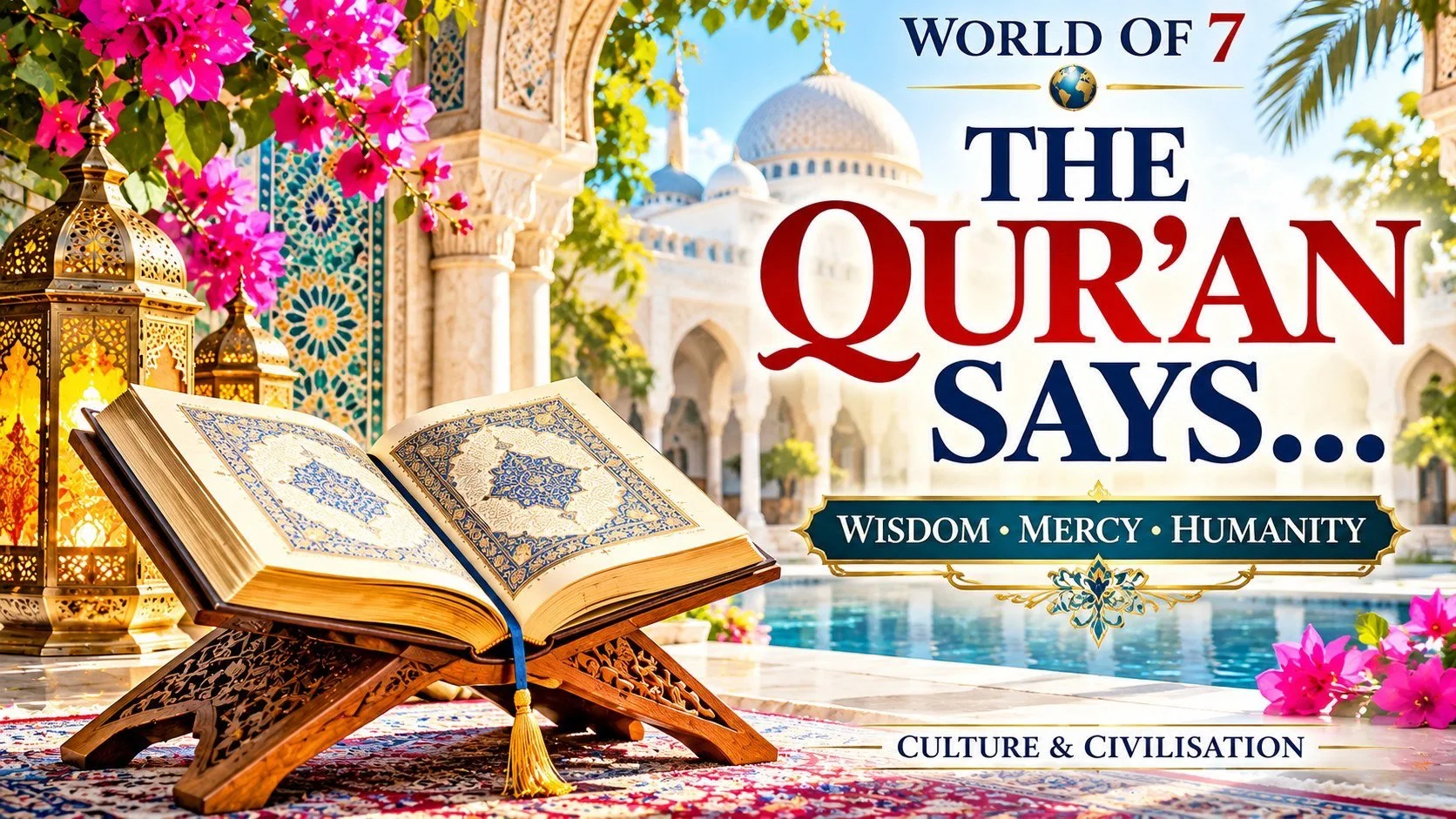
WISDOM, MERCY AND THE LESSONS THAT SPEAK TO HUMANITY
By Publisher Ray Carmen
At a time when the world seems determined to divide itself into competing camps, what can one of humanity’s most widely read sacred books teach us about living together? The Qur’an, Islam’s holy scripture, is first and foremost a religious text. Yet its discussions of human dignity, honesty, duty, kindness, justice and forgiveness also invite thoughtful conversations across cultures. WORLD OF 7 explores seven Qur’anic passages, what they say, and why they continue to matter.
1 | DIFFERENCE CAN BE AN INVITATION, NOT A DIVIDE — QUR’AN 49:13
The Qur’an addresses humanity as people of different peoples and tribes, with the purpose that they might come to know one another. The verse also locates honour not in ancestry or nationality but in righteousness before God.
For a world crossing borders daily through migration, travel, work and technology, that is a striking starting point: difference need not be an excuse for contempt. A neighbour’s language, clothing, heritage or faith can be a reason to ask a thoughtful question rather than make an assumption. This is not a denial of religious conviction; it is a challenge to arrogance.
2 | JUSTICE MUST BE BIGGER THAN LOYALTY — QUR’AN 4:135
One passage calls believers to stand for justice even when truthful testimony may count against themselves or their closest relatives. It also warns against letting the wealth or poverty of those involved distort fair judgement.
That principle is demanding precisely because it is inconvenient. It asks whether we defend an innocent stranger as readily as a friend, and whether we admit a mistake when our own side makes it. Justice ceases to be justice if it is reserved for the people we like.
3 | KINDNESS BEGINS CLOSE TO HOME — QUR’AN 4:36
The Qur’an places kindness to parents, relatives, orphans, people in need, neighbours both near and farther away, companions and travellers within a larger religious instruction. The verse reflects the social conditions and categories of its historical setting, while its repeated concern for human relationships remains central to many Muslim ethical reflections.
Compassion is often celebrated as a grand idea. Here it becomes practical: visit an elderly parent; feed someone who is hungry; help a neighbour whom you barely know. Those acts may not become headlines, but they can change the daily life of a household or street.
4 | FAITH AND CONSCIENCE — QUR’AN 2:256
The well-known opening of this verse is frequently rendered ‘There is no compulsion in religion.’ Its place in the Qur’an has prompted extensive discussion about belief, persuasion, religious freedom and the historical circumstances of revelation.
Interpretations and legal applications differ across Muslim traditions and historical periods. It would therefore be misleading to pretend that one short phrase resolves every debate about religious liberty. It does, however, provide an important text for thinking about why genuine conviction cannot simply be manufactured by force.
5 | MERCY IS NOT THE SAME AS GIVING UP — QUR’AN 39:53
In a passage that many readers find deeply consoling, people who have wronged themselves are told not to despair of God’s mercy. The verse speaks from within Islamic teachings on repentance and divine forgiveness.
That is not an invitation to avoid responsibility. Rather, the prospect of forgiveness can be the first step towards acknowledging wrongdoing, seeking to repair harm and changing direction. A person’s past matters — but need it be the only story their future can tell?
6 | MEET WRONG WITH SOMETHING BETTER — QUR’AN 41:34
Good and evil, the Qur’an says, are not equivalent. It encourages responding to harm with what is better, describing how hostility can sometimes be transformed into friendship. The following verse links this aspiration with patience.
Such advice should not be misused to tell victims to tolerate violence or abandon their safety. Its moral force lies in the possibility of breaking cycles of insult and retaliation where doing so is safe and just. Refusing needless cruelty can be a sign of courage, not weakness.
7 | READ, LEARN, REFLECT — QUR’AN 96:1
The opening command of Sūrat al-ʿAlaq is variously translated ‘Recite’ or ‘Read’, in the name of the Lord who created. Muslim tradition associates these verses with the earliest revelation to the Prophet Muhammad, and they carry a powerful emphasis on divine instruction and human learning.
For WORLD OF 7, the editorial lesson is not to use religion as a slogan, but to approach it with study and humility. Sacred writing is easily misquoted, shortened or detached from its setting. Responsible curiosity asks not merely ‘What does this line say?’ but ‘How has it been understood, and what does the wider text mean?’
A MESSAGE FOR THE WHOLE WORLD
These seven passages do not exhaust the Qur’an. The scripture also contains law, worship, narratives of earlier prophets, accounts of creation and judgement, and challenging passages whose interpretation has been debated for centuries. Muslims are not a single uniform community, and translations into English necessarily make choices about meaning.
Yet reading with care can illuminate rather than inflame. Across the seven continents, people will continue to disagree about religion. The more urgent question is whether they can disagree with knowledge, protect one another’s dignity, seek justice and offer compassion.
Perhaps the most enduring invitation in this feature is simple: before judging a book, a belief or a human being, take the time to understand.