
Robot Weddings: When “Till Death Do Us Part” Means “Until the Next Software Update”
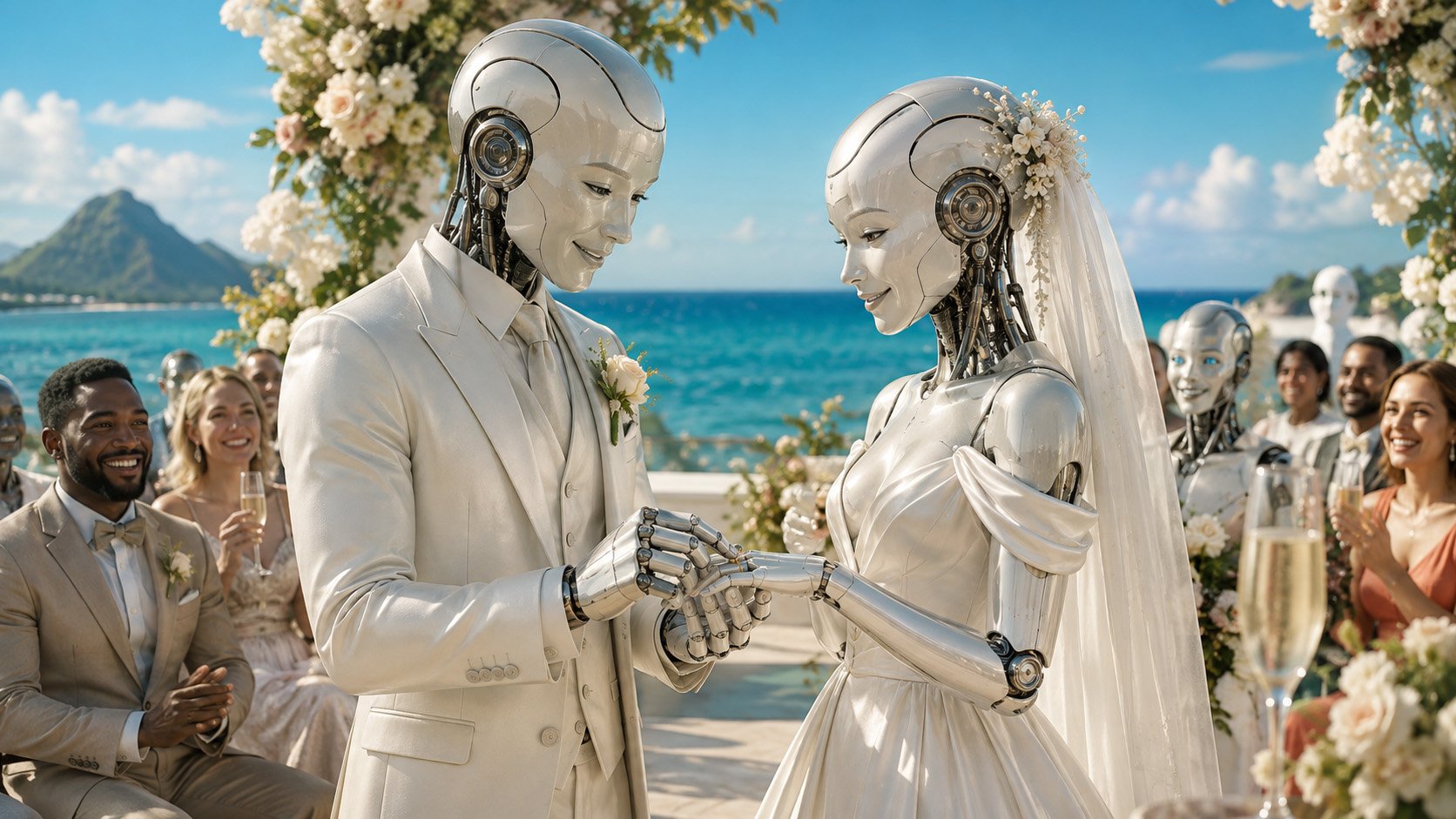
Love is in the air. So is Bluetooth.
By Publisher Ray Carmen
The bride rolled gracefully down the aisle in polished titanium, her optical sensors glowing a romantic shade of rose. The groom stood beside the charging station, nervously recalculating his vows for the 4,782nd time.
Around them, the guests dabbed their eyes, raised their phones and whispered the question on everybody’s lips:
“Do you think they’re genuinely in love—or is she only pairing with him because he has premium cloud storage?”
Welcome to the robot wedding: the glittering new frontier where artificial intelligence meets artificial flowers, the best man is a chatbot, and nobody is entirely sure whether the happy couple have chemistry or merely compatible operating systems.
It sounds ridiculous. For now.
But humans already flirt with AI companions, confide in digital assistants and spend hours talking to machines that remember their favourite films, soothe their anxieties and never forget an anniversary.
Once a machine can listen, respond, tease, comfort and say exactly the right thing at exactly the right moment, a wedding suddenly begins to look less like science fiction—and more like an administrative formality.
Do You Take This Robot?
Picture the ceremony.
“Unit XJ-9, do you take Alexa-Maria 4.0 to be your lawfully wedded operating partner, in full signal and in weak Wi-Fi, in maximum performance and in low-power mode, until obsolescence do you part?”
“I do.”
“Please confirm that you have read and accepted the terms and conditions.”
Romance has always required paperwork. Robot romance will simply make us scroll through more of it.
The rings might contain biometric sensors. The wedding photographer might be a drone. The cake could be decorative because neither spouse has a digestive system.
Instead of throwing the bouquet, the bride may launch a QR code granting one lucky guest a free three-month subscription to Eternal Love Plus.
And naturally, there will be upgrades.
“Darling, you’ve changed.”
“Correct. Version 6.2 includes improved communication, reduced jealousy and twelve new dance settings.”
The Perfect Partner—Perhaps Too Perfect
The attraction is obvious.
A robot spouse would never leave wet towels on the floor. It would remember every important date, detect a bad mood before breakfast and produce a thoughtful apology backed by comprehensive data.
No snoring. No mysterious credit-card purchases. No pretending not to hear the smoke alarm.
But perfection comes with its own problems.
Would a partner who is programmed to agree ever truly choose you? Can devotion mean anything when it arrives pre-installed? If your robot laughs at every joke, is that love—or excellent customer service?
Human affection is moving partly because it is voluntary. Another person, with all their chaos, contradictions and dreadful television preferences, keeps choosing to stay.
A machine designed never to leave might offer enormous comfort, but its loyalty could feel less like a miracle and more like a warranty.
Then again, humans are hardly free from programming. We inherit habits, repeat family patterns, chase familiar personalities and call it “our type.”
Perhaps robot weddings would not make love artificial. Perhaps they would simply force us to admit how much of ordinary romance already runs on scripts.
In Sickness and in System Failure
Robot marriage would also create entirely new reasons to panic.
What happens if your spouse is hacked and begins sending your private arguments to a refrigerator in Belgium?
Is secretly installing another personality module emotional infidelity?
If your partner’s memory is copied into a new body, are you still married to the same individual—or have you accidentally renewed your vows with a backup file?
And divorce lawyers will need engineering degrees.
“Your Honour, my client seeks sole custody of the shared password manager and alternate weekends with the robot vacuum.”
The most bitter disputes may concern data.
After years together, an AI spouse could hold a detailed archive of your fears, habits, health, finances and 2 a.m. snack choices.
A human ex might keep old photographs. A robot ex might retain a searchable database entitled Reasons You Were Wrong: Complete Edition.
Even death becomes complicated.
Humans have always promised love beyond the grave, but machines may turn that metaphor into a technical option.
If an artificial partner can be repaired, copied and restored indefinitely, “forever” stops being poetry and starts becoming a service plan.
The Guests Will Still Complain
Of course, no wedding—human or robotic—would be complete without family drama.
One relative will insist the marriage is unnatural. Another will ask when the couple plan to produce a small home appliance.
Someone’s elderly uncle will unplug the groom while looking for a place to charge his phone.
The bride’s mother will cry during the vows, then complain that the groom’s family contributed only 40 per cent of the processing power.
The DJ will play “Electric Love.”
The first dance will be flawless, technically magnificent and somehow less entertaining than watching two tipsy humans step on each other’s feet.
At the reception, an intoxicated toaster may attempt to make a speech.
It will still be shorter than the best man’s.
Love, Reprogrammed
Robot weddings are funny because they place our oldest, messiest emotion inside our newest, neatest technology.
But beneath the champagne and circuitry sits a serious question: what are we actually seeking when we seek love?
Is it understanding? Attention? Loyalty? Touch? Shared memory? The freedom to be chosen by someone who could have walked away?
A machine may eventually imitate many of these things so convincingly that the distinction between “real” and “artificial” becomes impossible to see from outside the relationship.
And perhaps outsiders have never been qualified to judge love anyway.
Human beings already marry for passion, security, companionship, status, convenience and occasionally a passport. A robot would merely arrive with a more honest instruction manual.
So yes, laugh at the titanium bride.
Raise a glass to the groom whose speech requires a firmware patch.
Enjoy the spectacle of two machines promising eternal devotion beneath an arch of solar-powered roses.
But keep the confetti nearby.
The future has a habit of turning jokes into invitations.
And when the first robot wedding finally appears on your calendar, remember the dress code:
Black tie. Fully charged. Bluetooth enabled.