
NAVARATHRI — NINE SACRED NIGHTS CELEBRATING THE DIVINE MOTHER
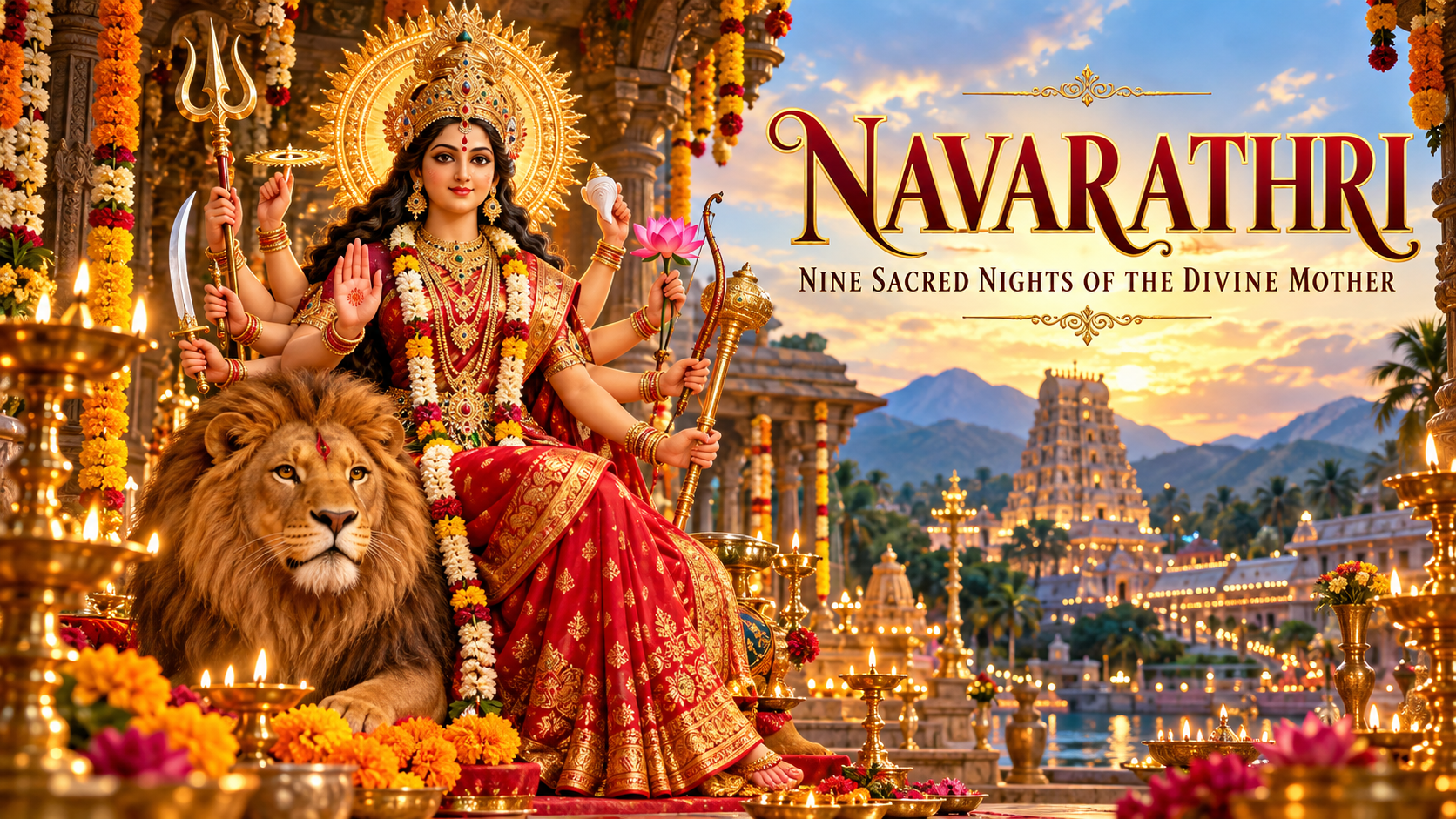
THE HINDU FESTIVAL OF FAITH, FEMININE POWER AND THE ETERNAL VICTORY OF GOOD OVER EVIL
By Publisher Ray Carmen
For nine extraordinary nights, millions of Hindus across the world illuminate their homes, temples and hearts in honour of the Divine Mother.
It is a festival of prayer, music, dancing, devotion, fasting, flowers, lamps and spiritual renewal.
Its name is Navarathri, also written Navaratri or Navratri, meaning Nine Nights in Sanskrit.
Yet beyond its breathtaking colour and celebration lies a message that transcends geographical borders and speaks to humanity itself.
That light can overcome darkness. That courage can overcome fear. That wisdom can overcome ignorance.
And that the feminine divine is not merely a symbol of tenderness, but also of extraordinary strength.
Who is the Divine Mother?
At the spiritual heart of Navarathri stands Goddess Durga, a powerful manifestation of Shakti — the divine feminine energy that sustains the universe in Hindu traditions.
Durga is depicted as a radiant goddess, often riding a lion or tiger and carrying sacred weapons in her many arms.
Her appearance conveys both compassion and courage.
According to the celebrated Hindu sacred narrative, the buffalo demon Mahishasura had become a force of oppression and destruction.
Durga confronted and defeated him after a tremendous battle.
Her victory represents the triumph of righteousness over arrogance, cruelty and evil.
The lesson is timeless: power finds its highest purpose when used to protect, rather than oppress.
The nine manifestations of Goddess Durga
In the widely observed Navadurga tradition, each sacred night honours a different manifestation of the Goddess.
Shailaputri — the daughter of the mountains, representing strength and stability.
Brahmacharini — the embodiment of devotion, discipline and spiritual determination.
Chandraghanta — the courageous protector associated with peace and fearlessness.
Kushmanda — associated with creative cosmic energy and the emergence of life.
Skandamata — the nurturing mother of Skanda, also known as Lord Murugan or Kartikeya.
Katyayani — the warrior goddess symbolising courage and the defeat of injustice.
Kalaratri — the fierce destroyer of darkness, ignorance and fear.
Mahagauri — representing purity, serenity and spiritual transformation.
Siddhidatri — the bestower of spiritual fulfilment and divine blessings.
Together, these manifestations express the many dimensions of feminine divinity, from maternal love to fearless protection.
The three great goddesses — Durga, Lakshmi and Saraswati
In many South Indian and Tamil Hindu traditions, Navarathri is also understood through three principal forms of the Divine Mother.
Durga represents strength, protection and the overcoming of destructive forces.
Lakshmi represents prosperity, wellbeing, generosity and abundance.
Saraswati represents knowledge, wisdom, learning, music and the arts.
A familiar devotional arrangement dedicates three nights to each goddess, although customs vary among families and regions.
It is a remarkable spiritual progression: first overcome what holds us back, then cultivate wellbeing, and finally seek wisdom.
How the world celebrates Navarathri
Across India, Navarathri takes on wonderfully different expressions.
In Gujarat, thousands gather in colourful traditional clothing for Garba and Dandiya Raas, devotional dances that turn entire communities into celebrations of rhythm and movement.
In West Bengal, Durga Puja brings spectacular artistic installations, elaborate goddess images, music and communal worship.
In Tamil Nadu, families arrange beautiful displays of dolls and divine figures known as Golu or Kolu, inviting friends and relatives to share prayers, songs and hospitality.
In Karnataka, Mysuru's Dasara celebrations combine royal heritage with magnificent public festivities.
In Sri Lankan Tamil Hindu communities, temples and homes honour the Goddess through devotional music, prayers and special observances, including worship of Saraswati.
And far beyond South Asia, Hindu communities in Britain, Mauritius, Malaysia, Singapore, South Africa, the Caribbean, North America and Australia continue these sacred traditions.
Navarathri has become a truly global celebration.
Why do devotees fast?
Fasting during Navarathri is not simply about abstaining from food.
For many devotees, it represents self-discipline, purification, gratitude and a conscious turning away from excess.
Some observe vegetarian diets, others undertake particular fasts, and many concentrate on prayer, meditation, charitable acts and acts of kindness.
Practices differ considerably, and not every Hindu observes the festival in the same way.
At its heart is the intention to create greater space for spiritual reflection.
The tenth day — victory and a new beginning
Following the nine sacred nights comes Vijayadashami, also known as Dussehra.
It is a celebration of victory.
In some traditions, it marks Durga's triumph over Mahishasura. In others, it commemorates Lord Rama's victory over Ravana.
For many South Indian families, Vijayadashami is also an auspicious occasion for children to begin their education, a ceremony often called Vidyarambham.
The symbolism is beautiful.
After nine nights devoted to divine strength and wisdom, the tenth day becomes an invitation to begin anew.
A message for the whole world
One need not be Hindu to appreciate the human values expressed through Navarathri.
Its celebration of courage, learning, compassion, motherhood, dignity and the triumph of goodness offers a window into one of the world's oldest living spiritual traditions.
At a time when humanity faces conflict, division and uncertainty, the festival reminds us that the struggle between darkness and light is not confined to ancient sacred narratives.
It also exists within our own decisions, actions and responsibilities.
Navarathri encourages us to confront what is destructive, nurture what is good and seek the wisdom to distinguish between them.
Nine nights. Nine manifestations. One enduring message: wherever there is darkness, humanity must continue to seek the light.
From WORLD OF 7, we extend our warmest Navarathri greetings to Hindu communities across the seven continents.
May the Divine Mother bless every home with peace, courage, wisdom and prosperity.