
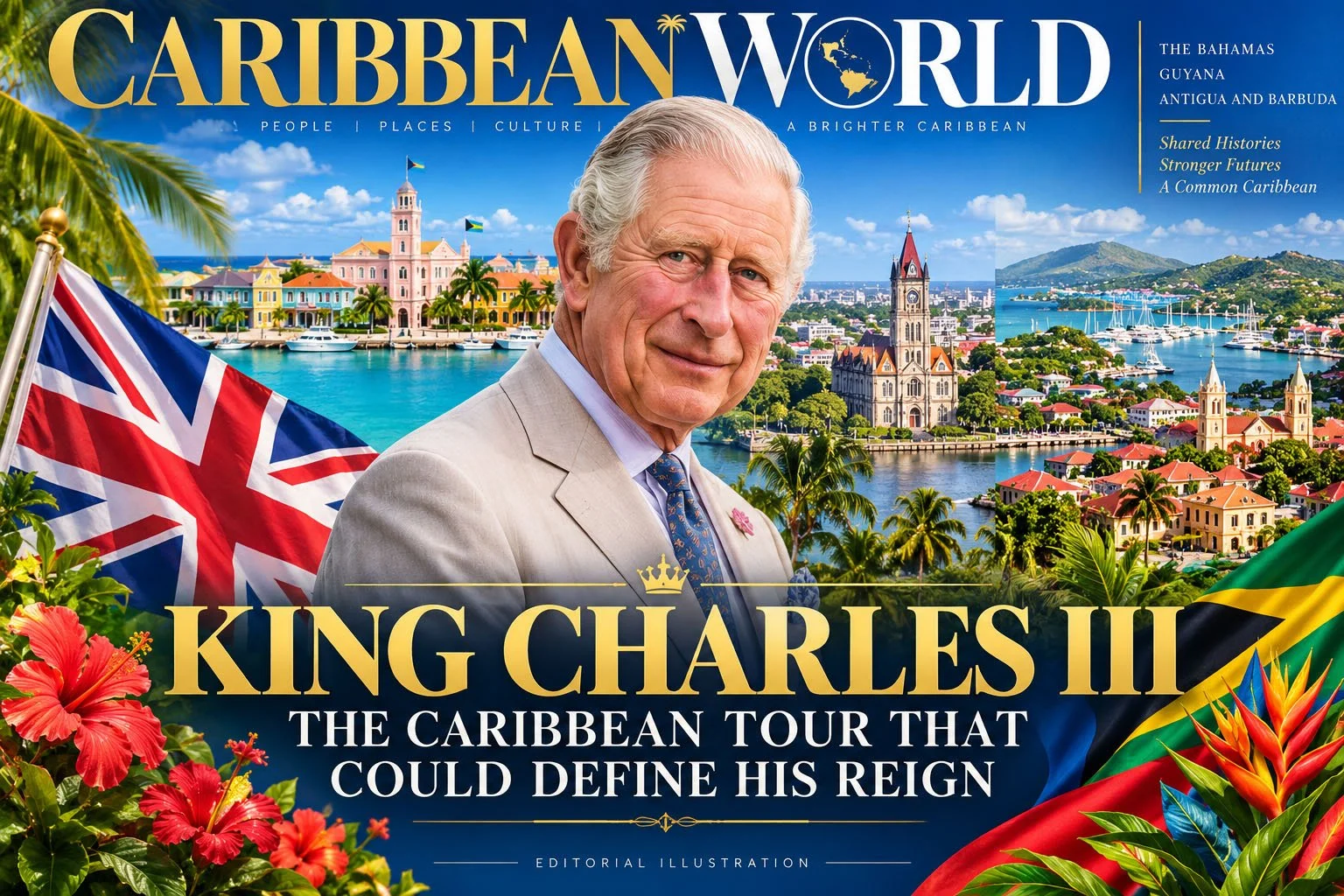
Royal diplomacy, the legacy of slavery and the changing relationship between Britain and the Caribbean.
By Publisher Ray Carmen
King Charles III begins a nine-day visit to the Bahamas, Guyana and Antigua and Barbuda on 27 October 2026. The itinerary promises celebration, conservation and Commonwealth diplomacy. Yet beneath the ceremonies sits a profoundly difficult question: how can Britain and its former colonies build a shared future while confronting the injustices of the past?
A ROYAL TOUR AT A CROSSROADS
The King is travelling at a moment when many Caribbean voices are demanding more than symbolic expressions of regret. Across the region, activists and political leaders are seeking fuller acknowledgment of Britain's involvement in the transatlantic slave trade, formal apologies and discussions of reparatory justice. Their proposals are not identical: for some, repair includes education, investment and institutional reform as well as financial redress.
Writing ahead of the visit, BBC royal correspondent Daniela Relph highlighted historian Sir Anthony Seldon's view that the trip could be the King's greatest risk so far. The danger is not simply an unfriendly reception. It is the possibility that familiar royal ceremony may be judged inadequate when set against unresolved questions of history, equality and sovereignty.
THREE DESTINATIONS, THREE DIFFERENT RELATIONSHIPS
In the Bahamas, where Charles is still head of state, the programme includes a youth rally in Nassau, meetings with community representatives, defence-force personnel and environmental initiatives. The island nation became independent in 1973, but debate about the place of the monarchy continues.
Guyana, on the South American mainland and culturally part of the wider Caribbean, has been a republic since 1970. The King's state visit will mark 60 years of relations with Britain and include events concerning biodiversity, business and Indigenous communities. Its history also carries the memory of the 1823 Demerara uprising against slavery. For some Guyanese, a royal visit is an opportunity for partnership; for others, it is an occasion to press for an apology.
In Antigua and Barbuda, another independent country where Charles remains head of state, the King and Queen are scheduled to join Independence Day celebrations and the Commonwealth Heads of Government Meeting. There, questions of constitutional change and reparations will accompany a programme intended to showcase the country's culture and its role on the international stage.
SLAVERY, APOLOGY AND REPARATIONS
King Charles has previously spoken of the brutality of slavery and the enduring pain of its legacy. Buckingham Palace says the visit will acknowledge the wrongs of the past rather than avoid them. But, according to reporting ahead of the tour, an official apology is not planned, and the British government continues to reject paying reparations. The Palace says questions of apology and compensation are principally for elected governments.
That distinction matters constitutionally, yet it may offer limited comfort to advocates seeking action. The Caribbean reparations movement argues that the economic and social consequences of enslavement and colonial extraction did not vanish at independence. Opponents of state compensation question how liability should be determined across centuries and whether modern taxpayers should fund it. The debate is therefore political, legal and moral, not merely ceremonial.
The Bahamas National Reparations Committee and other campaigners have made clear that public celebrations need not silence dissent. Guyana's President Irfaan Ali has also called for an apology. The disagreement need not mean hostility to ordinary Britons or rejection of future co-operation; it reflects the determination of independent societies to speak for themselves.
THE COMMONWEALTH — A CHANCE TO LOOK FORWARD
From 1 to 4 November, Commonwealth leaders will gather in St John's, Antigua and Barbuda, to discuss climate resilience, trade, investment, innovation and development. Those practical concerns are especially acute for small island nations exposed to storms, coastal erosion and rising costs. The King's longstanding advocacy of environmental protection may offer common ground, particularly with leaders of vulnerable states and with Guyana's conservation community.
There is also a diplomatic opportunity. A modern Commonwealth cannot rely on nostalgia for empire; it has to demonstrate that its 56 sovereign member countries can meet as partners. Listening to younger generations, acknowledging contested history and supporting measurable co-operation may achieve more than a flawless succession of motorcades and receptions.
WHAT WILL DEFINE SUCCESS?
The Caribbean is not of one mind about the monarchy. Some value its continuity and the international attention a royal visit brings. Others see hereditary kingship as an anachronism, or want a deeper reckoning with Britain's colonial past. Both viewpoints deserve to be heard without caricature.
For King Charles, success may not be measured by how many flags are waved or how enthusiastically a crowd cheers. It may depend on whether he conveys respect for Caribbean self-determination while helping to create space for difficult conversations. Ceremonies can celebrate friendship; they cannot substitute for it.
The journey is being described as a risk because so much lies beyond any one monarch's control. It is also a chance to show that historic ties need not prevent honest disagreement. The outcome will belong not only to the King, but to the people of the Bahamas, Guyana and Antigua and Barbuda whose futures are their own to determine.