
ELON MUSK SAYS “YOU CAN’T TRUST WHATSAPP” — META-OWNED PLATFORM HITS BACK
By Publisher Ray Carmen
Privacy, encryption and the battle for billions of users
One of the technology world’s fiercest rivalries has moved into an arena that matters to almost everyone with a smartphone: who can we trust with our private conversations?
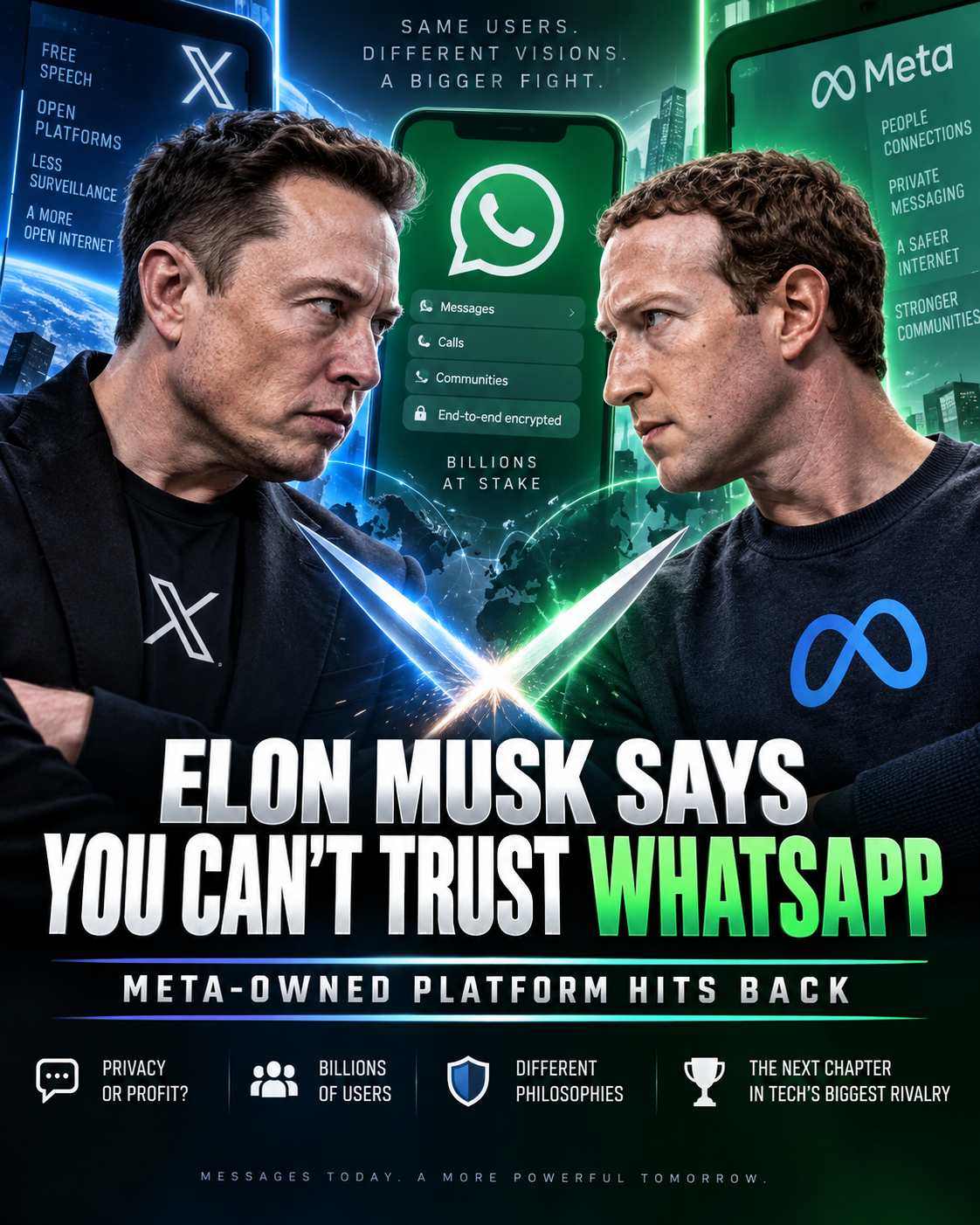
Elon Musk ignited the latest confrontation when he wrote “Can’t trust WhatsApp” on X on 9 April 2026. His comment came in response to allegations contained in a U.S. class-action lawsuit questioning whether WhatsApp’s assurances about the privacy of its users’ messages were accurate.
WhatsApp immediately fought back. The Meta-owned messaging service described the lawsuit’s allegations as “categorically false and absurd” and insisted that WhatsApp has used end-to-end encryption based on the Signal protocol for a decade, meaning ordinary private messages are designed so that only the sender and recipient can read their contents.
A BATTLE OVER TRUST
The argument goes far beyond Musk, Meta or corporate rivalry.
WhatsApp is used by billions of people around the world for everything from family conversations and photographs to business discussions and highly personal communications. Privacy is therefore not simply another feature of the service — it is central to the trust users place in the platform.
The lawsuit at the centre of the controversy alleged that Meta and WhatsApp could store or access communications despite telling users that their messages were private and end-to-end encrypted. Meta and WhatsApp vigorously disputed those allegations.
Musk’s intervention instantly transformed what might otherwise have remained a complex legal and technical dispute into a very public confrontation.
And he was not alone.
Telegram founder Pavel Durov also attacked WhatsApp’s privacy claims, making sweeping allegations about its encryption. WhatsApp rejected those assertions and stood by its security architecture.
WHAT DID THE COURT SAY?
There has since been an important legal development.
On 23 July 2026, U.S. District Judge Rita F. Lin dismissed the lawsuit as then pleaded, finding that it did not contain sufficient information establishing a reliable basis for the whistleblower allegations on which crucial parts of the case depended. The judge initially allowed the plaintiffs an opportunity to amend their complaint.
That distinction is important.
The ruling did not establish that WhatsApp secretly reads everyone’s encrypted messages, nor did the court validate the dramatic allegations being circulated online. Equally, the judge denied Meta’s request for sanctions and said Meta’s evidence did not conclusively establish that every scenario alleged by the plaintiffs was impossible.
So the responsible conclusion is not that Musk has “proved” WhatsApp cannot be trusted.
It is that his intervention has reopened one of the defining questions of the digital age.
MUSK VERSUS ZUCKERBERG
There is also a much bigger technology rivalry behind the exchange.
Musk controls X and has been expanding the platform’s communications capabilities, including private messaging and calling. Mark Zuckerberg’s Meta controls WhatsApp, Facebook, Instagram and Messenger — giving it an extraordinary position in global social communication.
Both companies are competing for something potentially more valuable than advertising revenue alone:
our digital lives.
The company that becomes the place where people communicate, make calls, consume news, conduct business, transfer money and interact with artificial intelligence could possess one of the most influential platforms of the next decade.
That explains why arguments about encryption and privacy have become part of a much larger battle over the future of the internet.
WHAT END-TO-END ENCRYPTION MEANS
In its simplest form, end-to-end encryption is intended to ensure that the contents of a message can be decrypted only on the devices belonging to the people participating in the conversation.
But digital privacy involves more than the text inside an encrypted message.
Platforms can still hold other information associated with how a service is used, while backups, reported messages, compromised devices, user settings and interactions with other services can create different privacy considerations.
That is why consumers should distinguish between the security of the encryption itself and the wider question of how much information technology companies possess about their users.
BILLIONS OF USERS — ONE ENORMOUS QUESTION
The Musk-versus-Meta confrontation therefore raises a question much larger than either billionaire:
How much trust should we place in the technology companies through which much of humanity now communicates?
WhatsApp maintains that its end-to-end encryption protects private conversations.
Musk says users should not trust the platform.
The legal allegations that helped ignite this latest confrontation have faced major challenges in court and should not be treated as established fact.
But the debate itself is unlikely to disappear.
Because as artificial intelligence, private messaging, digital payments and social networks increasingly merge into gigantic global platforms, the next great technology battle may not simply be about who has the best app.
It may be about who the world trusts with its conversations.
WORLD OF 7
Technology • Privacy • The Digital World