
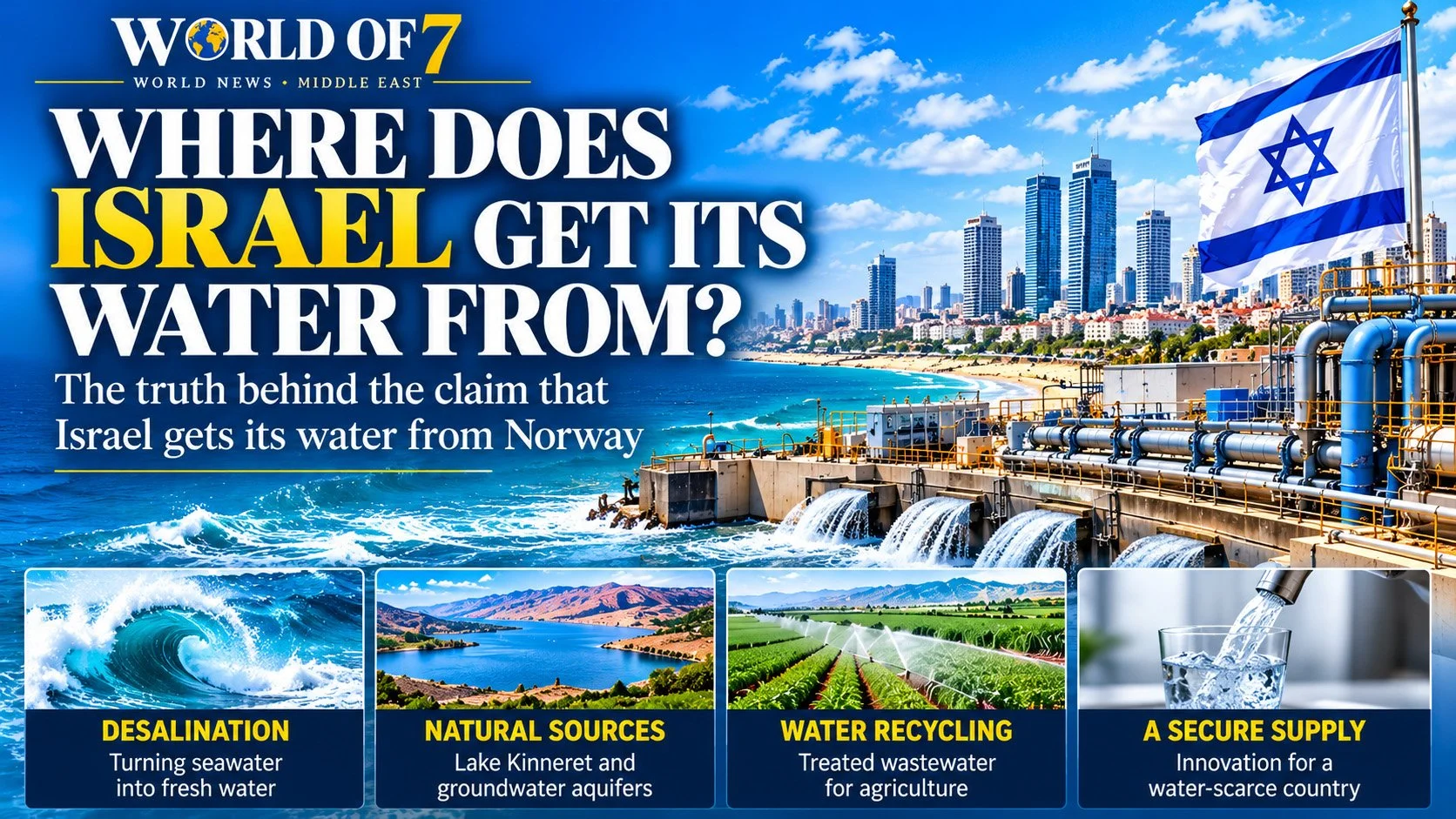
The surprising science behind a water-scarce country
By Publisher Ray Carmen
Israel lies on the edge of an arid region, yet water emerges from taps, irrigates farms and supports millions of residents. So where does it come from? Contrary to a social-media claim, Israel does not obtain its everyday water supply from Norway. The real explanation lies in the Mediterranean Sea, natural freshwater reserves and some of the world's most extensive systems for desalination and wastewater reuse.
THE MEDITERRANEAN: SALT WATER BECOMES DRINKING WATER
A major part of Israel's domestic drinking water now begins as seawater. Large coastal desalination plants - including facilities associated with Sorek, Hadera, Ashkelon, Ashdod and Palmachim - remove salt and impurities, primarily using reverse osmosis. Pressure pushes seawater through specialist membranes, producing fresh water that is treated and delivered into the national supply network. This is a technological achievement, although it requires energy, maintenance and careful management of its environmental effects.
THE NATURAL SOURCES THAT STILL MATTER
It would be wrong to say that this region has no natural water. Its sources include the Sea of Galilee, also known as Lake Kinneret; the Jordan River system and springs; and groundwater held in coastal and mountain aquifers. Rainfall is uneven, with wetter northern areas and much drier southern districts. The National Water Carrier and linked pipelines help transfer and balance supplies across the country.
RECYCLING WATER FOR AGRICULTURE
Israel also treats and reuses a high proportion of wastewater, chiefly for irrigating fields and orchards. This matters because agriculture consumes large amounts of water. Reclaimed wastewater is managed separately from ordinary drinking water: recycling wastewater for crops is not the same thing as pumping untreated sewage into household taps.
HOW SECURE IS THE SYSTEM?
Desalination reduces dependence on rainfall, but it does not eliminate water risk. In a September 2026 parliamentary discussion, officials reported that desalination facilities produced approximately 540 million cubic metres in 2024 - below the roughly 800 million cubic metres specified as capacity in relevant concession agreements. Recent operational difficulties, drought and pressure on the Sea of Galilee underline why backup sources and resilient infrastructure remain essential.
WATER AND THE PEOPLE WHO SHARE IT
Water is also a question of rights, access and regional cooperation. Israelis and Palestinians depend on connected natural water systems, while the allocation and control of water in the occupied West Bank remain contentious. Gaza has faced grave shortages of safe water amid damage to infrastructure and displacement. UNICEF reported delivering trucked safe water to around one million people in Gaza during January-March 2026. Engineering solutions do not erase unequal access or humanitarian needs.
AND THE NORWAY CLAIM?
No credible evidence supports the assertion that Norway provides Israel's daily drinking water. Norway has historically supplied a completely different substance known as 'heavy water' for nuclear-related purposes decades ago; that is not a national drinking-water supply. The most accurate headline is therefore a remarkable one in its own right: a dry and water-stressed country has built a major supply system by desalinating nearby seawater, managing limited freshwater reserves and recycling water for agriculture.
THE BIGGER QUESTION
As climate change, population growth and regional tensions sharpen competition for freshwater, the challenge is not simply to produce more of it. The deeper test is to make water systems reliable, environmentally responsible and accessible to all the communities who need them. Water is not merely a commodity. It is the foundation of life.