
THE FUTURE IS NO LONGER ON THE ROAD — IT’S ON THE RAILS
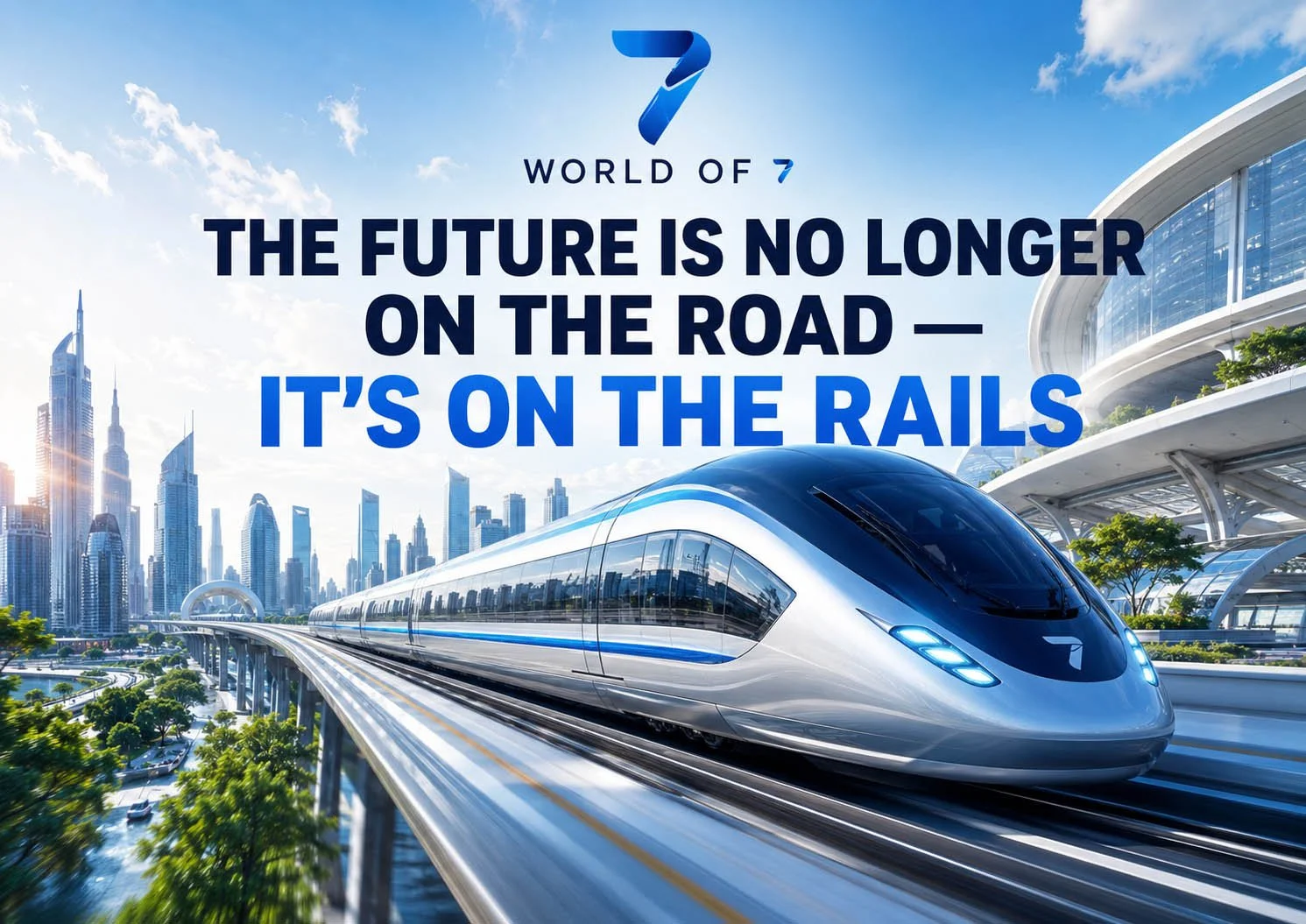
By Publisher Ray Carmen
For more than a century, the motor car shaped the modern world.
Roads expanded, cities spread outward and motorways became symbols of freedom, progress and economic power.
But the future of transport is beginning to move in another direction.
Across the world, governments and engineers are investing once again in rail — not as a relic of the past, but as a central part of the twenty-first century.
From high-speed intercity trains and urban metros to electric freight networks and automated systems, rail is being redesigned for a world facing congestion, pollution, population growth and climate pressure.
The future is no longer only on the road.
Increasingly, it is on the rails.
WHY TRAINS ARE RETURNING
Modern cities are struggling with too many vehicles competing for too little space.
Building wider roads may offer temporary relief, but traffic often returns.
Rail provides a different solution.
A single train can carry hundreds of passengers at once, moving large numbers of people without requiring each traveller to occupy a separate vehicle.
The International Energy Agency identifies rail as one of the least emissions-intensive forms of passenger transport.
For crowded cities, dependable rail can reduce traffic, improve air quality and give people a practical alternative to car ownership.
HIGH-SPEED RAIL IS CHANGING DISTANCE
The greatest transformation is taking place between cities.
High-speed trains are turning journeys once dominated by cars and aircraft into comfortable, direct rail connections.
Passengers can travel from one city centre to another without distant airports, long security queues, baggage delays or lengthy transfers.
Japan, France, Spain, Italy and China have shown how high-speed rail can connect major population centres and transform domestic travel.
Europe is also expanding cross-border services and working to make international rail faster, simpler and easier to book.
For many medium-distance journeys, the train could become the natural alternative to flying.
CHINA’S RAIL REVOLUTION
No country has embraced high-speed rail on the scale of China.
In a relatively short period, it has built a vast network connecting major cities, regional centres and distant provinces.
The impact goes far beyond transport.
Rail brings workers closer to jobs, tourists closer to destinations and businesses closer to customers.
It can reduce travel time, strengthen regional economies and reshape the geography of an entire country.
RAIL FOR THE DEVELOPING WORLD
The railway revolution should not belong only to wealthy nations.
Fast-growing countries across Africa, Asia and Latin America need efficient ways to move expanding populations.
Urban metros can connect workers to jobs.
Regional trains can link communities with schools, hospitals and markets.
Freight rail can move heavy goods more efficiently than thousands of lorries.
But rail must remain affordable and connected to local transport.
A fast train is of little value if ordinary people cannot use it.
The true measure of success is not speed alone.
It is accessibility.
THE RETURN OF THE NIGHT TRAIN
Not every rail journey needs to be made at extreme speed.
Sleeper trains are again attracting interest because they allow passengers to travel overnight and arrive directly in another city the following morning.
They offer comfort, convenience and an experience that road and air travel often cannot match.
For many travellers, the journey itself is becoming part of the destination.
FREIGHT COULD BE THE QUIET REVOLUTION
Passenger trains receive most of the attention, but freight rail could be just as important.
The global economy depends upon moving food, raw materials and manufactured goods over long distances.
Lorries will remain essential for final deliveries, but shifting more long-distance freight onto rail could reduce congestion, fuel use and pressure on roads.
The railway and the road do not need to compete.
They can work together.
SMARTER TRAINS AND CONNECTED CITIES
Future rail systems will not simply be faster.
They will also be more intelligent.
Digital signalling can allow more trains to operate safely.
Predictive maintenance can identify faults before breakdowns occur.
Artificial intelligence may help reduce delays and manage passenger demand.
Stations could become fully connected transport hubs, linking trains with metros, buses, taxis, bicycles and autonomous vehicles.
The aim is simple:
one smooth journey across several forms of transport.
RAIL IS NOT WITHOUT CHALLENGES
Railways are expensive to build.
High-speed lines require land, bridges, tunnels, stations, electricity and years of planning.
Poorly chosen projects can become financial burdens.
Construction also carries an environmental cost, particularly through the use of steel and concrete.
A railway succeeds only when enough people use it.
Rail is not magic.
It is infrastructure, and it must be planned responsibly.
THE CAR WILL NOT DISAPPEAR
The rise of rail does not mean the end of the motor car.
Cars remain essential in rural areas and for journeys not served by public transport.
Aircraft will continue to dominate intercontinental travel.
The most effective future will use each form of transport where it works best.
Rail for major passenger and freight corridors.
Roads for local access.
Aircraft for long distances.
Walking and cycling for shorter journeys.
The real goal is not to declare one form of transport the winner.
It is to build a system that is cleaner, faster, safer and more efficient.
THE RAILWAY MAY SHAPE THE FUTURE AGAIN
Railways transformed the nineteenth century.
They created cities, opened markets and changed the meaning of distance.
Today, they may be preparing to do the same again.
The train of the future will be electric, connected, efficient and integrated into everyday life.
It will travel beneath cities, across continents, through mountains and over deserts.
It will carry commuters, families, tourists, workers and freight.
As roads become more crowded and the world searches for cleaner ways to move, rail may once again become one of the great symbols of progress.
The future is not abandoning the road.
But increasingly, its fastest, cleanest and most exciting journey may be travelling on steel rails.
WORLD OF 7 — Exploring the ideas, technologies and innovations shaping tomorrow.