
China’s Futuristic Hotels Are 100 Years Ahead — American Engineers Are Shocked
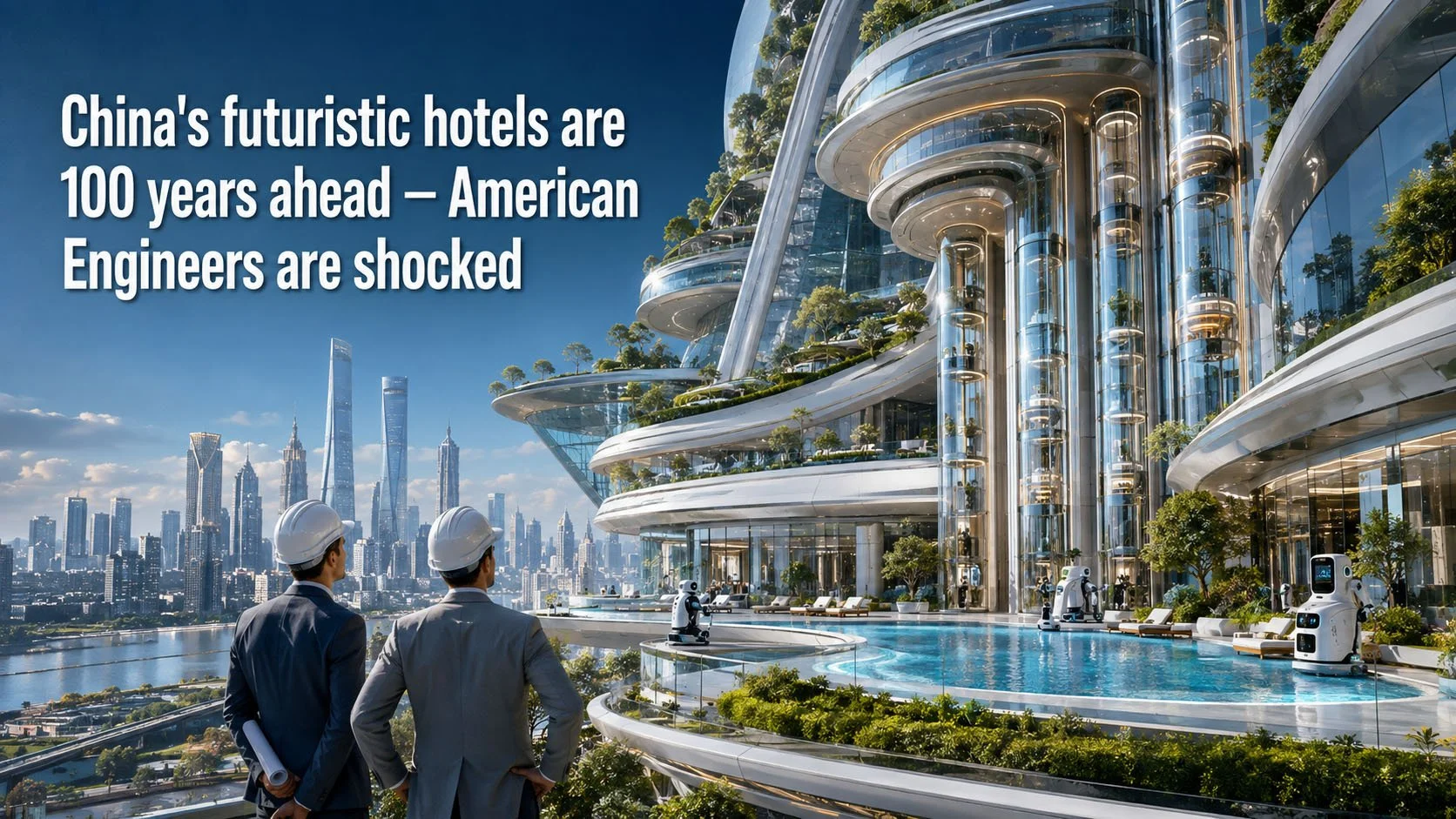
By Publisher Ray Carmen
Walk into one of China’s most advanced hotels and the traditional rituals of travel begin to disappear.
There may be no room key to collect, no receptionist to call and no need to touch a switch. Your face can open the door. A voice assistant can close the curtains, change the temperature or order dinner. Minutes later, a robot may glide along the corridor and deliver it.
The claim that these hotels are “100 years ahead” may be dramatic, but the engineering behind them is real—and it is moving from novelty to working reality at remarkable speed.
The Hotel Inside the Earth
One spectacular example begins not with artificial intelligence, but with an extraordinary piece of civil engineering.
The InterContinental Shanghai Wonderland is built into the wall of an abandoned quarry in Songjiang, outside Shanghai. The hotel descends into a space where most developers would have seen an unusable scar in the landscape.
The property extends 88 metres below sea level, with its 17 floors and 330 rooms wrapped around the quarry’s rock face. Glass, water and exposed stone transform the former industrial site into a luxury destination.
It feels less like a building placed on the landscape and more like architecture fused with the Earth itself.
For engineers, the most impressive feature is not simply its appearance, but the complexity hidden behind it. Quarry walls, groundwater, drainage, structural loads and emergency access all had to be managed on a site that challenges the normal rules of hotel construction.
When Your Face Becomes the Room Key
In Hangzhou, Alibaba’s FlyZoo Hotel offers a different vision of the future.
Guests can use facial recognition to check in and enter their rooms. Inside, voice-controlled technology operates the lights, curtains, television and temperature. Robots deliver meals and other items, while a robotic arm can even prepare drinks.
FlyZoo is not simply a conventional hotel filled with clever gadgets. It was designed as one connected digital system.
Identity, access, room controls, ordering and payment are linked into a single journey. Guests move through the building with fewer cards, fewer queues and fewer routine interactions.
Many hotels elsewhere still operate with separate systems: mobile check-in alongside plastic key cards, individual room-service apps and traditional reception desks. China’s most ambitious hotels are attempting to join all those fragments together.
Robots Move Beyond Room Service
Delivery robots are already becoming familiar in Chinese hotels, but the country’s next experiment is far more ambitious.
On the western artificial island of the Shenzhen–Zhongshan Link, developers are preparing a 44-room luxury hotel designed to use robots throughout the guest’s stay.
Machines are expected to welcome visitors, carry luggage, assist with check-in, deliver meals, clean rooms and public spaces, conduct security patrols and provide assistance around the clock.
The hotel is expected to welcome its first guests in early 2027. If the project is completed as planned, it will be more than a hotel that happens to use robots—it will be a hotel organised around them.
That distinction is important.
A single delivery robot can be a novelty. A coordinated fleet capable of sharing lifts, navigating corridors, managing tasks and operating safely around guests becomes an intelligent operating system for the entire building.
Why China Is Moving So Quickly
China’s advantage does not come from one miraculous invention. It comes from combining architecture, robotics, digital payments, artificial intelligence and large-scale manufacturing within the same project.
Hotels are particularly useful testing grounds because they contain so many repetitive tasks: checking in guests, carrying luggage, cleaning rooms, delivering food, controlling facilities and monitoring security.
Each task can be automated individually. Together, they create a demanding real-world laboratory for the technology of the future.
There are still limitations.
Hospitality depends on human warmth and trust as much as efficiency. Facial recognition raises important questions about privacy and consent. Robots can follow predictable routes and complete routine jobs, but unusual requests, emergencies and emotional situations still require people with experience and judgement.
The strongest future may therefore not be a cold hotel with every human removed.
It could be one in which machines quietly handle repetitive work, allowing hotel staff to concentrate on personal welcomes, thoughtful service and solving problems.
The Future Has Already Checked In
No serious measurement can prove that China’s hotels are literally a century ahead. But the headline captures the genuine reaction created by the speed and confidence of the country’s experimentation.
In Shanghai, engineers turned an abandoned quarry into a breathtaking destination.
In Hangzhou, a guest’s face can replace the room key.
In Shenzhen, an entire hotel is being designed around a robotic workforce.
Elsewhere, these ideas are often presented as demonstrations of what might happen one day.
In China, guests can already book the room.