
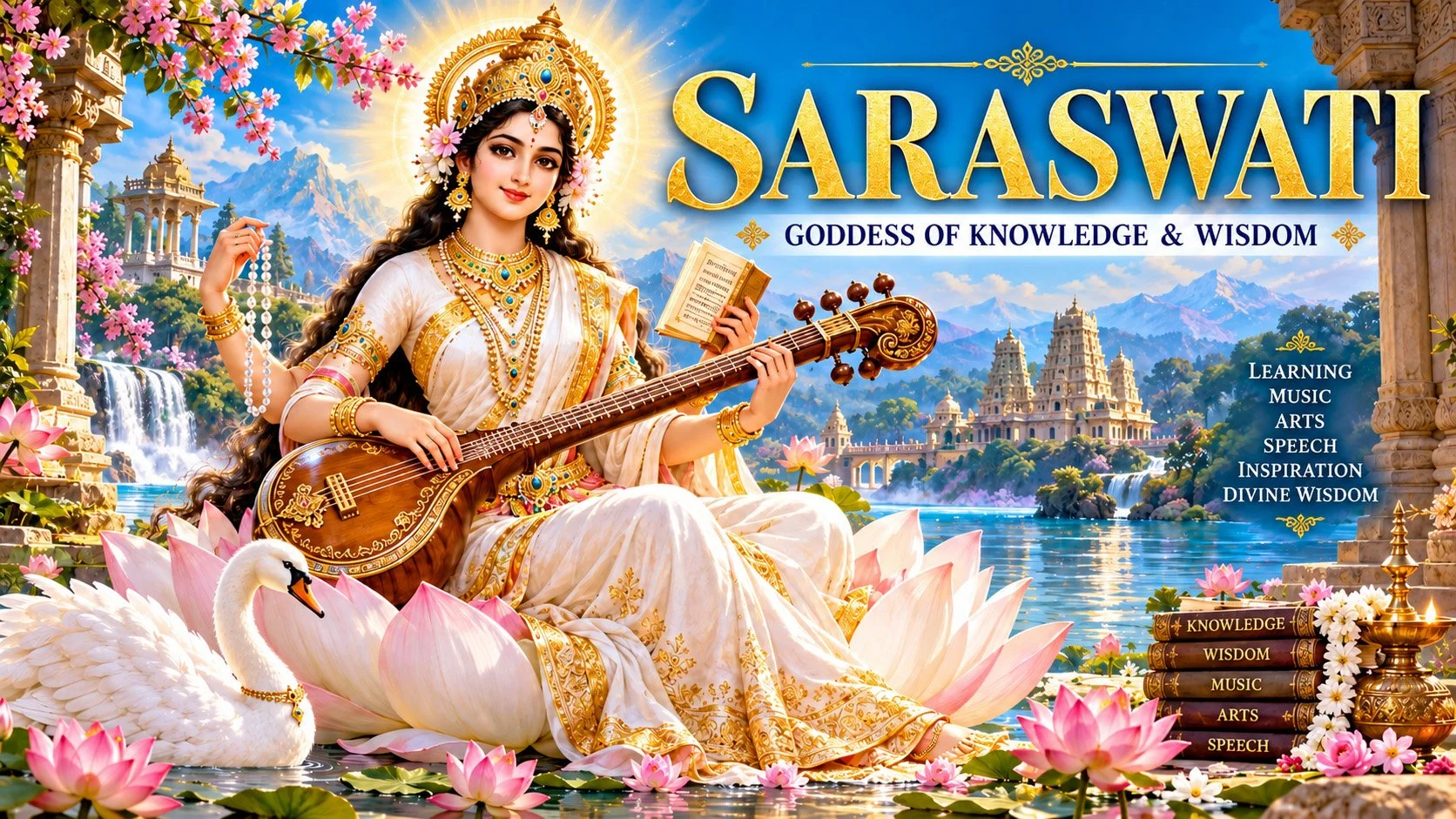
SARASWATI — THE DIVINE LIGHT OF KNOWLEDGE AND WISDOM
The sacred inspiration behind learning, music, eloquence and the creative spirit
By Publisher Ray Carmen
A child opens a book for the first time. A musician touches the strings of an instrument. A poet searches for the words that will give feeling a voice. In Hindu spiritual tradition, such moments of awakening belong to the luminous world of Saraswati — the goddess of knowledge, wisdom, learning, music and the arts.
The goddess who illuminates the mind
Revered with affection as Maa Saraswati, she represents something greater than the accumulation of facts. Her blessings are sought for understanding, clarity of thought, eloquence, creativity and the wisdom to use learning well. A person may possess a library of knowledge, yet wisdom asks a deeper question: what good will we do with all that we know?
To students she is an inspiration to persevere. To teachers she represents the responsibility of passing understanding to the next generation. To musicians, artists and writers she is associated with the elusive marriage of discipline, beauty and inspiration. Her presence in Hindu devotion reminds us that learning can be both an intellectual pursuit and a spiritual calling.
The sacred meaning of her beautiful form
Saraswati is often pictured wearing white, seated upon a lotus, with a graceful swan nearby. Each detail speaks through the language of sacred symbolism. Her white garments evoke purity of intention and clarity; the lotus suggests the possibility of rising above confusion without losing one’s connection to the world.
Across her lap rests the veena, the traditional stringed instrument associated with music and harmony. Its message is a gentle one: genuine mastery requires listening, patience and practice. A sacred manuscript or book signifies the treasure of learning, while prayer beads, when shown, point towards reflection, devotion and the stillness from which insight can emerge.
The swan is especially meaningful in many interpretations, symbolising discernment — the ability to distinguish what matters from what merely distracts. Different regions and devotional images may portray her attributes in different ways, but the heart of the message remains recognisable: knowledge should lead us towards understanding.
From flowing river to flowing wisdom
Saraswati’s story reaches back to the Vedic world, where the name is associated with a revered river and a divine presence praised in sacred hymns. Over centuries, Hindu traditions came to celebrate her especially as the divine patron of speech, learning and the arts. It is a deeply poetic journey: the flowing waters become an image of thoughts, words and wisdom moving through human life.
Traditions and sacred stories do not all describe her origins in precisely the same way. This richness of interpretation is part of Hinduism’s long and varied spiritual inheritance.
Saraswati Puja — a celebration of awakening
Her best-known festival is Vasant Panchami, also called Basant Panchami or Saraswati Puja in many communities, marking the promise of spring. Families, schools and temples honour her with prayers, flowers and offerings. Books, pens and musical instruments may be placed before her image as symbols of the learning and creativity that devotees hope to nurture.
Yellow clothing and flowers often brighten the celebrations, reflecting the season’s fresh energy. Some families also mark a child’s first formal steps into reading and writing. Customs differ by region, household and tradition, yet the intention is shared: to greet education not as a burden, but as a blessing.
A prayer for the modern world
Her message travels far beyond any single classroom or country. From South Asian temples to Hindu communities in the Caribbean, Britain and elsewhere, Saraswati continues to inspire students, singers, dancers, scholars and families who honour the power of learning.
One familiar devotional invocation is “Om Aim Saraswatyai Namah” — a salutation to Goddess Saraswati. For devotees, prayer may be accompanied by study, music, silence or service. The spirit of the prayer is not that effort becomes unnecessary, but that effort be guided by humility and clear intention.
In an age of instant answers and ceaseless information, Saraswati offers a beautiful distinction: information is what we collect; wisdom is how we live. A brilliant mind is an extraordinary gift, but compassion gives that brilliance its purpose.
The blessing of true knowledge
May our words bring understanding rather than division. May our curiosity never fade. May the music of life be shaped by kindness, and may every generation be given the freedom to learn, to question and to create.
For those who revere her, Maa Saraswati is the quiet light within the search for truth. Her enduring spiritual lesson is as graceful as the veena in her hands: knowledge reaches its highest beauty when it is shared for the good of others.