
SUELLA BRAVERMAN SPARKS GLOBAL DEBATE WITH REPARATIONS COMMENTS
By Publisher Ray Carmen
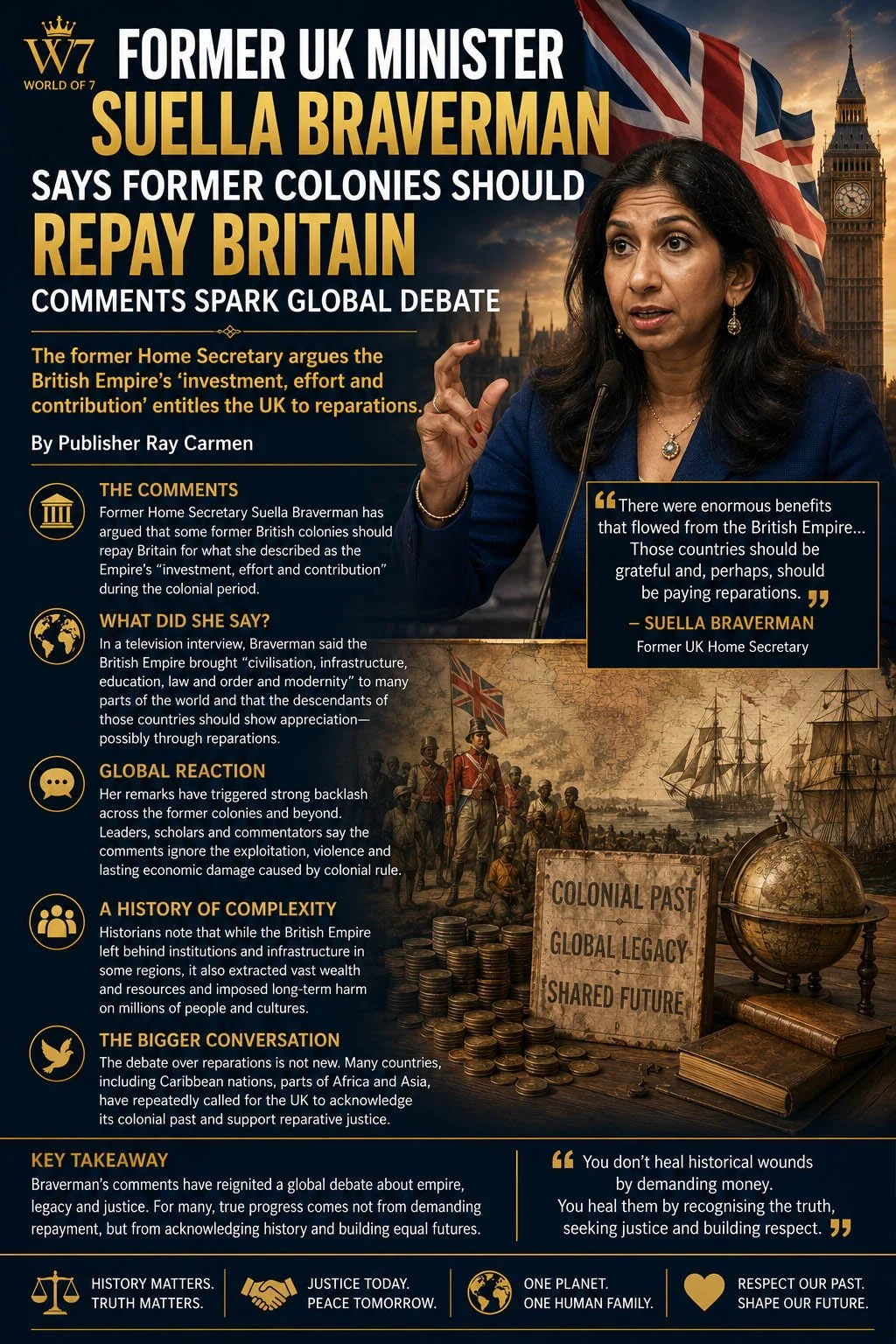
Former UK Home Secretary Suella Braverman has reignited international debate after arguing that some former British colonies should consider making reparations to the United Kingdom for what she described as the British Empire’s investment and contribution during the colonial era.
Her remarks quickly attracted widespread attention, prompting strong reactions from historians, politicians, commentators and members of the public across Britain and many Commonwealth nations.
For decades, international discussions about reparations have largely centred on calls for former colonial powers to acknowledge and compensate for the lasting effects of slavery, colonialism and exploitation.
Braverman’s comments turned that debate in the opposite direction. She argued that Britain’s investment in infrastructure, railways, ports, education, legal institutions and public administration in parts of its former empire should also be recognised when assessing the legacy of colonial rule.
Supporters of her position contend that the history of the British Empire should be viewed in its entirety, including its economic development, institutions and public works, alongside its more controversial chapters.
Critics, however, argue that such an approach overlooks the wider human, political and economic consequences of colonialism, including exploitation, displacement and inequality experienced in many territories under imperial rule.
The discussion highlights how the legacy of empire continues to shape political debate well into the twenty-first century. Questions surrounding history, responsibility and national memory remain subjects of passionate disagreement across Britain and many former colonies.
Whether viewed as a provocative challenge to conventional thinking or a controversial reinterpretation of history, Braverman’s remarks have once again placed the issue of reparations firmly in the international spotlight.
As governments, historians and communities continue to examine the legacy of empire, the debate is likely to remain one of the most significant and emotionally charged discussions in modern public life.