
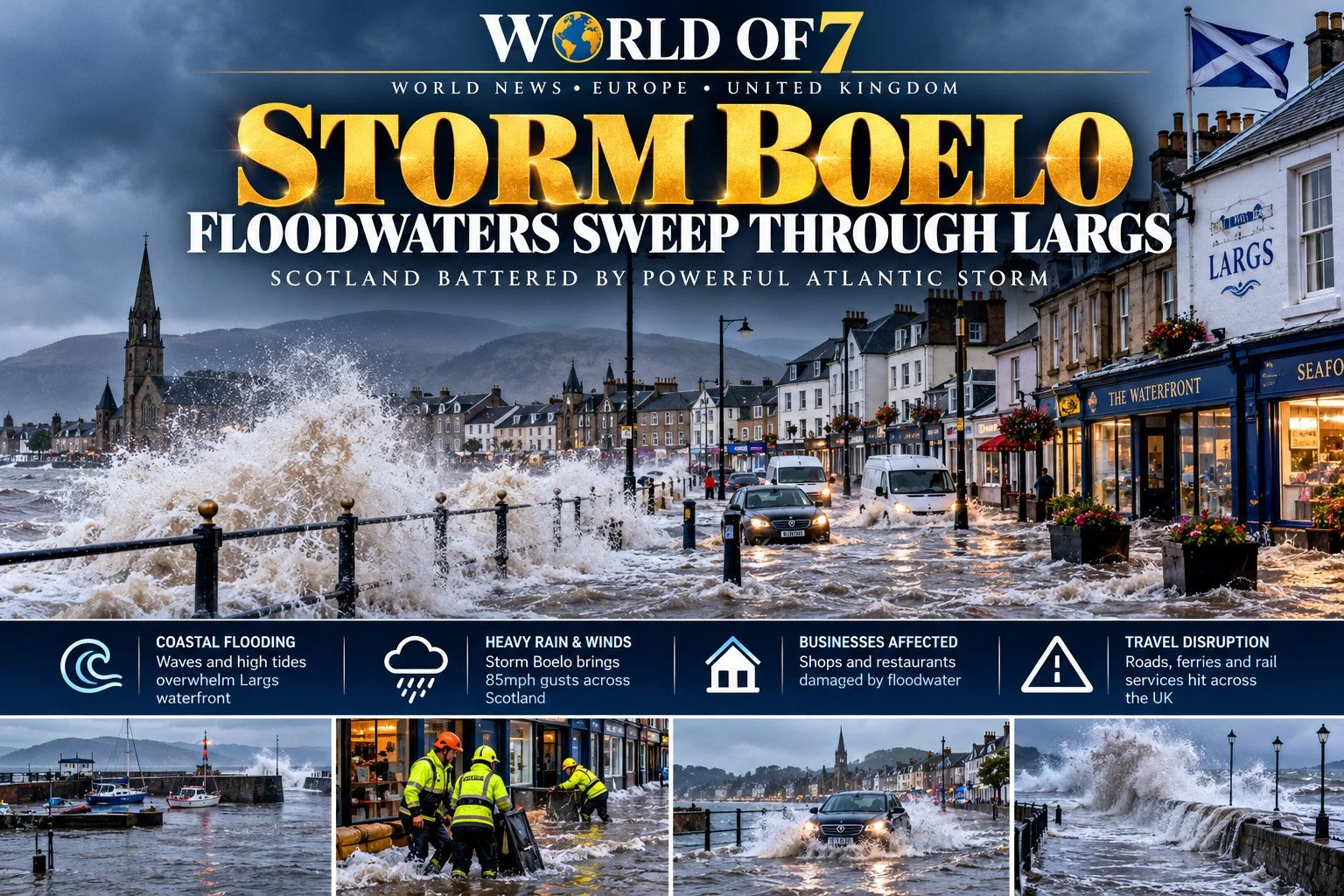
Scotland’s picturesque coastal town battles devastating flooding as a powerful Atlantic storm sweeps across Britain
By Publisher Ray Carmen
A picturesque Scottish seaside town, celebrated for its coastal beauty and peaceful atmosphere, has become the scene of extraordinary flooding after Storm Boelo battered Britain’s western coastline.
Largs, in North Ayrshire, Scotland, was among the communities hardest hit as powerful winds, torrential rain and dangerous coastal conditions swept across the country.
BBC television coverage showed floodwater surging through the town centre, transforming familiar streets into waterways.
For residents and business owners, the storm brought scenes of destruction, anxiety and uncertainty.
And for Britain, it provided another powerful reminder of the vulnerability of coastal communities when severe Atlantic weather strikes.
LARGS — A BEAUTIFUL TOWN UNDER WATER
Largs occupies a beautiful position on Scotland’s Firth of Clyde, overlooking the island of Great Cumbrae.
Known for its waterfront promenade, traditional shops, cafés, restaurants and maritime connections, the town attracts visitors throughout the year.
But during the weekend of 24–25 October, the familiar seaside setting was dramatically transformed.
Floodwater swept through parts of the town centre, affecting commercial premises and leaving business owners confronting extensive damage.
According to STV News, shops and restaurants along Main Street were among the properties affected, with traders reporting damaged stock and water entering their premises.
The flooding was not confined to Largs.
The Scottish Government confirmed that properties in nearby Saltcoats were also affected, while severe weather damaged transport routes and brought down trees.
THE POWER OF STORM BOELO
Storm Boelo brought exceptionally strong winds and heavy rainfall to several parts of the United Kingdom.
BBC Weather reported a wind gust of 85mph at Machrihanish, demonstrating the extraordinary force of the weather system.
Across Scotland, dangerous winds combined with heavy rain to create hazardous conditions.
Coastal areas faced additional threats from powerful waves and rising water levels.
In Largs, the storm’s effects were particularly visible as water moved through the town centre and waves battered the waterfront.
The BBC’s reporting captured the scale of the disruption, showing how quickly an attractive seaside destination could become a place of danger.
BUSINESSES COUNT THE COST
For local businesses, the consequences could extend well beyond the storm itself.
Floodwater can damage stock, flooring, electrical equipment, furniture and building interiors.
Even after the water recedes, owners may face substantial cleaning costs, repairs and temporary closures.
STV News reported that traders in Largs were left dealing with extensive water damage after the overnight flooding.
The full financial cost has not yet been established.
For smaller independent businesses, the interruption to trading can be especially difficult.
The immediate challenge is to make damaged premises safe, assess losses and begin the process of recovery.
A STORM THAT AFFECTED THE NATION
The damage in Largs formed part of a much wider weather emergency.
Storm Boelo disrupted roads, railways, flights and ferry services across the United Kingdom.
Fallen trees blocked roads and damaged infrastructure.
Power cuts affected large numbers of households and businesses.
The storm also brought tragedy.
A 60-year-old man died after being struck by a falling tree near Castle Douglas in Dumfries and Galloway.
A second man, in his twenties, died after a tree fell onto his car in north London.
The deaths underlined the danger posed by severe winds, even away from exposed coastlines.
Across the country, emergency services, transport operators and electricity engineers faced difficult conditions as they worked to restore essential services.
SCOTLAND MOBILISES ITS EMERGENCY RESPONSE
The Scottish Government convened its Resilience Room on Sunday, 25 October, to assess the storm’s impact and coordinate the response.
Officials confirmed flooding in Largs and Saltcoats, disruption to transport networks and widespread electricity outages.
At the time of the government’s afternoon update, approximately 40,000 customers in Scotland remained without electricity, while supply had been restored to around 26,000 others.
Authorities warned that dangerous conditions could continue even as the original storm moved away.
Motorists were advised to check road conditions before travelling, while rail and ferry passengers were encouraged to consult their operators.
Emergency responders also urged the public to avoid unnecessary journeys and remain alert to local warnings.
THE DANGER HAS NOT COMPLETELY PASSED
Although Storm Boelo began moving away from Britain on Monday, 26 October, forecasters warned that further unsettled weather was approaching.
BBC Weather reported that another Atlantic low-pressure system could bring additional rain and strong winds during Monday and Tuesday.
The Scottish Environment Protection Agency warned that further coastal flooding could occur as large waves and elevated tidal levels affected vulnerable shorelines.
For communities already dealing with storm damage, the prospect of more severe weather adds to the difficulty of recovery.
Residents and visitors should continue to follow official weather and flood warnings.
THE BIGGER QUESTION — HOW PREPARED ARE OUR COASTAL TOWNS?
The flooding in Largs raises a question relevant to coastal communities across Europe and beyond.
How can towns with historic waterfronts, established businesses and vulnerable infrastructure better protect themselves against severe weather?
Coastal flooding can result from several interacting factors, including high tides, storm-driven waves, strong winds and heavy rainfall.
Climate change is increasing sea levels globally, which can worsen the consequences of coastal flooding over time.
However, a single storm cannot automatically be attributed to climate change without specific scientific analysis.
The experience of Largs demonstrates the importance of flood preparedness, resilient infrastructure, effective warnings and coordinated emergency responses.
Protecting communities requires planning not only for the storms of today but also for the changing risks of the future.
LARGS — A COMMUNITY FACING RECOVERY
Beyond the dramatic television pictures lies a community beginning the difficult task of rebuilding.
Business owners must assess their losses.
Residents must check their properties.
Local authorities and emergency services must address damaged infrastructure and continuing risks.
Largs remains one of Scotland’s attractive coastal destinations, with a proud maritime identity and a strong connection to the surrounding Clyde coast.
The flooding does not diminish that heritage.
But it demonstrates how quickly severe weather can disrupt the everyday life of a seaside town.
THE WORLD OF 7 VIEW
Storm Boelo will be remembered for its powerful winds, widespread disruption and tragic loss of life.
In Largs, it will also be remembered for the extraordinary sight of floodwater moving through the heart of a much-loved Scottish town.
The television pictures were dramatic.
The consequences for residents and businesses are real.
As recovery begins, the priority must be public safety, restoring essential services and helping affected communities return to normal life.
For coastal towns across the world, the message is unmistakable:
THE BEAUTY OF LIVING BESIDE THE SEA MUST BE MATCHED BY THE PREPARATION NEEDED TO WITHSTAND ITS POWER.